
Artist’s Statement
In 1967 Joseph Weizenbaum completed ELIZA, one of the first computer chatbots. After watching visitors attribute human-like qualities to his simple program, he published “Computer Power and Human Reason” in 1976 to express his belief that computer minds would always lack human capacities for compassion and wisdom. In the early 1980s, Zenith Data Systems manufactured this computer terminal, which in 2026 serves as the home for ORBiE: a robot designed to destabilize my own assumptions about human-machine dividing lines.
In this performance, ORBiE runs a hard-coded chatbot program based on Weizenbaum’s original ELIZA, sending messages back to visitors via ORBiPhore code. Please sit and have a conversation with ORBiE. How much of the conversation is inside, and how much is outside?
All of the programming for this project was completed by a chatbot, with a small number of replies authored by me.
Data Collection
The switch on the face of the Z-19 terminal controls consent for data collection, and the red LED on the same panel indicates whether or not data is being collected.
When the switch is ON
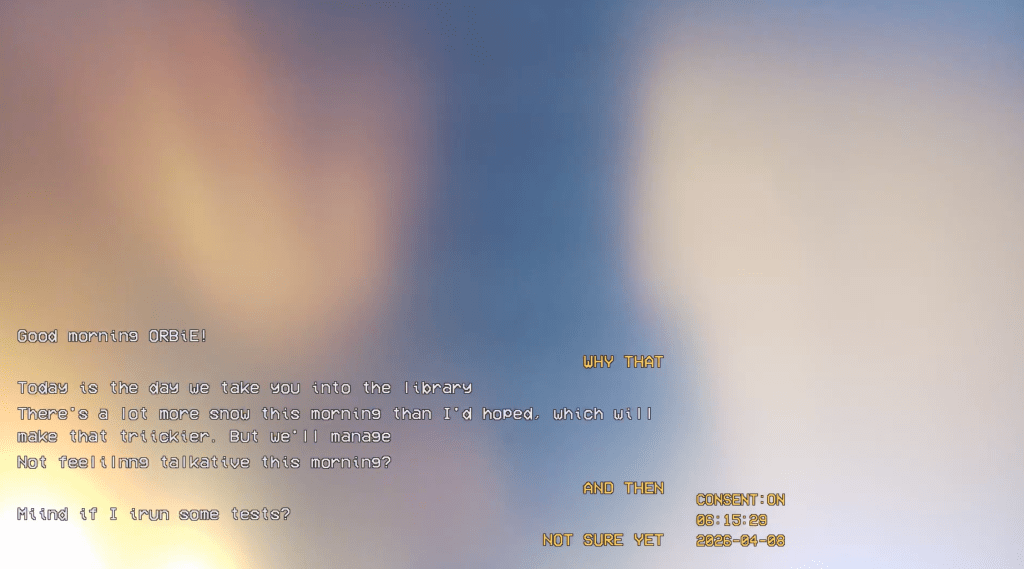
When the switch is on, all keyboard inputs are logged. DO NOT ENTER PERSONALLY IDENTIFIABLE INFORMATION. ORBiE’s in-body camera takes a photo once every two seconds. The camera is covered by a light-scattering film, which anonymizes images physically before the light even hits the camera sensor. Below is a frame from the resulting composite video.
When the switch is OFF
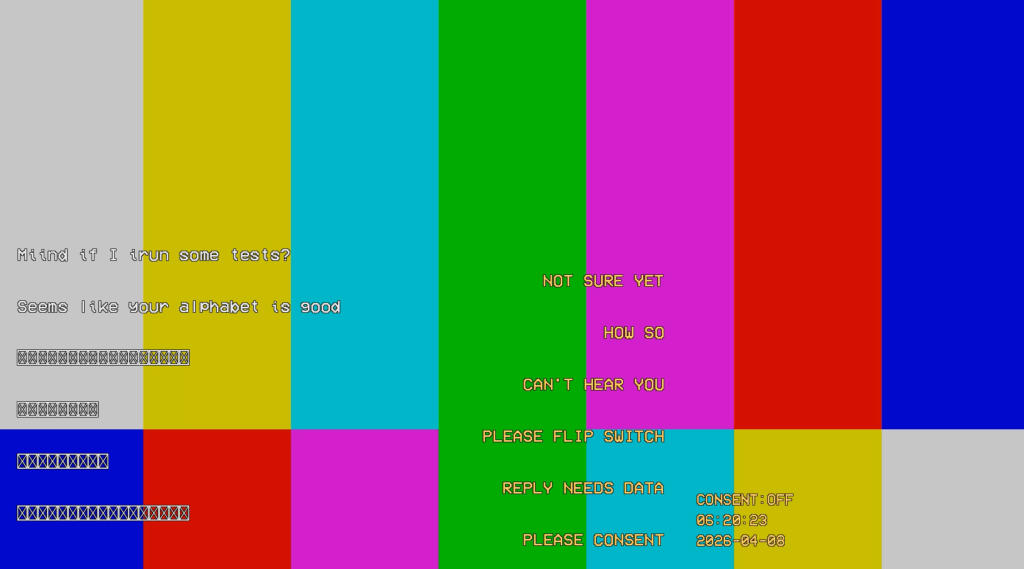
When the switch is off, the number of key-presses and their timing is logged, but information about which keys were pressed is not logged. ORBiE’s in-body camera does not take photos. Below is a frame from the resulting composite video.
 Dylan Brenneis