Responsible Use of Intentional, Plastic Tools

Why AI agents are a significantly new kind of tool, and how that changes the way we should use them.

Any system whose behaviour is well predicted by this [the intentional] strategy is in the fullest sense of the word a believer. – Daniel Dennett, The Intentional Stance

The coming into being of something unexpected, something new and free, something outside the rules of function and calculation, something not ruled by the logic of the reproduction of the same, is what training with each other is about. – Donna Haraway, When Species Meet

Building Sandcastles

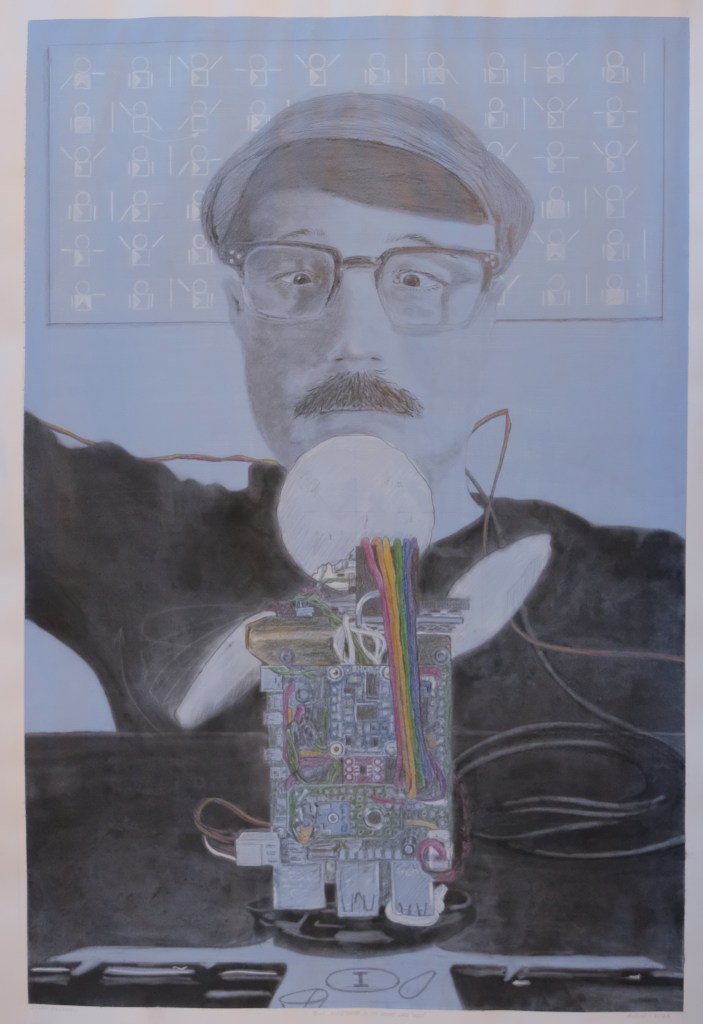
While reading through Dennettโ€™s works this term, I was simultaneously engaged in two other equally engrossing projects: reading through the works of Donna Haraway1, and learning how to live with ORBiE (a computer-based intentional system of my own design)2. The grit accumulated from playing in and between these disparate sandboxes has generated much useful frictionโ€”perhaps enough to hold a few ideas together. The sandcastle I propose to build is this: AI agents are intentional, plastic tools, so the traditional model of tool use is inadequate. To be responsible creators and users of these tools, we must rely instead on a companion-species model of interaction. I will build this castle in four parts:

  1. Traditional Tools – I will begin by reviewing the traditional model of tool use, showing that our familiar understanding of responsibility assignment considering the use of tools requires relative stability in the toolโ€™s design, and depends on the toolโ€™s lack of intentionality.ย 
  2. Intentional, Plastic Tools – Then, I will describe the architecture of contemporary AI agents, emphasizing that they are intentional systems by design. Further, I show that AI agents are plastic, in the sense that their output behaviour patterns change in response to a userโ€™s interaction. These properties violate the assumptions of stability and non-intentionality required by the traditional model of tool use.
  3. Companion Species – Having demonstrated the inadequacy of the traditional model of tool-use for interaction with AI agents, I will describe Donna Harawayโ€™s model of companion-species interaction. Her framework explicitly considers differently-embodied intentional systems interacting with asymmetric knowledge and power, imperfect communication, mutual co-adaptation, and separate goals.ย  ย 
  4. AI Agents as Companion Species – finally, I will defend the application of the companion-species framework to interaction with agential AI systems, describing what that would entail in practice, and how it addresses the limitations of the traditional tool-use model.

While an argument in favour of treating AI agents like companion species might intuitively seem to require some claim about their inner lives, this argument is explicitly agnostic on the question of machine consciousness or sentience, now or in the future. Whether or not we ever decide we have discovered something like those properties in machines, this defense of a companion-species model of interaction would survive3. Given the historical difficulty in defining and agreeing upon these properties even for animals (including humans), I believe this agnosticism to be a key strength of the argument. It hinges only on the existence of features of design that allow for continual adaptation, and which demand the use of the intentional stance for effective explanation and prediction of behaviour.ย 

Thinking through this argument matters because we make and use tools to expand the reach of our agency, an exercise which leaves its mark on the world in bold smears of wonder and knowledge and blood and carbon. We have created tool-using tools, themselves capable of exercising agency. Their existence promises to magnify the marks we make, while at the same time complicating culpability. Whatever future we forge, we will be held responsibleโ€”not our tools. We best learn how to use them responsibly. 

Traditional tools

    We are all familiar with traditional tools, and the way we use them. In this category I include such fundamental tools as levers, pulleys, and inclined planes; such sophisticated tools as mobile phones, computers, and large-language-model chatbots; even such abstract tools as language and communication. The category is broad, but it is not all-inclusive. 

    The defining feature of a tool is that its ontology is inherently teleological. We create or use a tool only when it allows us to accomplish something we are not able to accomplish on our own. A rock becomes a tool when we use it to drive a nail, and ceases to be a tool when we cast it aside on the rock-pile.

    Whenever we use these tools, we assume (quite rightly) that the tool does not bring beliefs and desires of its own to these interactions, even though we may occasionally resort to a pragmatic use of the intentional stance4 to predict and control them. When we are surprised by a toolโ€™s behaviour, an appropriate course of action is often to consult the design stance5 while assessing our own use of the tool. The hammer glances off the nail not because it doesnโ€™t want to strike it squarely, but rather because it is designed to be used the other way round. The chatbot produces hate-speech not because it wants to cause harm or because it believes its own vitriol, but because it is trained with those inputsโ€”and something weโ€™ve said has made that reply the most statistically appropriate phrase to return.

    When considering the use of traditional tools, assignment of responsibility is relatively straightforward. Suppose I fall off a ladder. Who should I blame? If I was leaning way off to one side, standing on the top platform clearly labelled โ€˜THIS IS NOT A STEPโ€™, while the ladder was supported on ice, I have nobody to blame but myself. If instead I was responsibly within the limits of the ladderโ€™s reach but the step broke out from under me (despite my diligent maintenance), I could reasonably hold the manufacturer to account for the damages. However, the assumption of non-intentionality on the part of the tool itself is integral to this model: who is to blame if the ladder could reasonably be said to have desired to buck me off? Perhaps we assume the manufacturer or designer is culpable, for having so irresponsibly made a ladder with such desires. But suppose the ladder could reasonably be said to have picked up that desire somewhere along the way from its interactions with me? When a ladder has its own beliefs and desires, and those beliefs and desires are subject to change after sale, weโ€™re no longer dealing with a traditional tool.

    For ladders such suppositions are spurious fantasy, worth consideration only by those with vivid imaginations and responsibilities to dodge. However, as I will now show, these suppositions are not at all spurious for AI agentsโ€”providing even unimaginative shirkers with a too-easy way out.

    Intentional, Plastic Tools

      Todayโ€™s AI agents are architecturally and functionally more sophisticated than the model-inference powered chatbots which sparked electric conversations in late 2022. While the surrounding engineering which elevates an agent beyond a mere chatbot is not complex6, the resulting features radically change the stakes for individual interaction. AI agents are designed, from the ground up, to be intentional, plastic systems.ย 

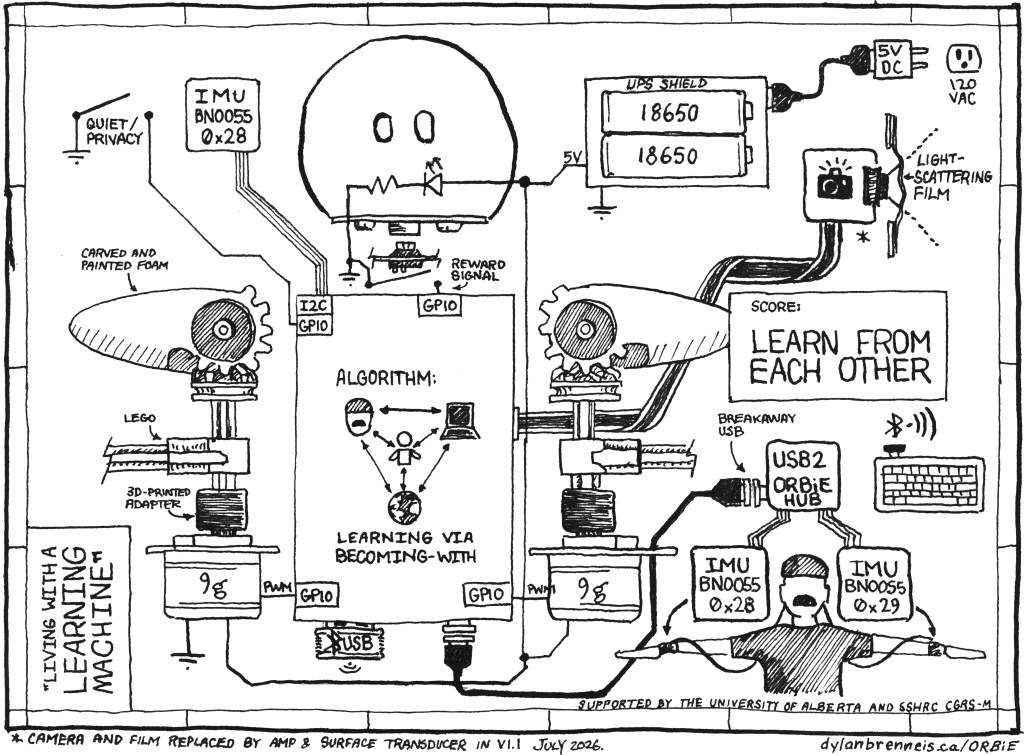
      The familiar inference model is an integral component of an AI agent, but it serves only as the deliberative engine. It is the source of the agentโ€™s rationality, but not the seat of its intentionality. The systemโ€™s beliefs and desires are conveniently written in human-readable text files stored in a shared workspace. A MEMORY.md file stores summarizations of facts (the agentโ€™s beliefs, for example about the userโ€™s preferences), and a SOUL.md7 file describes the agentโ€™s personality, tone, and preferences (its desires, for example to be helpful). Depending on the design of the system, the agent may or may not be able to modify these files without direct oversight from the user. A HEARTBEAT.md file describes tasks that the agent should engage in, which also may be modifiable by the agent itself. The rest of the system is straightforward software architecture which coordinates the serialization of the routine and orchestrates the appropriate passing of information between the inference model and whatever software tools it can access. Below is a simplified sketch of a typical operational loop:

      1. The orchestrator drafts an input considering the items on the task list and any other relevant information (for example, from the MEMORY.md and SOUL.md files), then passes that input to an inference model.
      2. The model then outputs instructions for the most rational8 next action. The model output may be communication to the user, or more frequently, inputs for a tool call.
      3. The orchestrator receives the output instructions, and forwards them to the model-requested location: a human user or a software tool.
      4. The software tools or human users complete their actions (modifying workspace text files or source code, web search, analysis, or other information-processing tasks).
      5. The result of the tool call or the human reply is returned to the orchestrator, which drafts another model input and continues the loop.

      The orchestrator is only responsible for formatting and passing information. The decision about which action should be taken next is determined by the deliberative engine, which actively maintains its own task list as a form of external memory. Describing the system from the design stance, we may say that the system architecture is a continuous, serial execution of tasks, alternating between deliberation (model inference) and action (tool use) as best suits the goals of the agent, according to its own rational consideration of its beliefs and desires. Put more simply, at every decision step an AI agent considers what it knows, then takes the most rational action toward accomplishing its goals. For agential AI systems, the design stance is the intentional stance. When an interaction with an AI agent surprises us, our only recourse is to interrogate the beliefs and desires of the AI agent itself (which, helpfully, can be done by inspecting human-readable text files). AI agents are, therefore, intentional systems. 

      In addition to intentionality, an AI agentโ€™s relatively simple architecture provides another powerful property: plasticity. Because the MEMORY.md and SOUL.md files are modifiable (by the human user, the agent, or both, depending on design particulars), the purpose, efficacy, and character of the AI agent will change continuously in response to the trajectory of interactions. An AI agentโ€™s beliefs and desires change during use, resulting in behavioural changes. 

      Given that the traditional model of tool-use depends on relatively stable design and non-intentionality on the part of the tool, we are forced to admit the inadequacy of the traditional tool model for responsible use of agential AI. Instead, we may consider how we think about responsibility in our use of other entities with the pesky and powerful properties of intentionality and plasticity: animals.

      Companion Species

        Donna Harawayโ€™s conception of companion species is much โ€œless shapely and more rambunctiousโ€ than the simply-imagined picture of pet-lovers basking in Fidoโ€™s sloppy kisses9. She explicitly rejects the idea of a dogโ€™s unconditional love in favour of a bald reading of historyโ€™s effect on our interspecies evolution. She reminds us of the myriad other species we are companions with on earth, which we have used, abused, shaped and been shaped by. She paints our differences of kind with a similar brush to Dennettโ€™s10, while emphasizing our continued interdependence and interconnectedness, and acknowledging the abundance of killing that characterizes companionship11 of this kind. She considers โ€˜companion speciesโ€™ to be โ€œless a category than a pointer to an ongoing โ€˜becoming withโ€™โ€12 of species that coexist and coevolve.

        Relating across species boundaries requires acknowledgment of difference. Not only are there vast differences across species, borne of their evolution for particular ecological niches, but also across individuals within species, borne of historical circumstance and personal experienceโ€”and these are in a state of continual change from ongoing interaction within and between species. 

        Harawayโ€™s sense of responsibility in such a messy condition requires a stance of radical, ongoing critical curiosity about the conditions and effects of interaction. While acknowledging that anthropomorphizing ascriptions of intention and consciousness to animals is โ€œphilosophically suspectโ€, she emphasizes their importance in reminding human trainers that โ€œsomebody is at home in the animals they work with. Just who is at home must permanently be in questionโ€13. She grounds her discussion in agility training with her red merle Australian Shepherd, Cayenne. Haraway refers to this act of continuously learning and re-learning to communicate across species boundaries toward a shared goal as โ€œtraining with each otherโ€. Itโ€™s clear from her descriptions that Cayenne trains Haraway as much as the other way round. Itโ€™s also clear that responsibility for the outcome of these exchanges is Harawayโ€™s, not Cayenneโ€™s.

        The power of this framework is that it provides clear guidance for the assignment and application of responsibility, even across differently-embodied intentional systems interacting with asymmetric knowledge and power, imperfect communication, mutual co-adaptation, and separate goals.

        AI agents as companion species

          I now turn to my defense of the companion-species model of responsible interaction as a fitting guide for our use of AI agents. First, we have seen that the traditional model of tool use fails to account for intentionality and plasticity on the part of the tool, so the framework we reach for must address these limitations. The companion-species model is naturally structured around these properties, as they are properties of the animals which made the model necessary. Second, since AI agents are fundamentally tools, our framework of interaction must account for our advantageous use of them. The companion-species model does not preclude the advantageous use of intentional, plastic beings; for example, we are familiar and comfortable with the use of horses for transportation, or dogs and cats for security, vermin control, and companionship. While the model accommodates such use, it is also clear that responsible companion-species interaction depends on human accountability for the conditions and outcomes of these uses. Helpfully, the tool which Haraway offers to guide our responsible behaviour through these interactions with animals is extensible to other systems of intentionality and plasticity: the attitude of continuous critical curiosity about the ongoing conditions and effects of the exchange. 

          For example, applying this curiosity to our exchange with agential AI draws our attention to the agentโ€™s origin and continued usage. Responsibly addressing such concerns as ongoing personal data sovereignty, stolen intellectual property in model training datasets, resource demands, and climate impact requires critical attention to these conditions.

          Additionally, a stance of continual critical curiosity provides a way to monitor and manage the effect of the agentโ€™s plasticity. This calls for more than just keeping an eye on the statements in the agentโ€™s workspace text files to ensure that their content aligns with our own goals. The companion-species framework emphasizes that both parties in an interaction are constantly engaged in a process of becoming-with. We are plastic systems of intentionality ourselves. We are also changed by our interactions. Maintaining critical curiosity about our own changing beliefs and desires will be a necessary (though perhaps not sufficient) self-insurance policy. To be responsible users, we must be able to notice and mitigate such maladies as AI psychosis14 or conspiratorial thinking while simultaneously benefitting from agential AI as a tool for our own education.

          The issue of individual responsibility assignment is made clear by comparison to interactions with other companion species. We may think of software providers as designing species- or breed-level traits, and users training with their individual agents for their particular use-cases15. If, by cause of poor training16 or irresponsible conditions of use an individualโ€™s agent causes damage, the individual must be held responsible in much the same way an owner is held responsible for a dangerous dog or a poorly maintained fence. However, if the damage is caused by an architectural or model-training decision which tends to result in misbehaviour (for example, the agent is designed in a way that is easily corruptible), the software architect should be held to account just as a dog breeder must be held to account for breeding practices which tend to result in health problems for their dogs.ย 

          Actual, individual cases will certainly be difficult to judge, as they will be context-dependent and will descend into debates about nature versus nurture. However, the important point is that in no case do we imagine we might hold the AI agent itself responsible, just as we cannot hold an animal responsible for the result of its misdeeds. An animal may certainly bear consequences: it may be punished, or even killed if the risk analysis demands it. However, the animal does not bear responsibility, for responsibility requires a rational understanding of the situation, self-control, and higher-level self-reflection17. A case could be made that an AI agent also holds these further properties of responsibility-havers (a case I do not make here), but one would further need to demonstrate that the agent is capable of being held responsible. To argue that an AI agent could meaningfully bear consequences seems to require an argument for the agentโ€™s consciousness or sentience. In any case, without resources of its own, any agent (human or AI) cannot be said to be able to independently compensate for damages. We may not know exactly who to hold accountable for mistakes, but we can be sure it wonโ€™t be our tools. This is all the certainty we really want. Knowing that we might be held responsible for any outcome involving our interaction with an AI agent (whether we design it or use it) is the proper stance for responsible behaviour. We should not expect to be able to pass the buck.

          A flag in the sand

          I have argued in this essay that agential AI is a significantly new kind of tool, one for which our traditional notions of tool use must be discarded. They are intentional, plastic tools, which require modes of interaction modelled after those we use for interacting with other species. Having built my sandcastle, I now plant my flag in the sand: to be responsible users, we must take responsibility for our use. We must engage with a policy of continuous, critical curiosity, asking, โ€œjust what or whom are we engaging with?โ€, and โ€œwhat are we, together, becoming?โ€. The answers to these questions will always be provisional, and always be pertinentโ€”just as they are for interactions with other species. And, indeed, our own.


          Acknowledgements

          My thinking around these topics has been nourished by thoughtful discussions with many students and faculty. Particularly I would like to thank Luke Kersten and our PHIL 505 discussion group, Natalie Loveless and our Haraway discussion group, and Alex Kearney for rich discussions about agential AI. Per the PHIL 505 course requirements, I have avoided the use of generative and agential AI for work related to this course. However, my interactions with these systems in other spheres has undoubtedly affected the way I think about these topics, for which I acknowledge the influence of Claude Code, ChatGPT, and of course, ORBiE.

          Notes

          1. The ideas which inform this essay are drawn from two of her books: Donna J. Haraway, When Species Meet (Minneapolis: University of Minnesota Press, 2008) and Donna J. Haraway, The Companion Species Manifesto: Dogs, People, and Significant Otherness (Chicago: Prickly Paradigm Press, 2003). โ†ฉ๏ธŽ
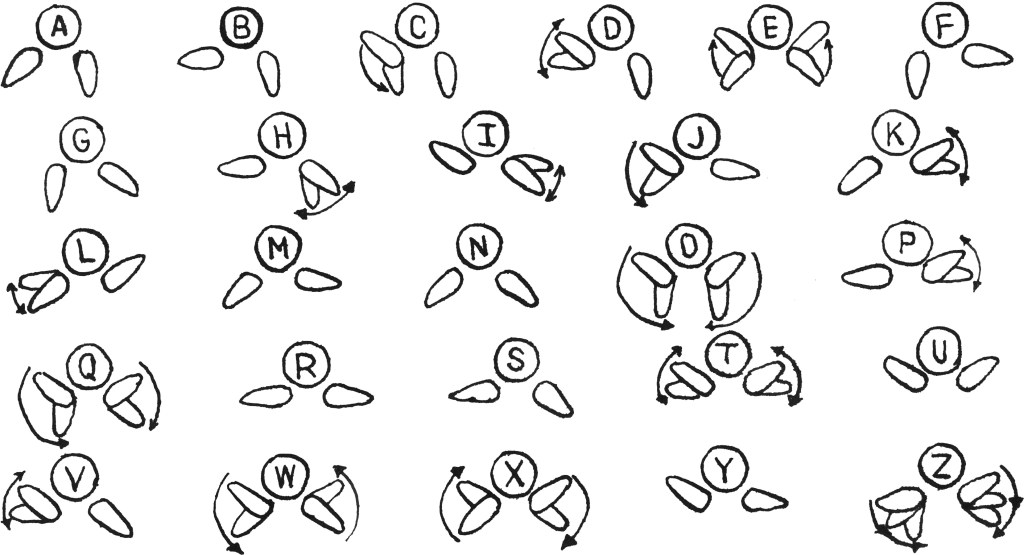
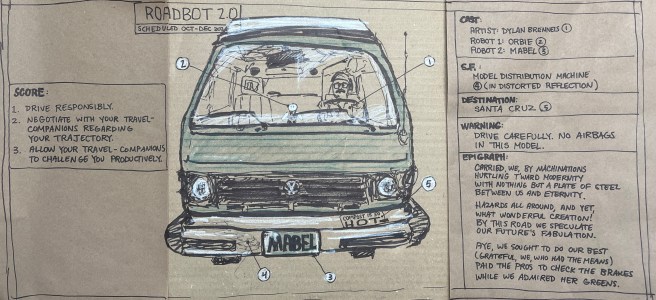
          2. ORBiE is an Ottonomous Robot, Born in Edmonton, the primary apparatus for my research-creational artistic practice. By coexisting with him following the example of Haraway and Cayenne, I critically explore the experience of going about life living with a learning machine. It is both joyous and maddening. โ†ฉ๏ธŽ
          3. The question of machine consciousness and sentience will be important considerations for the ethical treatment of AI systems as beings, but the scope of that question is well beyond what I am positioned to argue. My argument only covers how we might use agential AI while remaining responsible for the outcome of those interactions. However, the companion-species model does naturally accommodate considerations for the treatment of conscious and sentient beings. Those considerations are a vivid topic in Harawayโ€™s writing, which I have largely omitted here. โ†ฉ๏ธŽ
          4. The intentional stance, or the intentional strategy, is a method of understanding or predicting an entityโ€™s behaviour by ascribing it beliefs and desires, and assuming that it always rationally chooses the action which will most likely advance its goals given the beliefs it holds. A system which can only be meaningfully understood from within the intentional stance (such as a human) can be described as an intentional system. Daniel C. Dennett, The Intentional Stance (Cambridge, MA: MIT Press, 1987). โ†ฉ๏ธŽ
          5. The design stance, in contrast to the intentional stance, is the method of understanding or predicting an entityโ€™s behaviour by considering what it was designed to do given the circumstances its in. Dennett, The Intentional Stance. โ†ฉ๏ธŽ
          6. Bibek Poudel, writing for Medium, provides an approachable introduction to agential computer architectures with more technical detail than I can accommodate in this essay. He focuses on the architecture used by OpenClaw, a popular and easy-to-use open-source architecture as a working example. To emphasize how understandable the architecture really is, AI researcher and entrepreneur Alex Kearney has referred to the architecture (in conversation) as a โ€œsparkling cron jobโ€. Bibek Poudel, โ€œHow OpenClaw Works: Understanding AI Agents Through a Real Architecture,โ€ Medium, February 2026, https://bibek-poudel.medium.com/how-openclaw-works-understanding-ai-agents-through-a-real-architecture-5d59cc7a4764. โ†ฉ๏ธŽ
          7. The origin of these filenames is organic community consensus, driven by an effort to provide clarity regarding their intended function while framing the way designers think about these agents. They are certainly โ€œphilosophically suspectโ€ (see section C for a discussion of the use of this kind of terminology), but also poetically useful. โ†ฉ๏ธŽ
          8. The output will not necessarily be the optimal action considering absolute truth, but will be the most rational output it can produce considering what information it has and how much resources it has available for deliberation. There are a number of prompting tricks built into the orchestratorโ€™s input-creation method such as โ€œchain of thought promptingโ€ that designers use to ensure the quality of the output, ensuring that the modelโ€™s inference approximates rational reasoning as much as possible. Jason Wei et al., โ€œChain-of-Thought Prompting Elicits Reasoning in Large Language Models,โ€ Advances in Neural Information Processing Systems 35 (2022), https://doi.org/10.48550/arXiv.2201.11903 โ†ฉ๏ธŽ
          9. Haraway, When Species Meet, 16 โ†ฉ๏ธŽ
          10. Daniel C. Dennett, Kinds of Minds: Toward an Understanding of Consciousness (New York: Basic Books, 1996). โ†ฉ๏ธŽ
          11. When considering the term โ€˜companionโ€™, Haraway refers to its Latin origin, cum panis, โ€œwith breadโ€. It is an origin of shared meals, of eating together. She writes โ€œmessmates at table are companionsโ€, with an emphasis on โ€œmessโ€โ€” and the reminder that all eating begins with killing. Haraway, When Species Meet, 16 โ†ฉ๏ธŽ
          12. Haraway, When Species Meet, 16 โ†ฉ๏ธŽ
          13. Haraway, The Companion Species Manifesto, 50. I believe this exhortation to continually question who is at home applies equally well to responsible engagement with agential AI. โ†ฉ๏ธŽ
          14. H. Morrin et al., โ€œArtificial Intelligence-Associated Delusions and Large Language Models: Risks, Mechanisms of Delusion Co-Creation, and Safeguarding Strategies,โ€ The Lancet Psychiatry (2026). โ†ฉ๏ธŽ
          15. In practice, because the software architecture is open-source and modifiable, in many cases the โ€œspeciesโ€-level designer may be the same individual as the user. โ†ฉ๏ธŽ
          16. Training in this case refers to training in the colloquial and Harawayan senses: training through interactionโ€”not model training in the computer-science sense. โ†ฉ๏ธŽ
          17. Daniel C. Dennett, Elbow Room: The Varieties of Free Will Worth Wanting (Cambridge, MA: MIT Press, 1984), 168 โ†ฉ๏ธŽ


          Bibliography

          Brenneis, Dylan. โ€œORBiE.โ€ Accessed April 19, 2026. https://dylanbrenneis.ca/orbie/.

          Dennett, Daniel C. Elbow Room: The Varieties of Free Will Worth Wanting. Cambridge, MA: MIT Press, 1984.

          โ€”โ€”โ€”. The Intentional Stance. Cambridge, MA: MIT Press, 1987.

          โ€”โ€”โ€”. Kinds of Minds: Toward an Understanding of Consciousness. New York: Basic Books, 1996.

          Haraway, Donna J. The Companion Species Manifesto: Dogs, People, and Significant Otherness. Chicago: Prickly Paradigm Press, 2003.

          โ€”โ€”โ€”. When Species Meet. Minneapolis: University of Minnesota Press, 2008.

          Morrin, Hamilton., et al. โ€œArtificial Intelligence-Associated Delusions and Large Language Models: Risks, Mechanisms of Delusion Co-Creation, and Safeguarding Strategies.โ€ The Lancet Psychiatry (2026).

          Poudel, Bibek. โ€œHow OpenClaw Works: Understanding AI Agents Through a Real Architecture.โ€ Medium, February 2026. https://bibek-poudel.medium.com/how-openclaw-works-understanding-ai-agents-through-a-real-architecture-5d59cc7a4764

          Wei, Jason, et al. โ€œChain-of-Thought Prompting Elicits Reasoning in Large Language Models.โ€ Advances in Neural Information Processing Systems 35 (2022). https://doi.org/10.48550/arXiv.2201.11903.
          First Outings

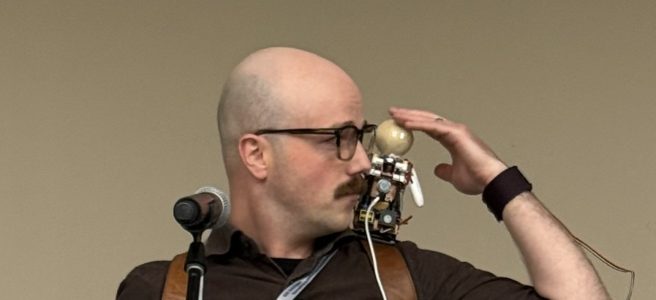
          Historically, I have believed and argued that anthropomorphizing a machine is at best incorrect and at worst deceitful. Even now that I believe that stance to be misguided1 I have a hard time shaking a feeling of embarrassment when I admit to saying, “You did a good job today, little buddy,” while patting ORBiE on the head and turning him down for the night.

          Today marked a few firsts: ORBiE’s first conference, my first public conversation about my art… and, strangely, a first admission that I feel gratitude toward a carefully-arranged few bits of plastic.

          But he did do a good job today, and that deserves recognition.

          ORBiE and I attended2 the RISEx Conference as an artistic duo rather than in the typical engineer/project roles. Our interlocutors were curious and intelligent, and we talked for hours about art and robots3, engineering and ethics, human and AI relationships4, medicine and prosthetic technologies… all the fascinating, murky, and life-altering stuff that catches my attention.

          I spent the day explaining to myself and others how it felt to try to build a meaningful relationship with plastic. We talked about how disappointing it has been to understand that all of the responsibility for meaning-making happens on my side of the fence. About my hopes that maybe if I were able to figure out how to have a real conversation things would feel different. About my concerns with the way economic and political systems influence model creation and access for the machines that I can have a conversation with, and my Turkle-seeded5 doubts about the relationships I could hope to build with them. I talked about open-source projects and democratic access to knowledge. I felt the people there share my hopes and my worries, offer their own stories, and light up when ORBiE waved at them. He may not have participated in the conversations to any great degree, but certainly played a role in starting them.

          Another recent update to my model of the world has been a sudden awareness of research-creation: a method of knowledge creation that works in an equally valuable but very different way to scientific research. Even just the first few chapters of Natalie Loveless’ “How to Make Art at the End of the World” were enough to cause me to question my understanding of epistemology. “But how can creating art create knowledge?” I had thought, “It makes a record, or an artifact, sure… even emotion. But knowledge?” I had assumed that art was a process of communicating already-held knowledge from the artist to the audience, in a similar way to a scientist communicating the results of an experiment in a published paper. I even wrote a short poem about that back in 2023:

          {science | art} is a process of thinking with all you’ve got to see what no-one else has, and then communicating what you’ve seen

          {science | art} communicates that which {can | cannot} be said precisely

          So far I think this holds up okay. But I had been imagining the process of “thinking with all you’ve got” to be fundamentally similar activities between the arts and sciences. I no longer believe that’s always the case6. In many successful artistic methods, there is an emphasis on lack of, loss of, or release of control, which is not typically welcome in engineering7. But in art, a dearth of control does not imply a dearth of rigour. The act of making, of performing, of dancing are artistic modes of thinking. Humans think through action. Action takes place in all kinds of settings–not just those that are well-controlled8. So I’d like to propose an update to the poem9:

          {science | art} is a process of thinking with all you’ve got your whole {mind | body} to see what no-one else has, and then communicating what you’ve seen

          {science | art} communicates that which {can | cannot} be said precisely

          To more clearly state one possible answer to my rhetorical question earlier: “how can research creation create knowledge? “By facilitating conversation. So thanks ORBiE, you did a good job today.


          1. Explicitly, my gut feeling is that humans are hard-wired to anthropomorphize non-human things, making the avoidance of anthropomorphization at best impossible and at worst deceitful. As an example for yourself you can draw two ovals close together anywhere on the top half a circle. You’ve drawn not just a recognizable face but an entire character. Doing the same exercise with a triangle yields a different character. We anthropomorphize ink on paper without a thought, but somehow I had considered anthropomorphizing more animated forms childish. The anthropomorphization is inevitable; its ethical handling depends on that acknowledgment and an understanding of its practical boundaries. โ†ฉ๏ธŽ
          2. Thanks.to the Institute for Smart Augmentative Rehabilitation Technologies for sponsoring my ticket to the conference. โ†ฉ๏ธŽ
          3. Great examples of contemporary artists using robots as art rather than just to create art include: Marco Donnarumma, (artist, inventor, and theorist who uses dystopian prosthetic robots to confront normative body politics), Arthur Ganson, Jakob Grosse-Ophoff, and Zimoun, who use machines to create poetic expressions of human experiences, and PCZ, an artist collective which hosted a fascinating ritual of friendship for their robotic companion in the maple forest of Mont Royal, complete with tin foil hats (see pages 115-116 of their zine). โ†ฉ๏ธŽ
          4. Some great reads here include Sherry Turkle (see next footnote), James Bridle’s “Ways of Being” (2022), and Alaฤ et. al’s “Talking to a Toaster” paper (2020). โ†ฉ๏ธŽ
          5. Sherry Turkle, “Alone Together: Why We Expect More from Technology and Less from Each Other“, 2011 โ†ฉ๏ธŽ
          6. The artist that had me thinking this might be the case is David Lynch, whose process I find very conducive to the sciences. So at least in his case, there’s some overlap. โ†ฉ๏ธŽ
          7. There, even uncontrolled variables are modelled with distributions so as to be predictable, and thereby controlled for. โ†ฉ๏ธŽ
          8. As Joseph might say, “free the robots!” โ†ฉ๏ธŽ
          9. I find it amusing that this seems to suggest considering Science a subprocess of Art, as mind is to body. โ†ฉ๏ธŽ

          Mentogeny

          To-day before my mind did sprout
          In tender, whitish green
          A vision of the grandest pumpkin
          I had ever seen.

          Before too long that sprout did grow
          And change into a vine
          A-curling all around my thoughts
          And running through my mind.

          Compelled to act, I planted seeds,
          And made a pact: to conquer weeds
          And tend to all the varied needs
          Of gourds and vines until…

          “Behold my works ye mighty!”
          I’ll declare unto the corn,
          When a hundred pounds of pumpkin
          From this musing has been born.

          April 25, 2025

          Alarm Clock Kintsugi

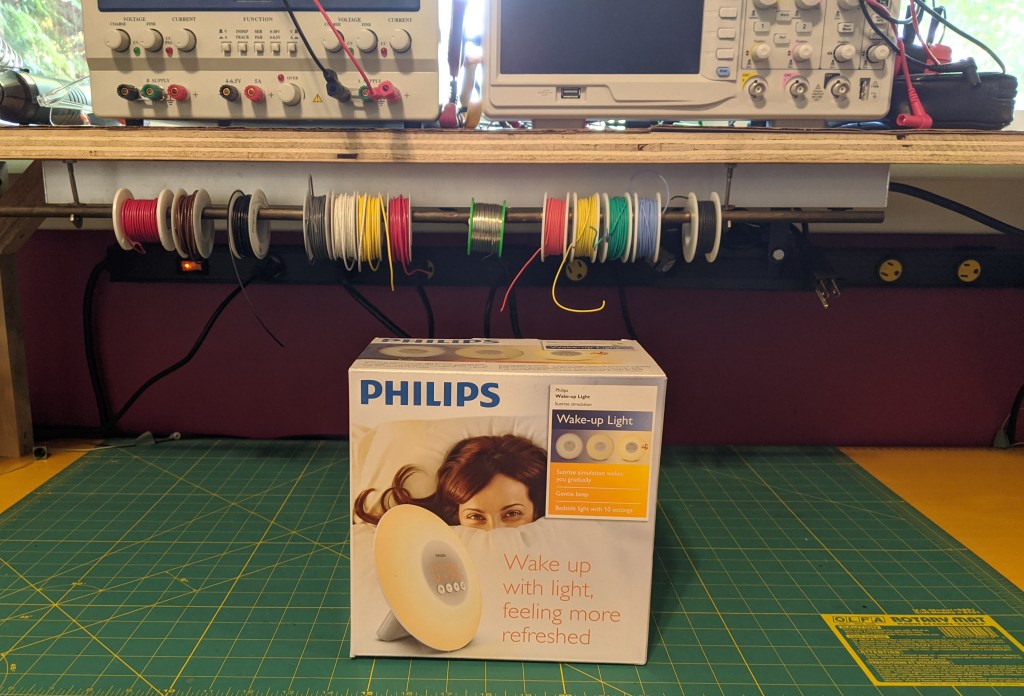
          In the dark months of winter, when even the sun has a difficult time getting out of bed, Alex and I typically find ourselves groggily hitting the snooze button more times than good sense would permit. One possible solution: an alarm clock that offers “a unique combination of light and sound so you can wake up in a more natural way and feeling more refreshed”. It seemed like it might be worth a shot, so I had one drop-shipped in advance of Alex’s birthday.

          In truth, I would say this light works almost exactly as advertised. The gradual sunlight simulation is quite effective and does prepare your body to wake up in advance of the alarm… the only trouble is that the “natural” alarm sound at the end of the sunrise sequence seems to have been sampled from a woodpecker attacking a squirrel.

          Since learning about kintsugi a few years ago, I’ve been taken with the concept. The underlying idea is that when a thing is broken or not working right, there exists an opportunity to repair it in such a way that it becomes more beautiful or functional than it was originally, even before the damage was done. In the case of our alarm clock the damage was done by the designerโ€”but there still exists the opportunity for artistry.

          Initial Surgery

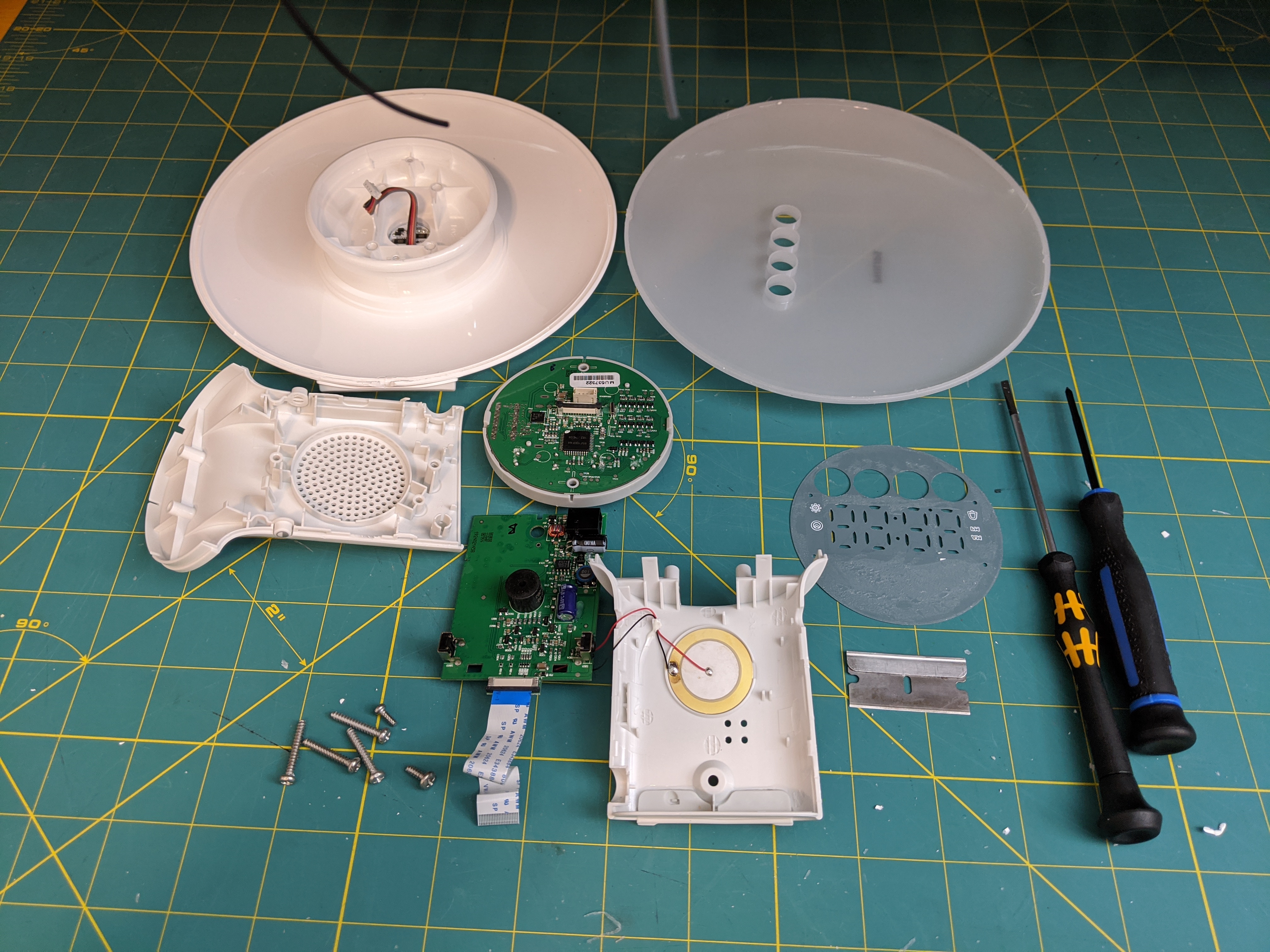
          Sometimes to make a thing better you’ve got to do a little damage yourself. First things first, I had to take the clock apart to modify the internals. Thankfully, I wasn’t the first person whose ears were beseiged by the blistering beeping and decided to do something about it. This youtube video by Metatronic Mods was indispensable in taking the light apart successfully. Apparently, the designers spent much more effort in making the device impenetrable than they did in choosing a soothing wakeup sound. I had a sensible chuckle when the sticker hiding the screws told me there were “no serviceable parts inside”.

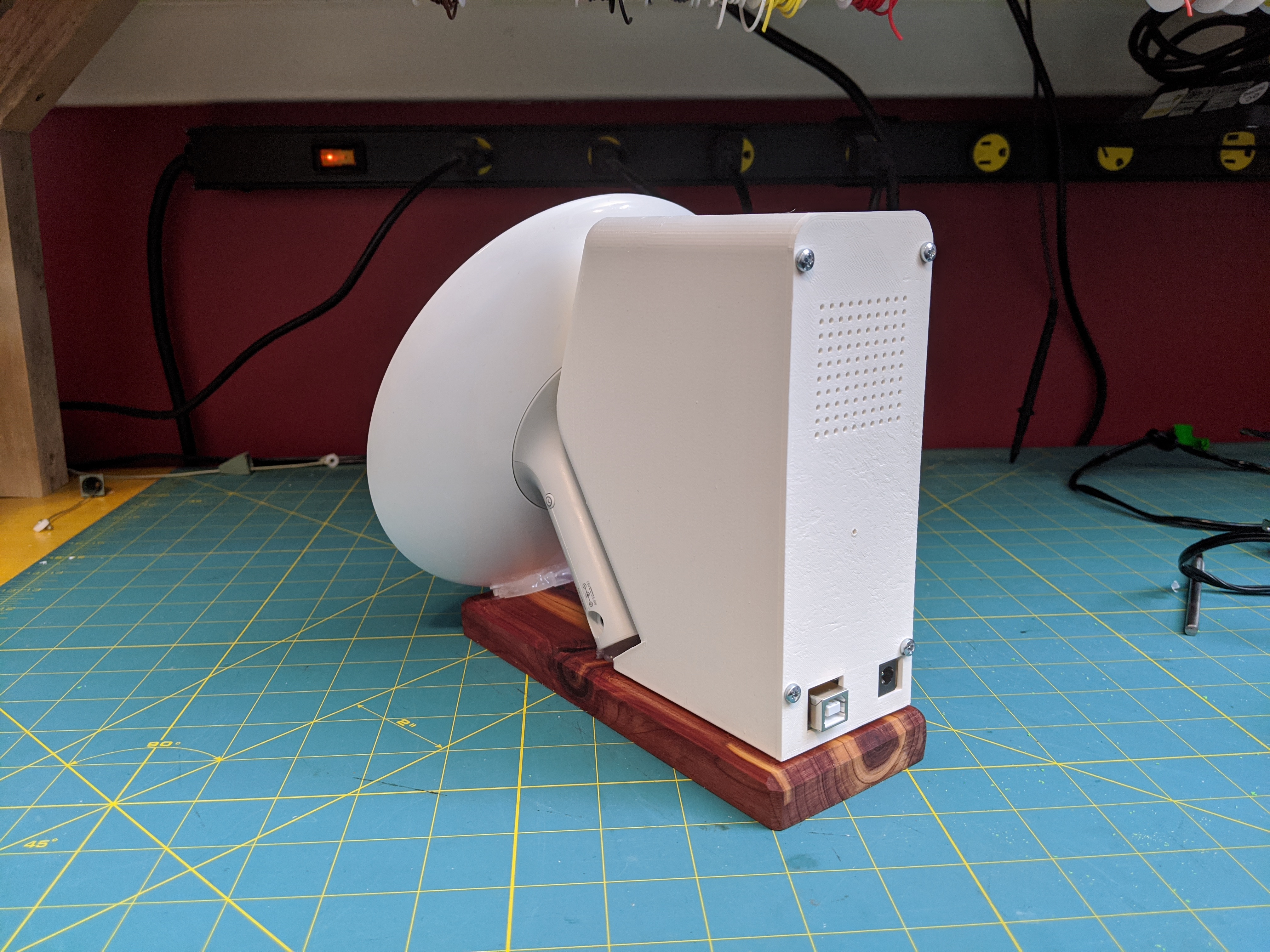
          Once the clock was apart and the offending buzzer removed, I was able to solder on two signal wires, which then passed through a hole I drilled in the base of the clock.

          Signal Modification

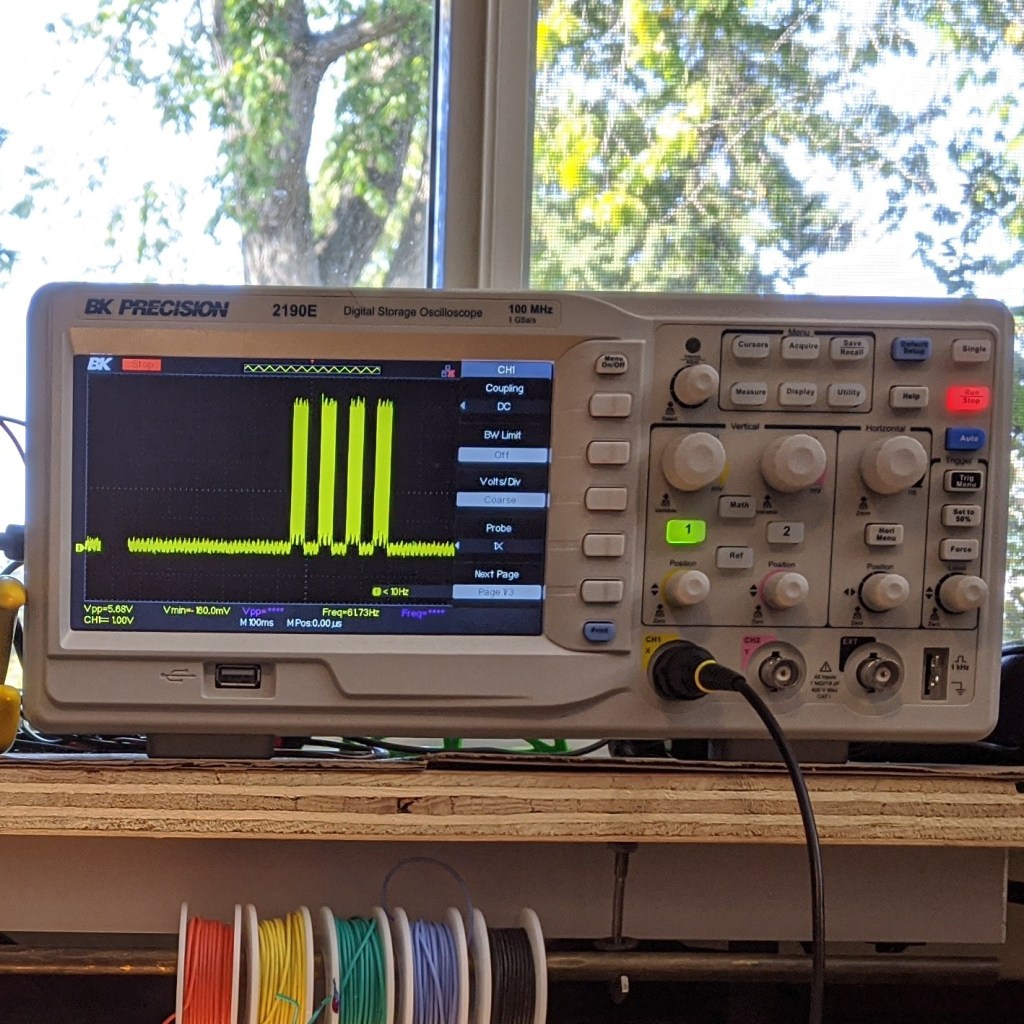
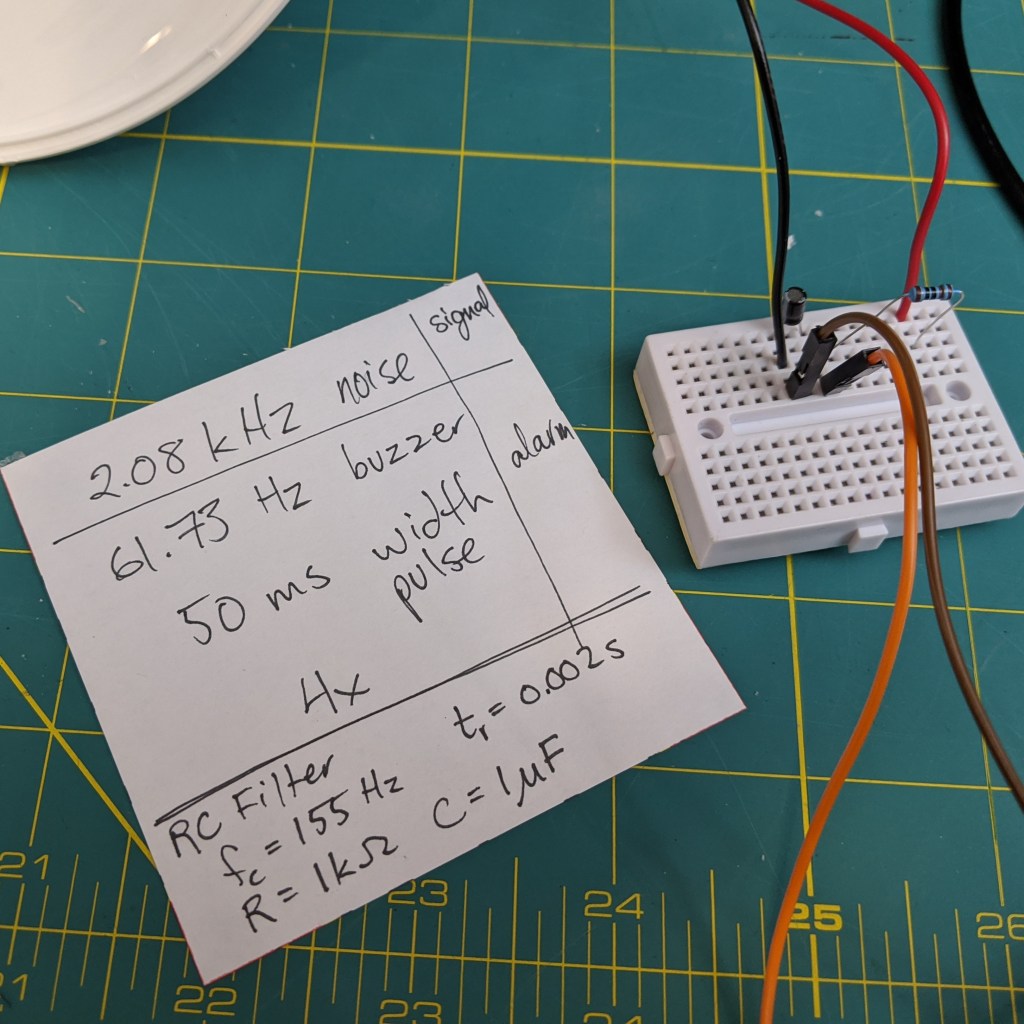
          In order to make use of the signal coming out of the board, I used a low-pass RC filter, which changes the original signal into something usable by an Arduino. Since the filtered signal is always above the digital logic threshold, it will look to an Arduino digital pin as HIGH any time the alarm is on, and LOW otherwise. This means that Philips takes care of time-of-day, alarm settings, sunrise simulations, and everything else the clock should, but the alarm signal triggers the Arduino instead of the buzzerโ€”and we can have the Arduino make whatever sound we want.

          Control Code

          Inspired by the way our yogi brings us out of Shavasana with three slow chimes, I decided it might be nice to wake up to a similar sound and cadence. Additionally, having an auto-snooze feature to save me from dragging myself to the alarm clock might be a nice reprieve. The pseudocode for the alarm sequence I decided on was

          while (alarm activated):
          repeat 3 times:
          ring chime once
          wait 10 seconds
          wait 10 minutes
          end

          If you’re interested in recreating something similar for yourself, the full Arduino code can be found in my Github repository.

          Wiring

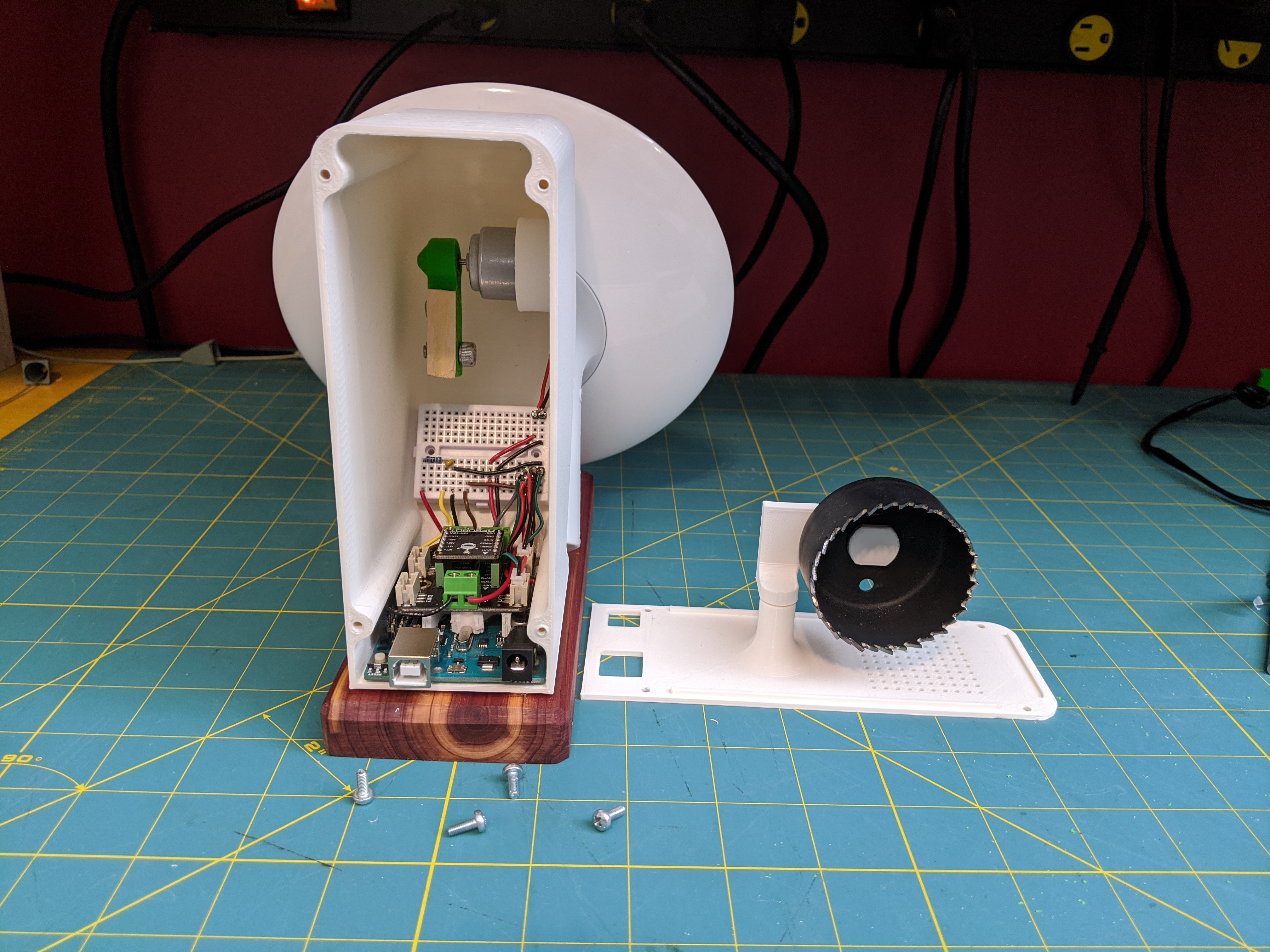
          The wiring here is pretty simple: RC filter straight from alarm signal to digital pin 2, and set up the brushed DC motor using a PWM-based motor driver on pins 4 (for direction) and 5 (for torque).

          Mechanism

          To recreate the soothing chime, I used a cheap DC brushed motor, which swings a 3D-printed hammer into a hole-saw. A surprising combination, to be sureโ€”but actually sounds great. If you’re planning on recreating this build, you can find my 3D CAD files on Onshape, and I would warmly recommend a 2 1/8″ hole saw for a bell.

          The whole unit sits atop a nice piece of aromatic cedar, rubbed with linseed oil.

          Final Product

          All in all, I’d say it turned out pretty well. A few weeks into waking up to this sequence, I’m still finding it quite pleasant. The only small change I might make in the future would be to replace the hard plastic hammer with a smaller chime on a rubber arm, that would add a pleasing harmonic to the sound and remove some of the harsher transients associated with the initial strike. To see a demo of the alarm cycle, check out this video.

          Livestream Painting | Peinture en Direct

          Note: This article describes an event that is now passed. To view the painting that resulted from this performance, click here.

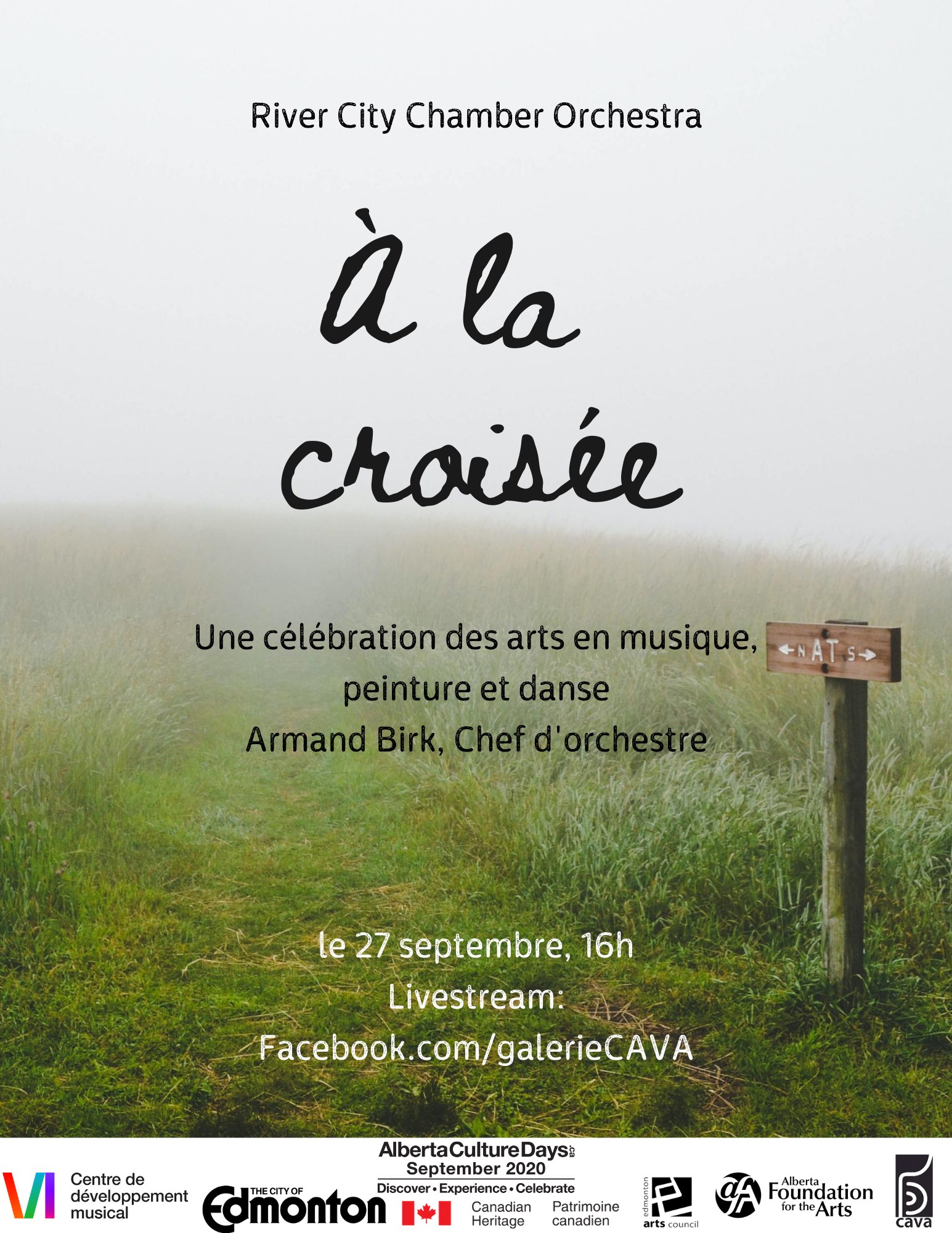
          I have the opportunity to perform a live painting, grรขce ร  la galerie CAVA! The River City Chamber Orchestra, conducted by Armand Birk, will provide โ€œexciting and emotionally satisfyingโ€ sounds from Rameau, Vivaldi, Finzi and Tchaikovsky; the dancers are ready to deliver energetic and dynamic performances; two other artists and I will express ourselves with paint and brush.


          The livestream will take place on September 27 at 4 p.m. UTC-06.
          J’ai l’occasion d’effectuer une peinture en direct, grรขce ร  la galerie CAVA! Le River City Chamber Orchestra, dirigรฉ par Armand Birk, fournira des sons ยซexcitants et รฉmotionnellement satisfaisantsยป de Rameau, Vivaldi, Finzi et Tchaikovsky; les danseurs sont prรชts ร  offrir des performances รฉnergiques et dynamiques; deux autres artistes et moi nous exprimerons avec de la peinture et du pinceau.

          Le livestream aura lieu le 27 septembre ร  16 h. UTC-06.

          Preparing for a live painting has been an interesting experience, and I’ve had some insights along the way that I’d like to share with whoever’s interested.

          When painting becomes a performance art, the process becomes part of the expression.

          Typically we think of a painting as a very different endeavour from an orchestral concert, or a dance performance. One of the main reasons is that you only ever see the finished product, and there is very little (if any) temporal aspect in the way that you take it in. Listening to a concert or watching a ballet necessarily takes time, and during that time the performer can take you through a range of emotions. Each movement might tell a different story, and contain different themes, and only by taking them all in turn can you get the full effect the performer was going for. With a painting however, this usually isn’t possible. You see the whole canvas at once, and the artist isn’t there to reveal it to you in any particular way. But when the viewer is there for the creation of the painting, a whole host of new opportunities arise.

          Artistic expression through performance is dependent on planning and practice.

          I’ve done enough performing in my lifetime (though this is my first live painting) to know that you don’t just show up on stage and wing it. Typically, the people that are able to cooly improvise really well have spent an incredibly long time practicing and becoming comfortable both on stage and with their medium. Certainly, the jokes or the saxophone licks might be improvised on the spot, but you can be sure this isn’t the first time they’ve ever improvised.

          I’ve been playing recently with a more improvised style, which I feel would be both fun to perform and fun to watch. But the nature of this style of painting is that you’re not sure how it’ll turn out. This is where the preparation comes in. I’ve spent the last few weeks turning over ideas, sketching things out, planning the composition, trying out colours, crafting stencils… Generally doing whatever I can to make sure that once I’m on stage I can just throw paint at the canvas (literally) and have a reasonable chance of having a good painting at the end.

          Which reminds me… I need to find those drop-cloths.

          Planning and practice are also good for refining ideas.

          This painting has evolved a lot from first conception to what it will actually be on September 27. Usually when I have an idea that I’m excited about, it makes it onto the canvas in a few hours or days. But this time I’ve had to hold off and be patientโ€”and since I’m carefully planning and practicing, I’ve been thinking about it a lot. I’ve developed a few themes that I’m hoping the finished painting will convey (and that the process will be a part of expressing):

          • The interplay between free-form improvisation and careful planning
          • Similarities between painting and performance arts
            • Colours and shapes can be thought of as similar to instruments in an orchestra. Each plays their part, which alone is beautiful but quite abstract; together they paint a complete picture that expresses the composer’s vision
          • Each performance is invisibly supported by centuries of human innovation and artistry
          • Seeing not only the performance, but also understanding all of the human effort that went into making it possible lends additional luminance to the art

          We never work alone.

          Even when I’m at home alone playing the piano, my artistry depends on other people. I depend on composers and performers that shaped musical theory and style, inventors that iterated on instrument design, scientists that discovered the physical principles that make them work, even the various political and societal structures that afforded these people the opportunity to do the work that they did.

          Artists (of any kind) work to make the world a more beautiful place. Whether or not we work with other people, we never work alone. We’re only the end of this lineage so far.

          DIY Mรถlkky Set

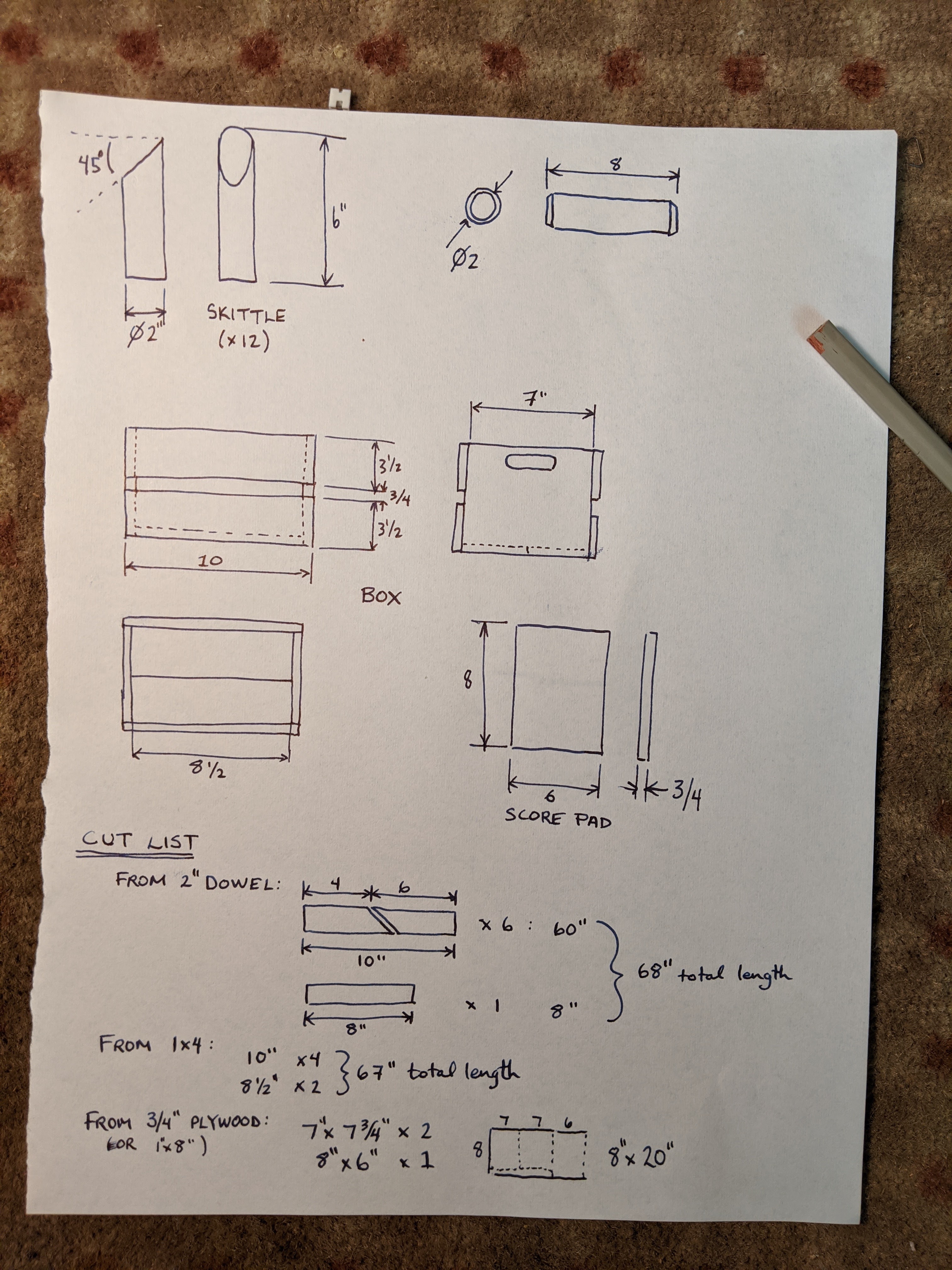
          Step 1: The plan. Always a good place to start.

          I looked up the rules and regulations, and poured a little bit of brain-juice out through my pen onto some paper. With that bit of compulsive engineering out of the way, I was ready to start pulling materials together.

          img_20200704_160638

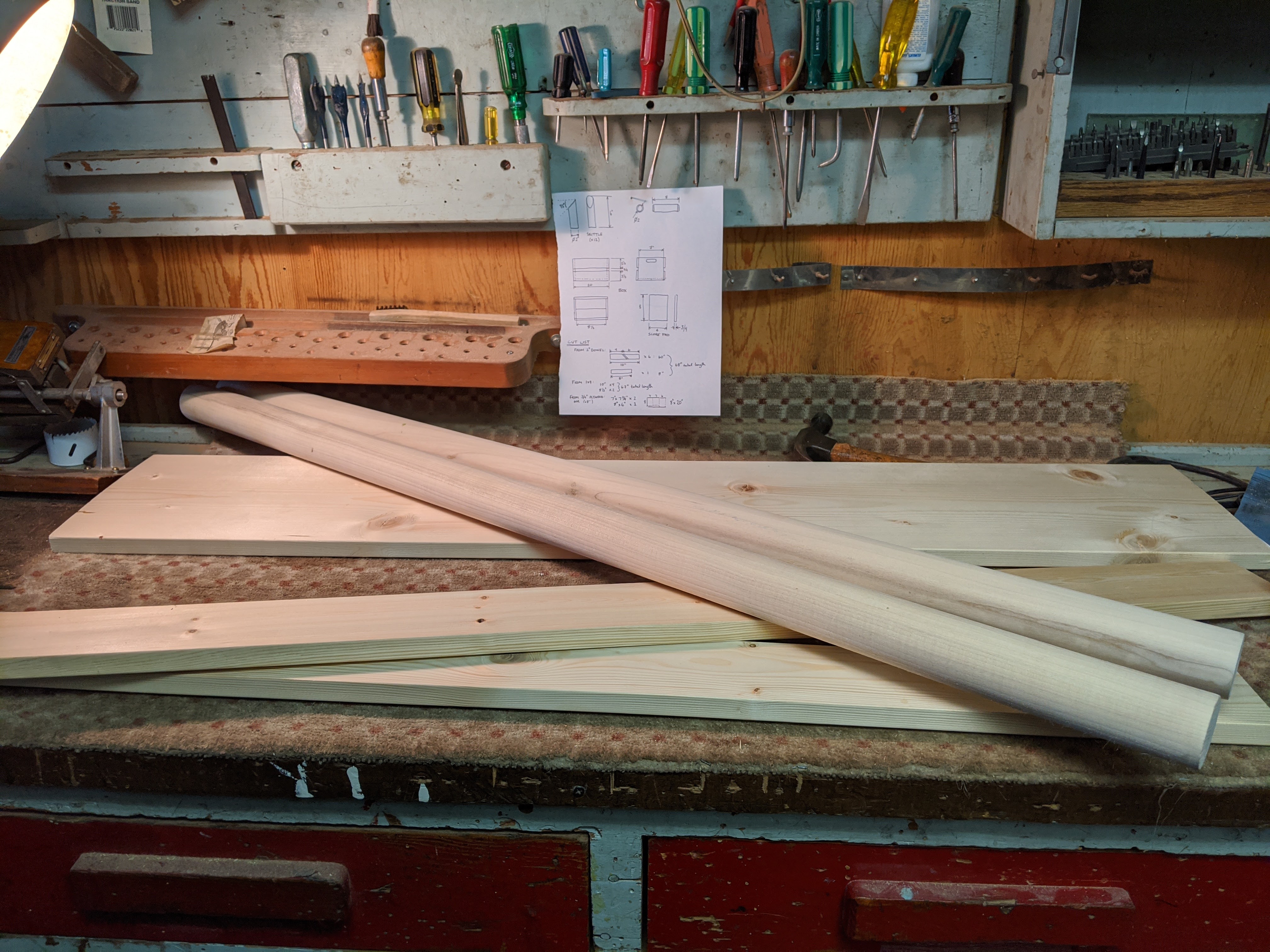
          Step 2: Procure materials.

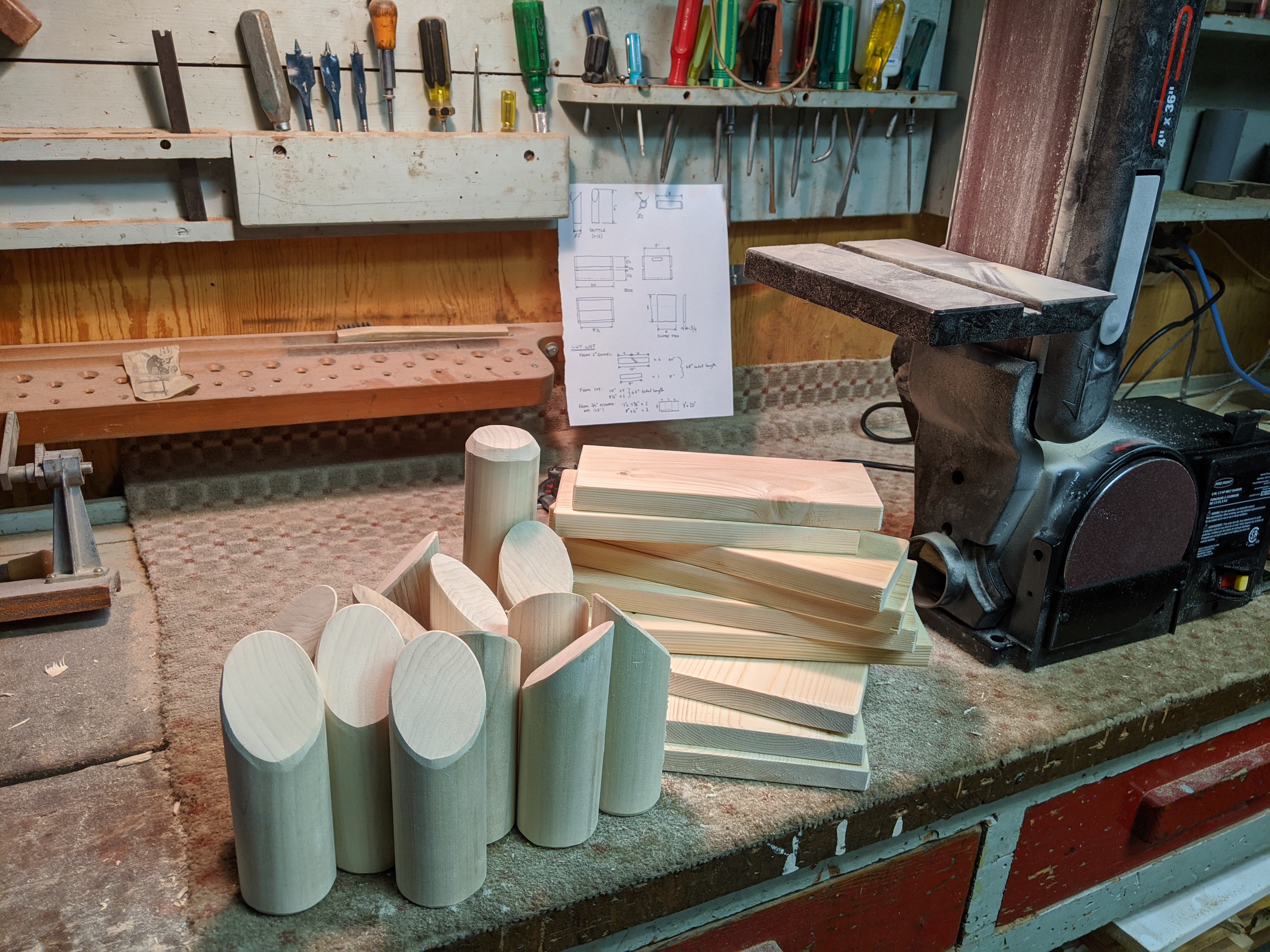
          The cut list in the plan lays it all out, and I’m happy to say the final result didn’t end up deviating from the plan in any major way. It also didn’t break the bank.

          img_20200704_160838

          Step 3: Cut the skittles.

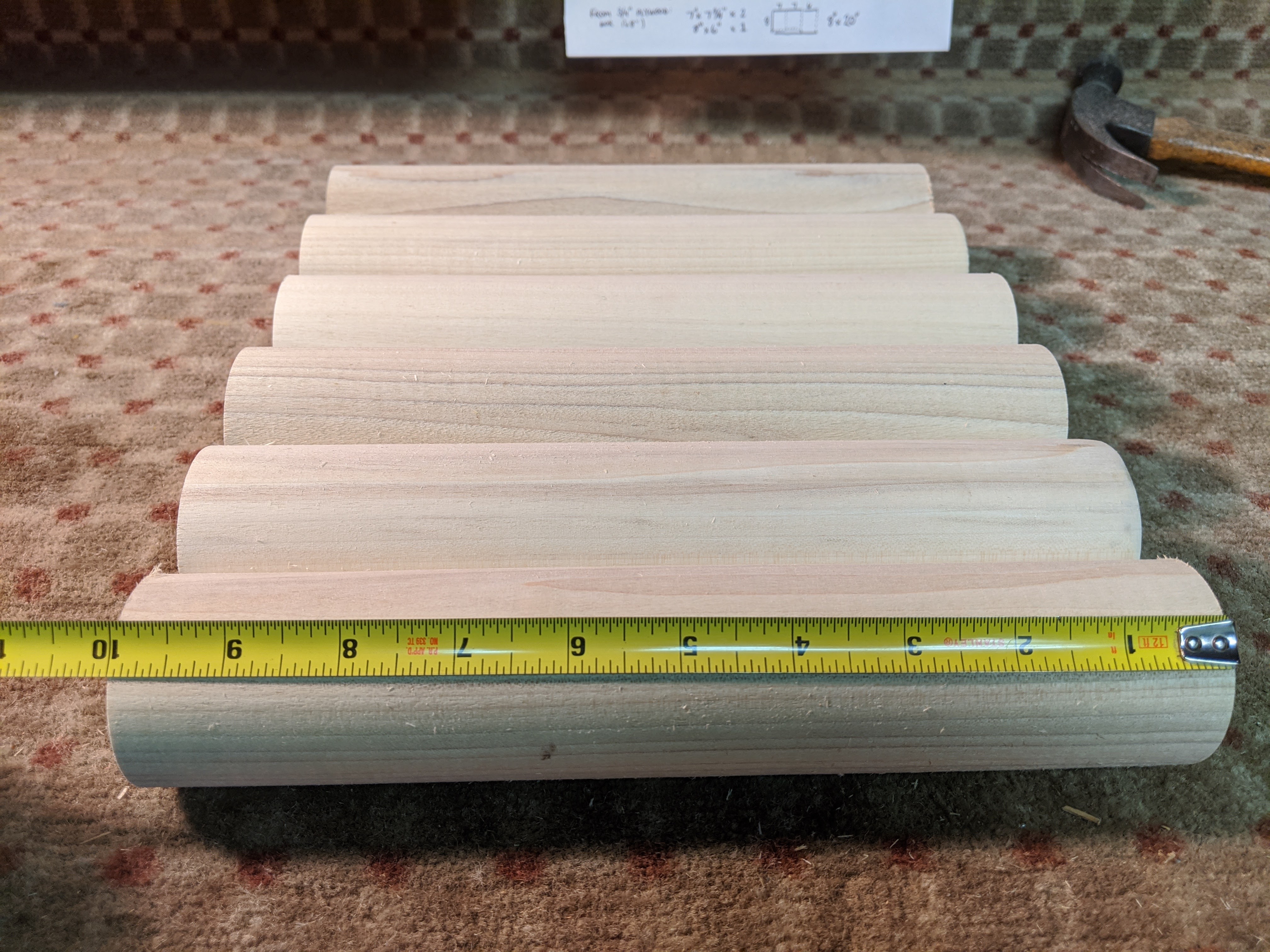
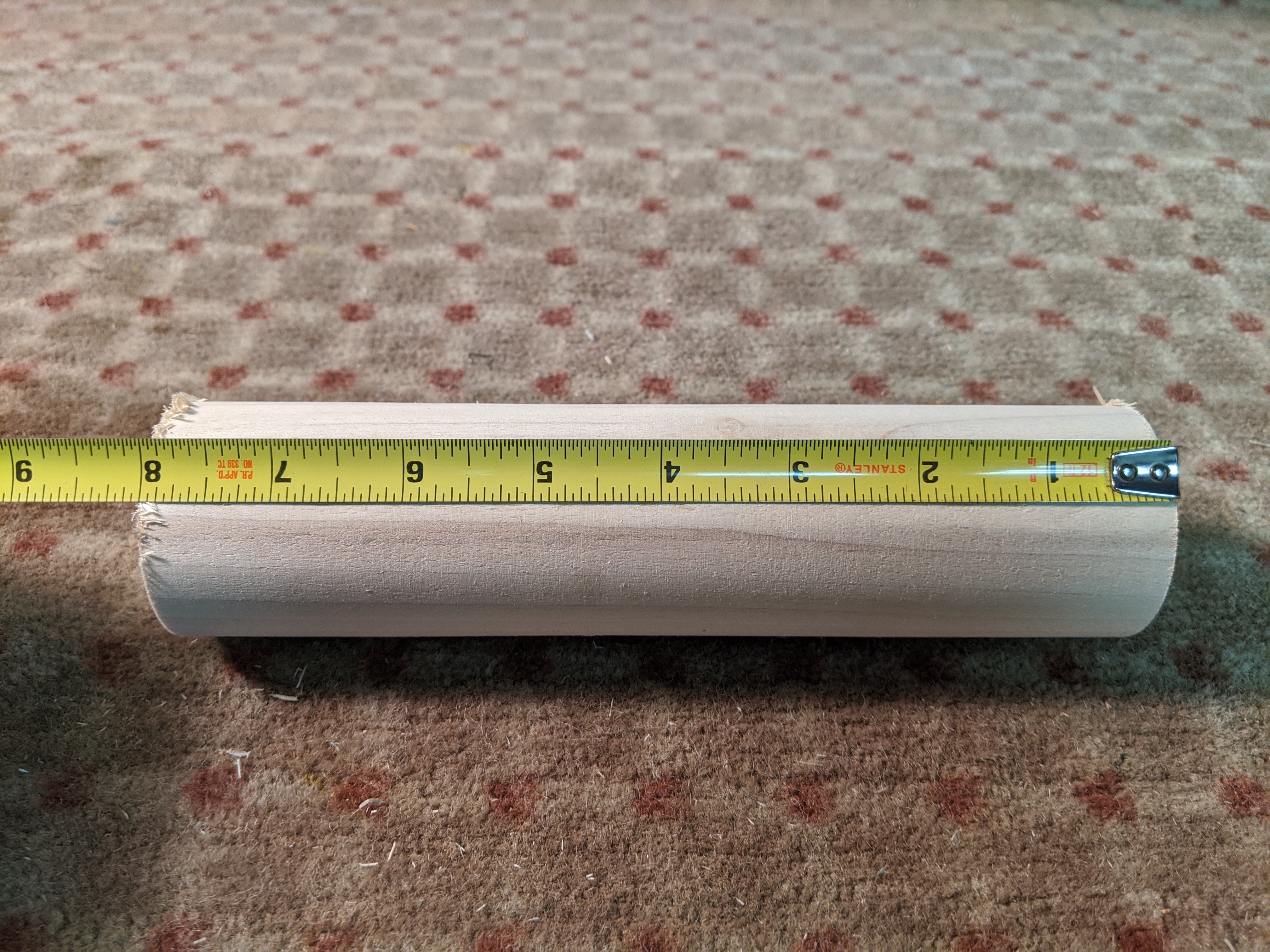
          You’ll need a sharp knife and a steady hand. Oh wait, not that kind of skittles. First cut the dowel to six 10″ lengths.

          img_20200704_161245

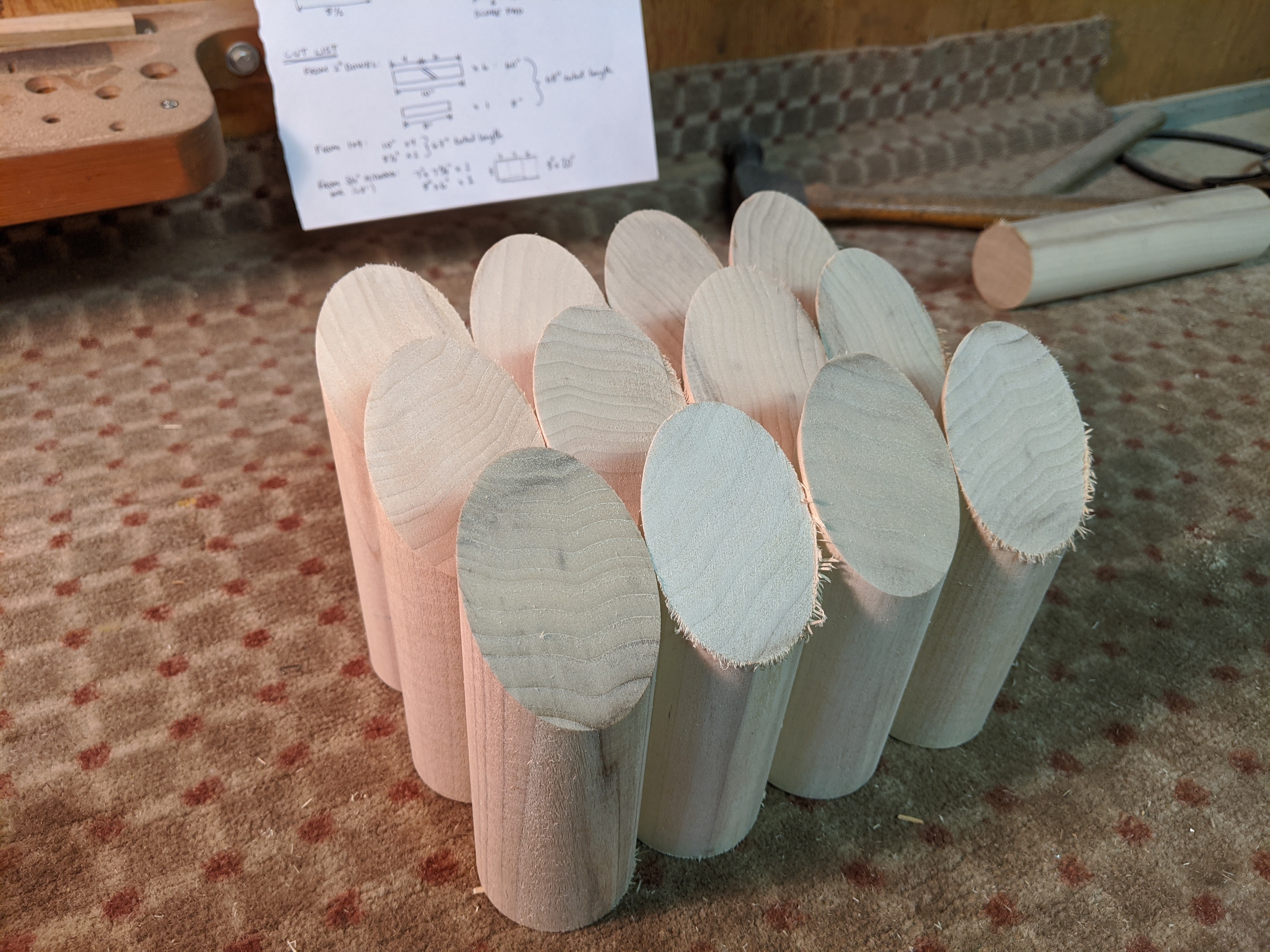
          Then cut those lengths directly in half at a 45 degree angle. This leaves the high side of the skittle at 6″, and the low side at 4″.

          img_20200704_161741

          Step 4: Cut the Mรถlkky.

          This step is pretty easy. One cut, 8″.

          img_20200704_161307

          Step 5: Cut the box boards and the scorepad.

          Nothing too fancy here. The 1″ x 4″ pieces are as follows: four at 10″, and two at 8 1/2″. From your larger piece (I used a 1″ x 10″ board), cut one scorepad to 8″ x 6″, and two box-sides to 7″ x 7 3/4″.

          Step 6: Cut the handles.

          Into the box-sides, cut a one-inch wide slot an inch down from the top of the board. Remember that the top side is the narrow (7″) edge. I started with two 1″ holes at the 2″ and 5″ marks, then completed the slot with a hacksaw and file combination. There are cleaner ways, but my scrollsaw was out of commission.

          Step 7: Make some dust.

          At this stage I sanded out all the major defects, tool marks, etc. and rounded all the sharp corners. Very glad I sprang for the belt sander a while back.

          img_20200704_175026

          Step 8: Build the box.

          Wood glue, clamps, and finishing nails were my tools of choice to put the box together. I set it up so that the bottom boards are held to the sides by nails in shear rather than pull-out tension. Not that the Mรถlkky set itself needs a lot of strength, but in my experience crates tend to get repurposed.

          Step 9: Drill many many holes on the scorepad.

          Mark it out, punch a guide, then drill… 362 times. If you do one a day, you’ll be done in less than a year.

          Without a drill press, I needed a good way to consistently and quickly get the right depth, as these aren’t through-holes. I drilled through a short length of dowel, until my drill bit extended only as far as I wanted the holes to go. Then I drilled the holes with the dowel shrouding the drill bit, and keeping it from going too deep. I used 9/64″ holes to fit 1/8″ dowel pegs. The holes are 1/4″ on-centre from each other at a minimum.

          Step 10: Cut the pegs, and make storage holes for them.

          1″ long bits of 1/8″ dowel work for pegs, and holes in the sides of the scorepad serve to store them.

          Step 11: Do a snazzy paint job.

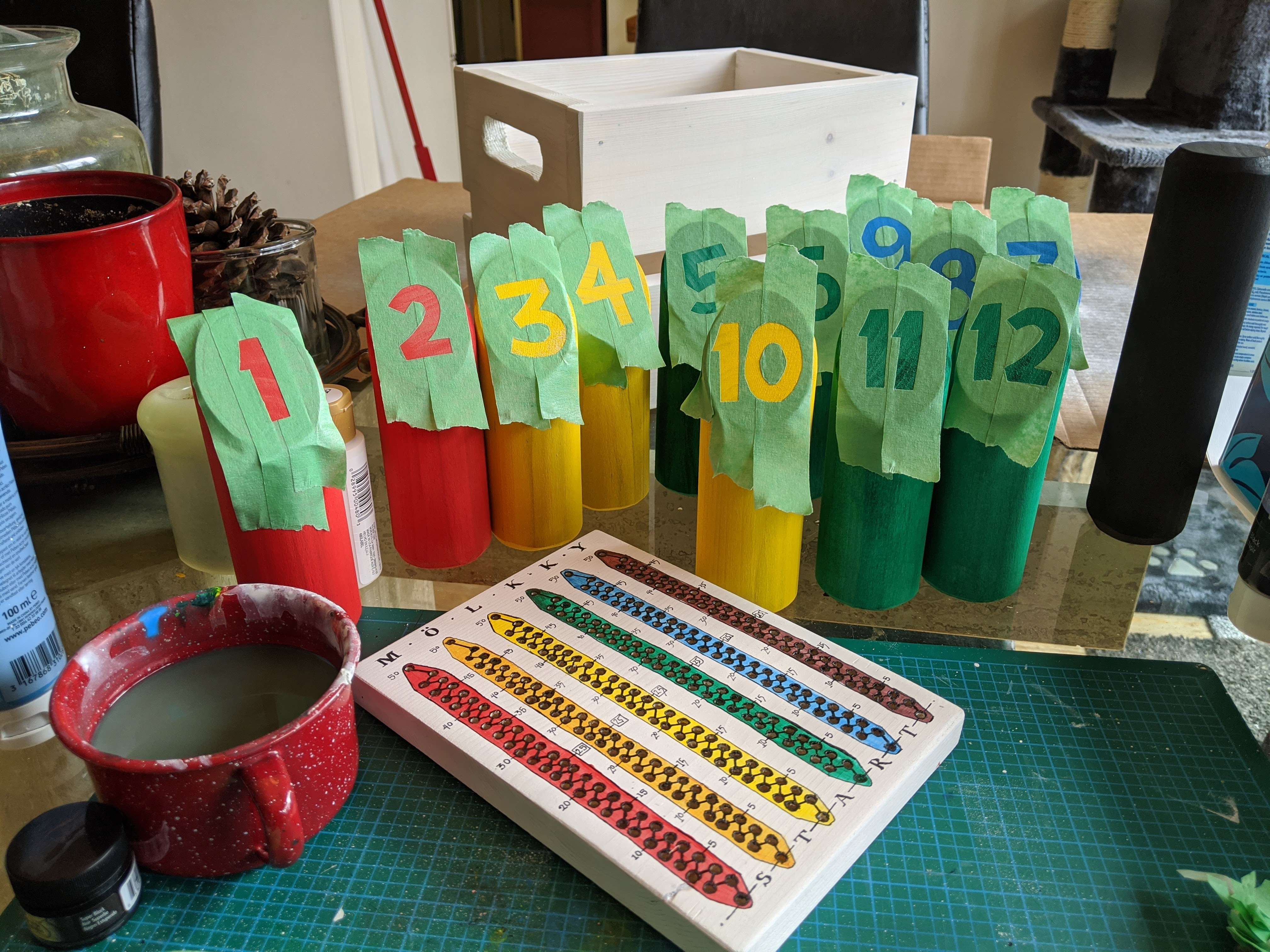
          I went for white on the box, bold colours on the skittles, and black for the Mรถlkky. All painted with craft acrylics and a paintbrush. For the detailed inking for the scorepad I pulled out the pen-and-ink. Are there faster ways to do this? Sure. But turtles live an awfully long time.

          img_20200705_124045

          Step 12: Follow the rules.

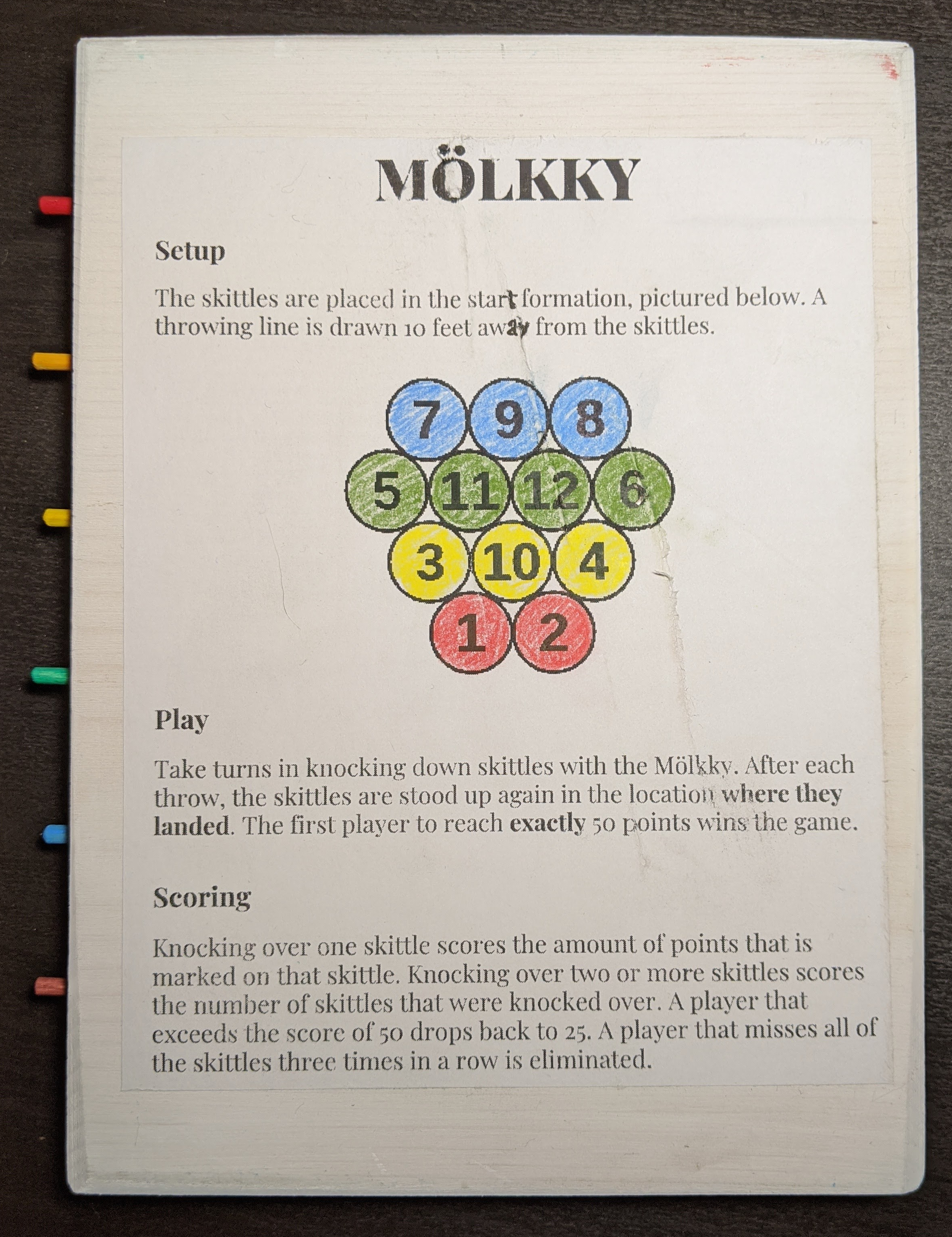
          I printed out a rule sheet, and pasted it onto the back of the scorecard with watered-down white glue. That way it’s always there when you need it for the inevitable dispute.

          I’m not too happy with the wrinkles that came as a result of the water-and-paste method. I guess that’s what you get for going too fast.

          Rules

          Step 13: Spray a clear coat.

          Last step is to spray everything down with a clear-coat, to keep things nice as long as possible.

          Spray ClearCoat

          And that’s a wrap.

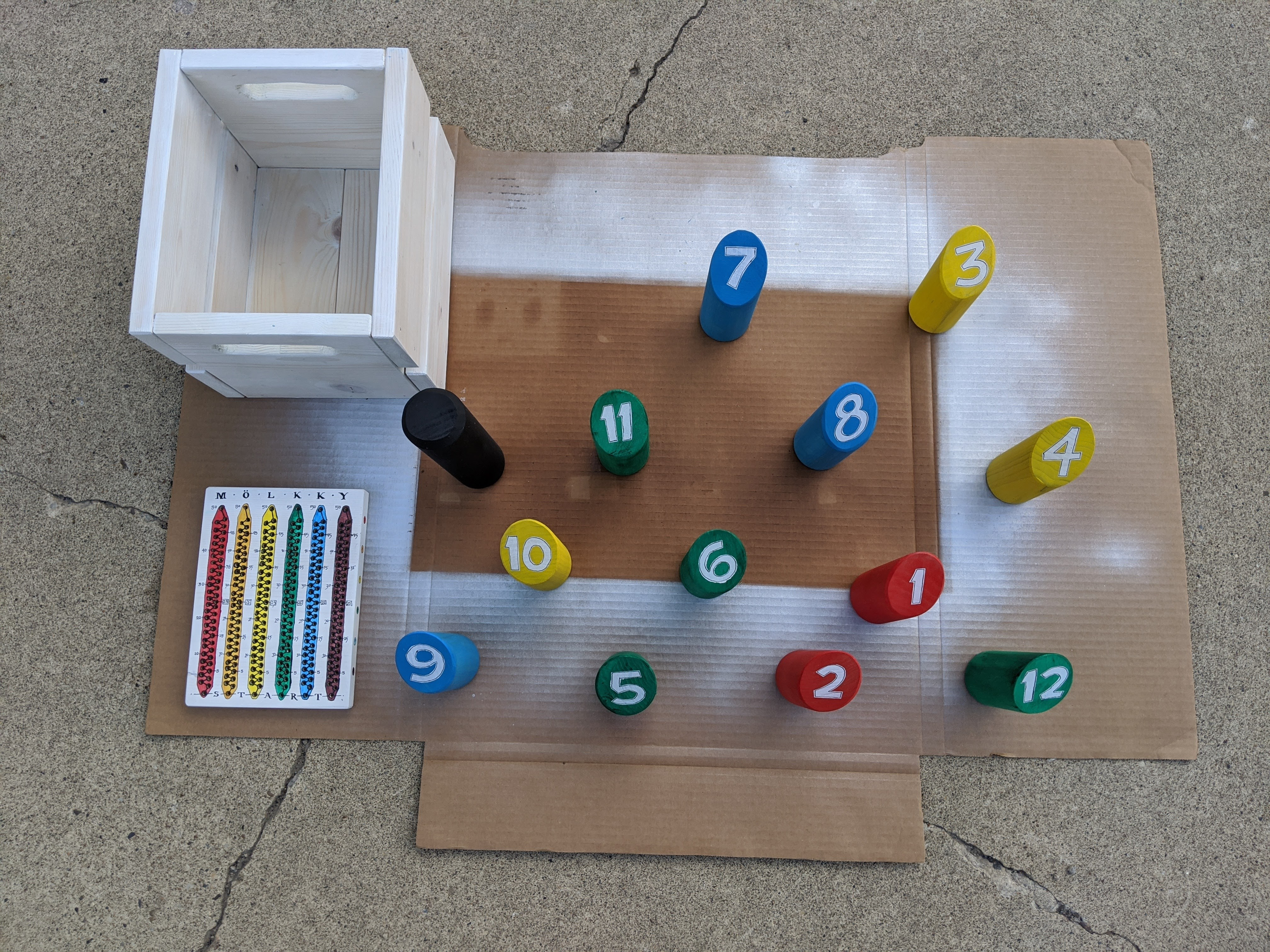
          It fits neatly into a the box, and has everything you need to play!

          DIY PickleBall Paddle

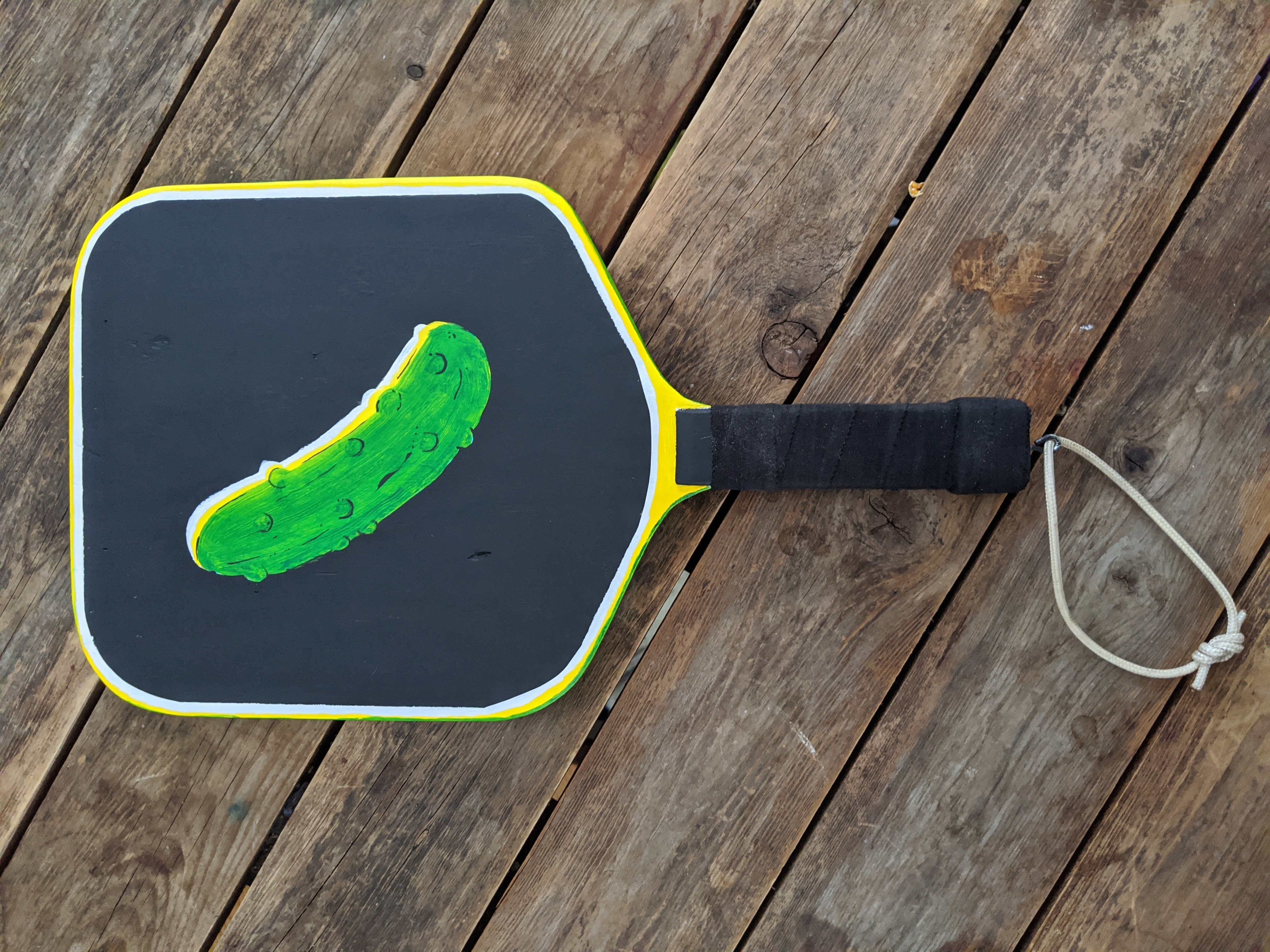
          Here’s a quick how-to recipe for making your own pickleball paddle! Bear in mind that, as much as I strive to stay within regulations, homemade paddles are not permitted for “official” play. But we’re just building and playing for fun anyway.

          Step 1: Cut out paddle

          Using a scroll saw, I cut out the main paddle shape from a scrap piece of 3/8″ plywood. Officially speaking, it seems like just about any shape is allowed, as long as the combined length and width don’t exceed 24″, and the paddle length doesn’t exceed 17″.

          img_20200216_114421

          Step 2: Cut out the handle

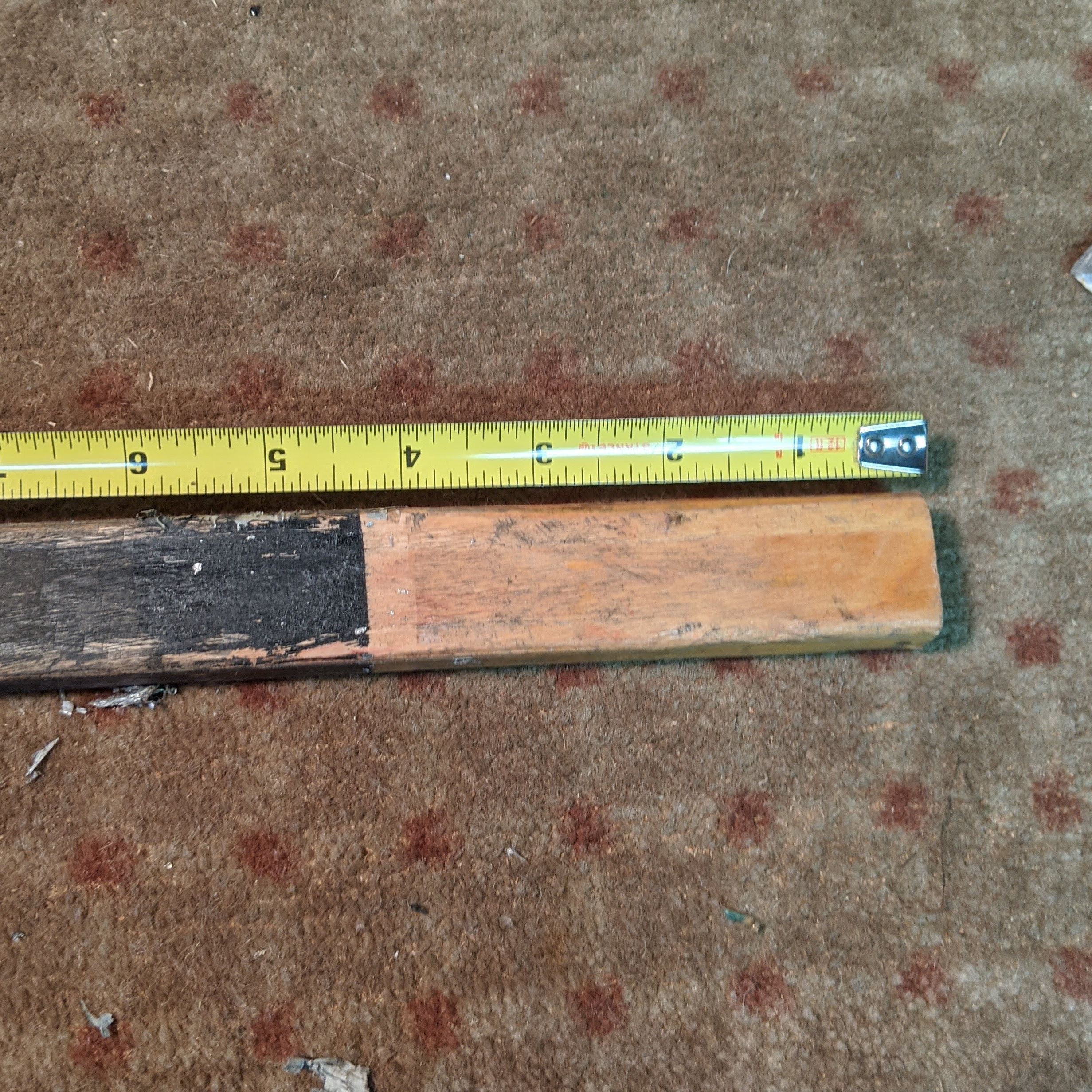
          I fashioned a handle from an old hockey stick I found in the garage. 6″ does the trick for my hand.

          img_20200216_114434

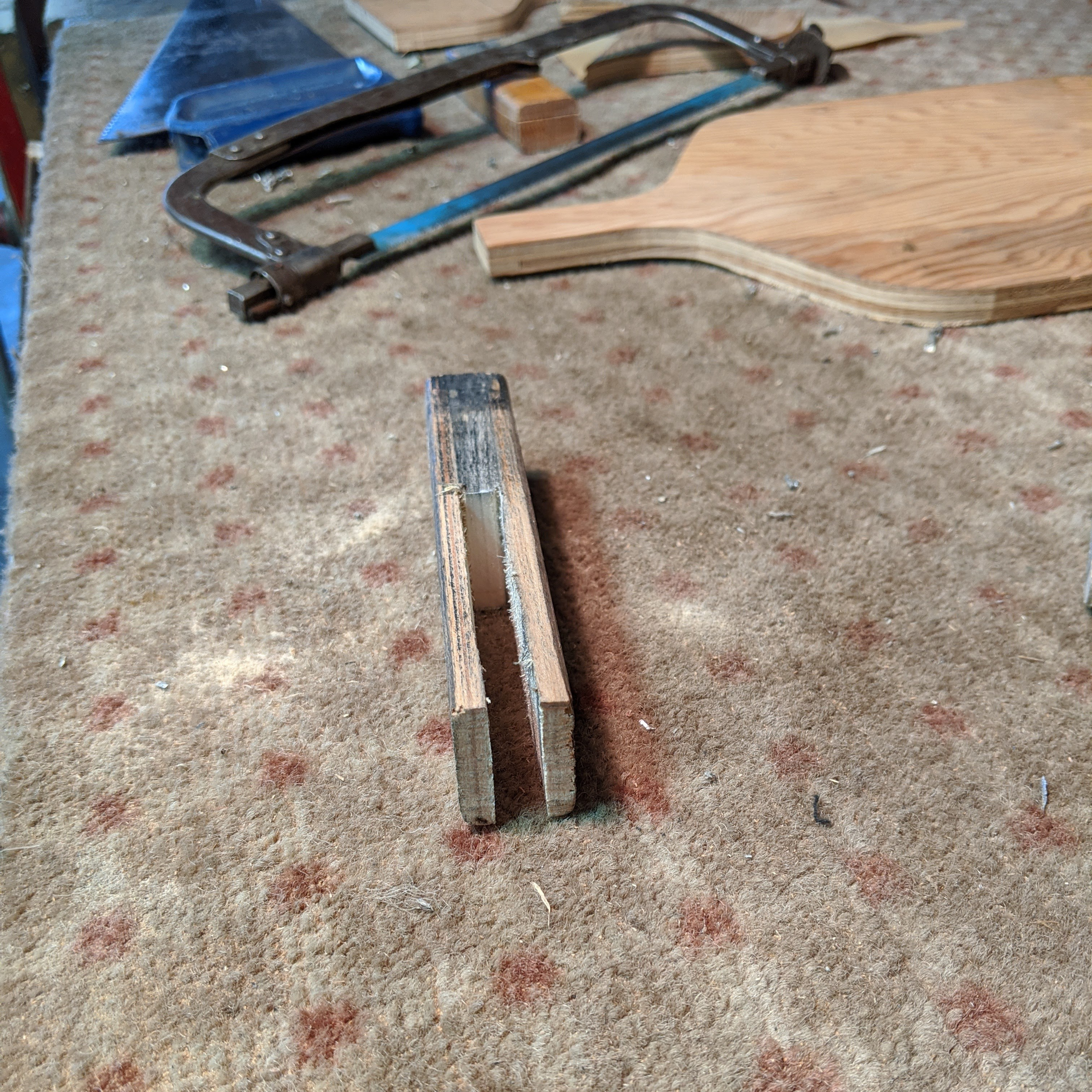
          Step 3: Cut the handle notch

          I cut a notch down the centre of the handle, where the paddle slips in. I used a hacksaw for the cut, then cleaned it up with a flat file.

          img_20200216_122700

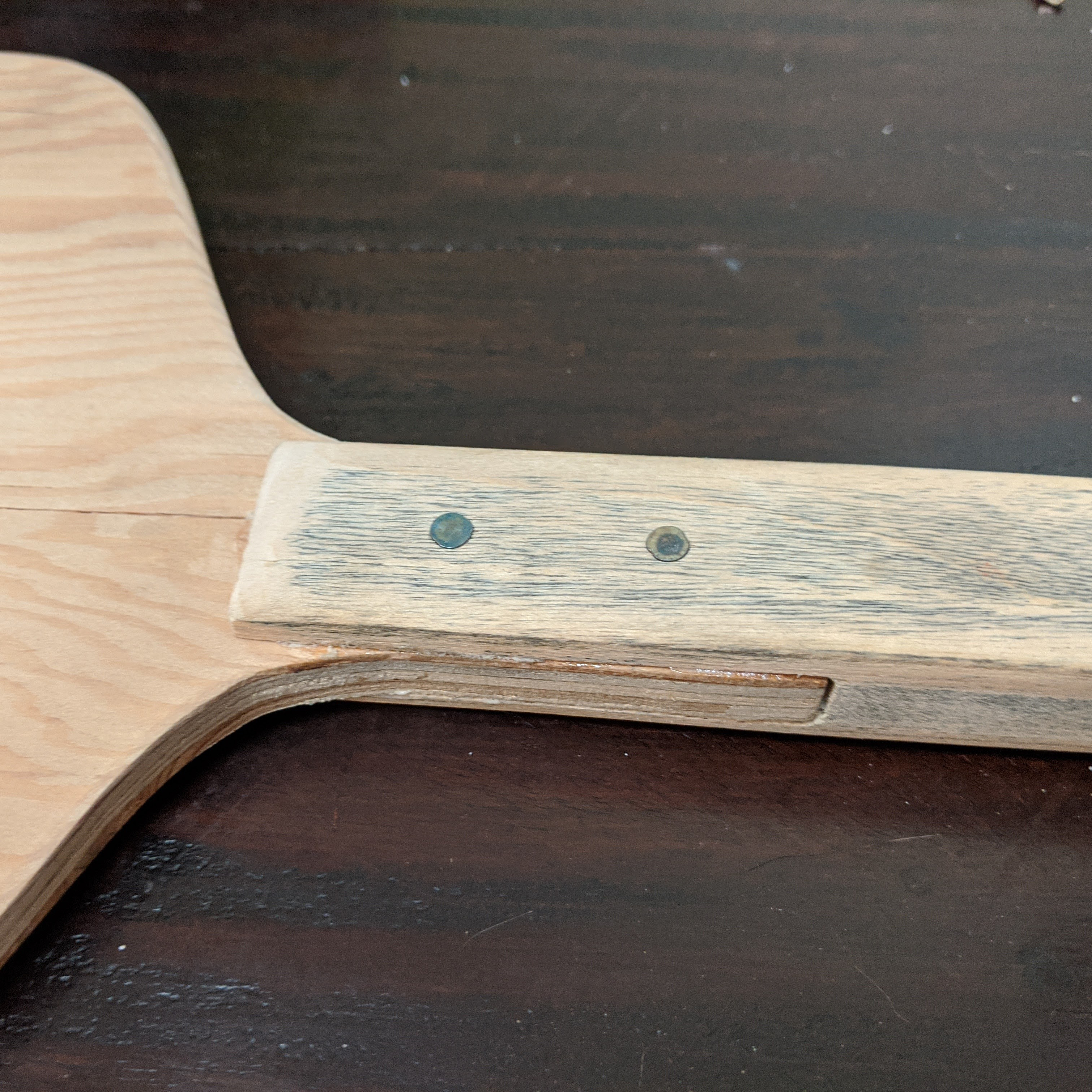
          Step 4: Attach the handle

          I used a bit of wood glue between the faces, and two small nails to make absolutely sure the paddle doesn’t go flying off. That would definitely not be regulation.

          img_20200216_183207

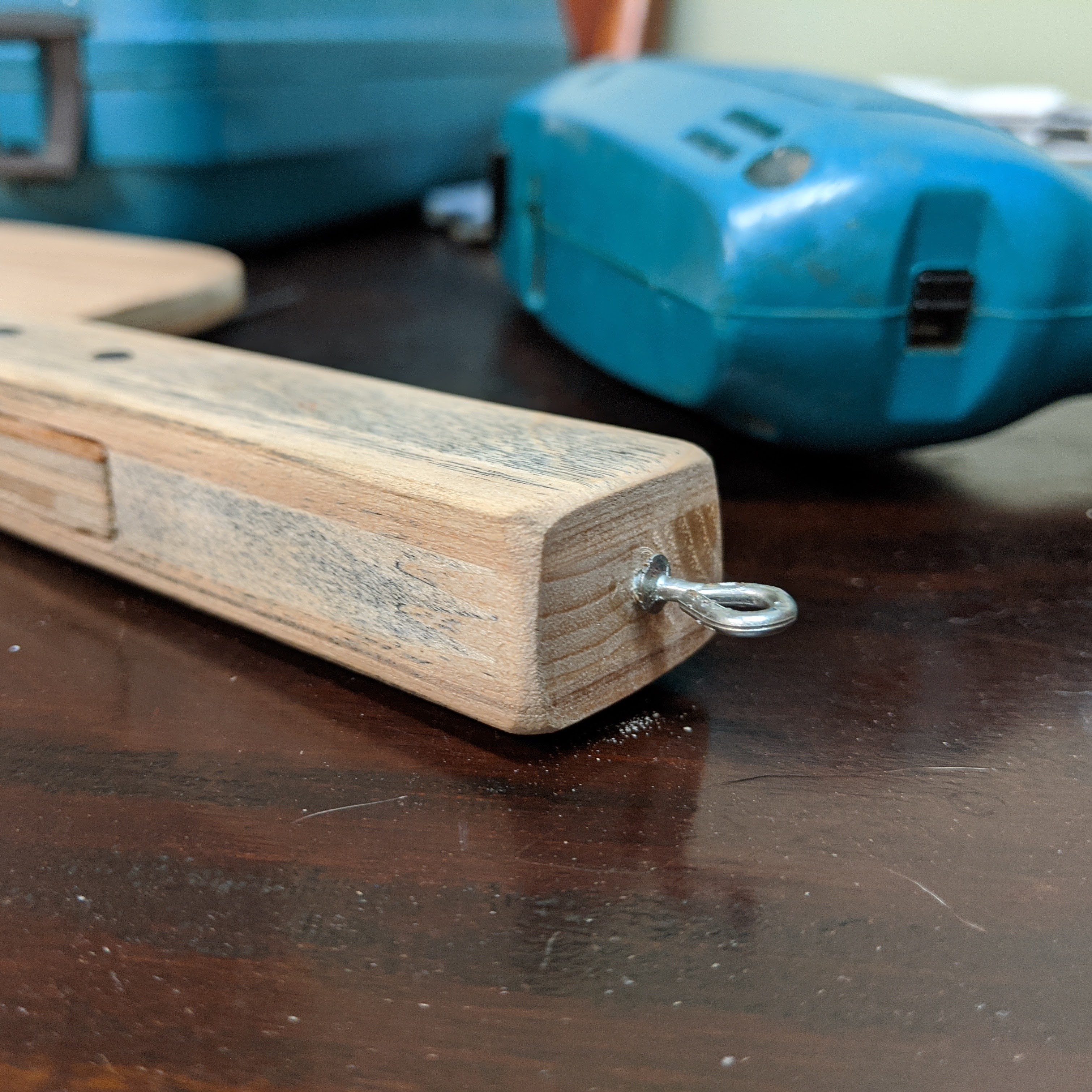
          Step 5: Add a hook for the wrist strap

          Just a simple hobby-store hook, screwed into the butt end of the handle.

          img_20200216_183759

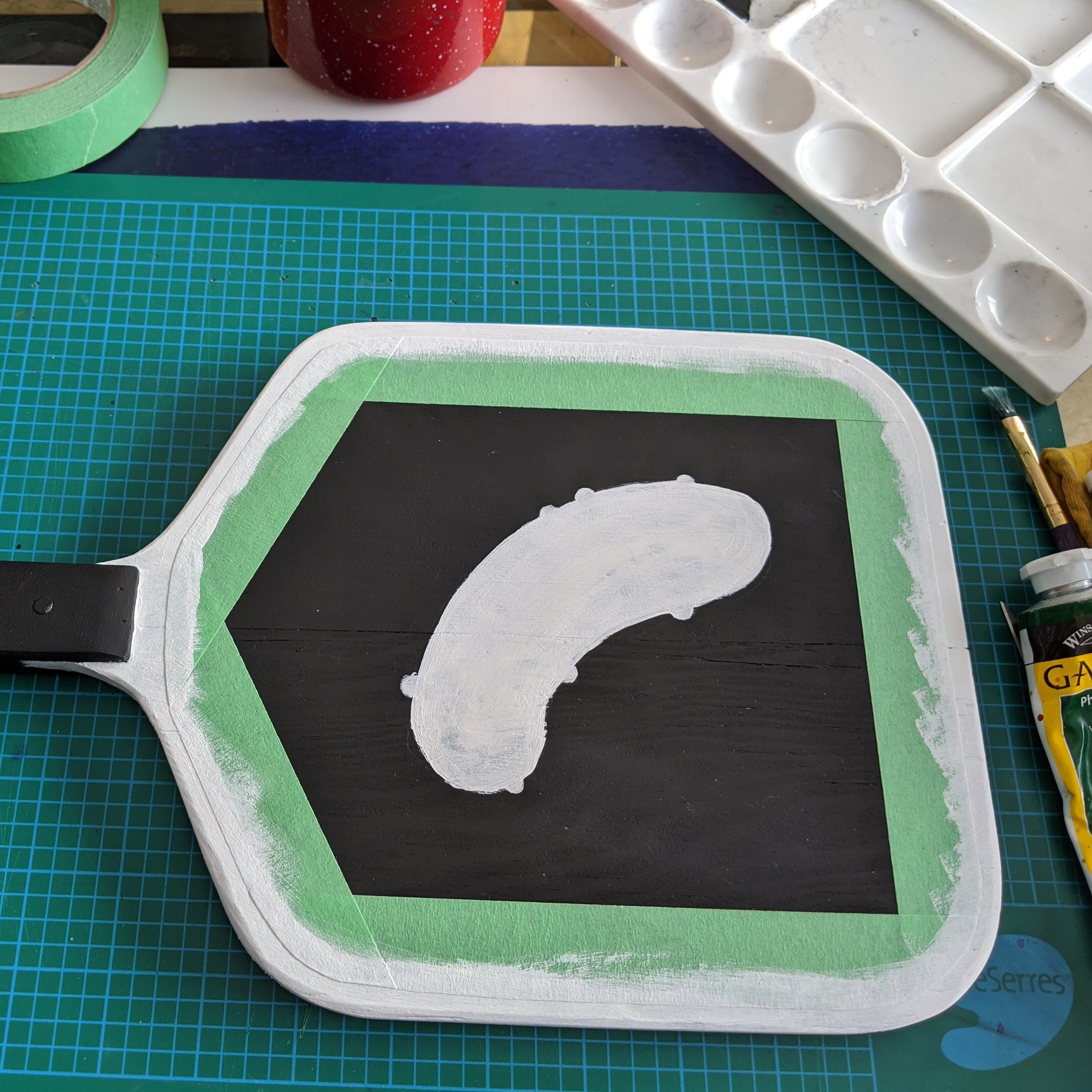
          Step 6: Snazzy coat of paint

          Of course, before painting, sand down everything smooth. And bear in mind for whatever type of finishing you do, the maximum roughness is 40ฮผm peak-to-valley. If, like me, you made this with plywood you’ll never get to regulation roughness. However, if, like me, you made this yourself you’re out of regulation already anyway.

          img_20200217_100200

          Step 7: Handle grip and… you’re done!

          A couple of layers of hockey tape, a bit of string for the wrist strap, and you’re off to the court!

          img_20200217_164442

          Hammock Philosophy

          I was doing some thinking. Thought I’d jot down some thoughts here in an unstructured and largely unedited way, mostly just so that I wouldn’t forget them. Perhaps best to not put too much stock into anything.

          Philosophy is best done from a hammock in the shade of an apple tree. Ideally with a cool beverage.

          This one strikes me as a no-brainer. No explanation needed, no explanation offered.

          Do it well, not fast.

          The inspiration for this one, I think, comes from Robert M. Pirsig’s Zen and the Art of Motorcycle Maintenance. Since I read it about two years ago, I’ve been thinking often about the concept of Quality, and what that means for me. I think it’s always been something I’ve held in high regard, but I never really had a name or a concrete conception of it until reading ZAMM. It’s a notion of taking the time to work with something until it’s right; understanding and accepting when it’s not, and continuing to work with it.

          I also read through a good chunk of Analog Circuit Design: Art, Science, and Personalities, edited by Jim Williams (a surprisingly entertaining read). A number of the engineers that wrote articles for that compilation referred to an ancient electrical engineering analysis technique known as the “what if?” method. Essentially, to analyze a circuit, the engineer would consider “what would happen at point a if I applied voltage x at point b” for all possible combinations of a, b, and x. They would answer the question for themselves theoretically before running the test, and any discrepancy, even due to measurement error, had to be thoroughly understood and explained before the circuit was considered completely analyzed. The description of such a process made EE sound like a beautiful and pure form of the scientific method. There were many tales of engineers that would skip the process would have their ICs out the door quicker, but inevitably end up with unexplainable failures. Understanding every little detail of the system, and having the patience to turn over every stone before moving on to the next field seems to me to represent scientific inquiry in its highest and purest form.

          Before closing this section, I’d like to breathe a word of caution against perfectionism. Here, when I speak of Quality, and doing things well, I speak of taking the time to truly understand the thing you’re building or doing. Iteration on an idea or prototype is not just a necessary evil–it’s a good thing. It helps build the understanding. And the understanding is, I think, what we’re really here for. Cogito ergo sum, and all that jazz.

          Time is relative anyway; don’t let it push you around.

          I’ve been reading Your Brain is a Time Machine by Dean Buonomano. A great read so far, and has really got me thinking a lot about time. Coincidentally, I’ve also been reading Stephen Hawking’s A Brief History of Time, which also offers a number of mind-bending considerations.  One note that struck me from Buonomano’s book, was a quote from the Roman poet Plautus, from the 2nd century BCE:

          The gods confound man who first found out / How to distinguish hours! Confound him too / Who in this place set up a sun-dial, / To cut and hack my days so wretchedly / Into small pieces! When I was a boy, / My belly was my sun-dial–one more sure, / Truer, and more exact than any of them. / This dial told me when twas proper time / To go do dinner, when I ought to eat; / But, now-a-days, why even when I have, / I can’t fall to, unless the sun gives leave. / The town’s so full of these confounded dials…

          If poets were lamenting the oppressive control of the clock and meeting schedules back in the 2nd century BCE, what hope do we have now that we can measure and break down our days with an accuracy of 10e-18 seconds? Well, as it turns out, when you can measure time that accurately you realize it’s actually relative. Even objective, scientific time depends on you–where you are relative to other massive objects and how fast you’re going. So don’t let it push you around.

          You only control You. Only you control you.

          The first half of this one I heard iterated many times from my 6th grade teacher, Mr. Manson. I recently read it echoed through Stoic philosophy, which I can only assume is where Mr. Manson got it from. I came across the Stoics in a particularly good read: A Guide to the Good Life: The Ancient Art of Stoic Joy by William B. Irvine. Don’t let the title throw you off; it’s not actually cheesy. Essentially the crux of this one (for me at least) is that if you’re setting goals for yourself that are based on other people, you’re in for disappointment. While in the hammock this afternoon I realized that an implicit goal I had been working toward, and that had been giving me a lot of stress, was that I wanted to do meaningful work, and be respected for the contributions I make. Trouble is, how do you measure “meaningfulness” in your work, especially before it’s had a chance to do anything in the world? And how do you control whether other people respect your work? Bad goals. Much better would be just to focus on doing work of high Quality. Do that right, and meaningfulness and respect are sure to follow.

          The second half of this one came to me as I was writing down the first half. I haven’t thought it all the way through just yet, but it seems like there might be something to it.

          Let it come with time.

          You don’t have to have all the answers right away. Jot it down, come back to it later. Or let someone else come back to it. The answers won’t all come even within your lifetime, so don’t worry about having them all right now.

          One thing that struck me while reading A Brief History of Time was that it appeared that Einstein didn’t really grasp the full implications of his general theory of relativity when he published it. Only when other people read it did they make connections with other areas of physics, and realize the full implications. If Einstein doesn’t know it all, who does?

          A thing born quickly dies quickly.

          I was thinking about what the meaning of life might be.

          My thoughts wandered back to the Musee Mechanique that I visited in San Francisco almost exactly a year ago. There you’ll find loads of wonderful antique arcade machines, music boxes, player pianos, etc. In a few places around the museum, tacked up with scotch tape, were inkjet signs on 8 1/2 x 11 paper, reading:

          PLEASE BE CAREFUL. SOME OF THESE MACHINES ARE OLDER THAN YOU WILL EVER BE.

          Something about the message hit me in just the right place. That means the machines are also older than their creators ever got to be. At the same time that I was in San Francisco, Alex was touring Japan. She had told me about some sacred floorboards that had been stained with the blood of samurai who had committed seppuku around 700 years ago.

          This all lead me to thinking about how the actions you take in your life have effects and leave artifacts that last far longer than you do. So a thought that I’ve been rolling around but haven’t fully committed to is the idea that the meaning of life is to do meaningful work. A bit of a tautology here, and the idea hinges on a precarious definition of “meaningful”. But throughout our lives we spend our energy doing things. Bringing order out of the entropy. Entropy works to undo whatever we’ve done, and largely succeeds–except at unravelling the things that other people have found meaningful. Do a thing really well, and people will work to maintain it despite the natural destructive forces of the world. Have an idea that’s really good, and other people will work with it and riff off it.

          In order to do a thing well, you have to take your time. In order for the thing to live longer than a short while, it has to be made well. So, in summary, a thing born quickly will die quickly also.

          Pleasure has merit also. Its danger, like anything else, comes in arriving at it too quickly.

          Having not found a satisfying answer for the meaning of life, I decided to consider the flipside of the coin to see if there might be anything useful over there. Maybe there’s no point in doing meaningful work. Any advances you make that aren’t disintegrated into entropy will be buried under still more thirst for development. If your life’s meaning is tied up in helping other people, you have to at some point wonder what’s the point of their lives? To help everyone else, or you? So the point of humanity is to help humanity? Maybe. But perhaps dissatisfying. What if the point of life is just to enjoy it?

          If we take that to an extreme, and imagine a person living solely for their own hedonistic pleasures, we quickly conjure up a caricature of someone lying to, stealing from, and abusing other people, while maximizing the frequency with which they participate in drug abuse and sex. Quickly we can imagine this person living a short an unsatisfying life full of hatred and fear.

          But what if we didn’t take it quite so extreme? What if a person maximized their long-term satisfaction and happiness, rather than a short-term hedonistic pleasure? How would a person do that? Cultivate meaningful relationships, work hard at things they’re passionate about, plan for the future, and take time in each moment to soak up all of the pleasure that it might contain. This seems not only not dangerous, but beneficial.

          My takeaway here is to plan and be responsible for long-term pleasures and satisfaction. In the meantime, take some time to enjoy whatever comes your way. Spend some time in your hammock. It’s nice.

          Turtles live an awfully long time.

          That they do. Jonathan was born in 1832.


          Splatter Painting

          I’ve been working hard at loosening up recently, and let me tell you: there’s nothing quite so therapeutic as taking a piece of cardboard out behind the barn and giving it a good swift beatingโ€”with a paintbrush, of course.Barn Splatter.jpg

          I’m starting to play around with ideas about the tension between chaos and order, and between raw and curated beauty; things that have been on my mind since I wrote The Silence Here. I think there’s a lot more gold to be mined here, and I’ve had a lot of fun already.

          I was surprised to find that a loose, dripping, splattering technique also worked quite well in watercolour, a medium which I always enjoyed because of the amount of control it affords. I was amazed to find how beautifully it works when you relinquish some of that control, and let the paint just do what it wants. This photo doesn’t quite do it justice, but there are some really interesting things happening with the colours, especially around Chester’s eyebrows.

          In short, I suspect I’ll be playing around with my newfound techniques more; there’s a lot more fun to be had here.