Robot from Household Trash

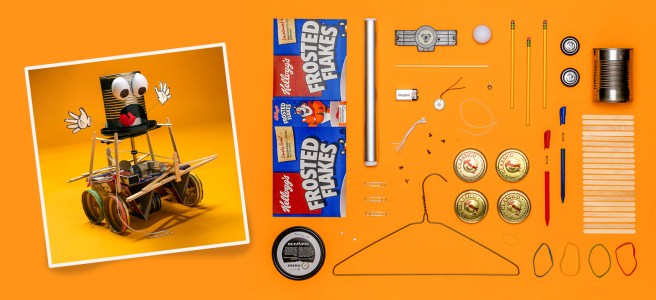
A few months ago, the New Trail magazine contacted me with an interesting request: They wanted me to design and build a robot out of household trash. At the time, I was right in the middle of writing my thesis, so of course, I jumped at the opportunity for something else to work on.

In order to be able to call the thing a robot, I figured it needed to take in some information about its environment, and change its behaviour based on that input. Making this thing out of household trash and salvaged components meant that I would have to keep it simple… but as with most of my projects, my ideas tend to run away with themselves.
NTD-02-19-Robot-Run-250x250

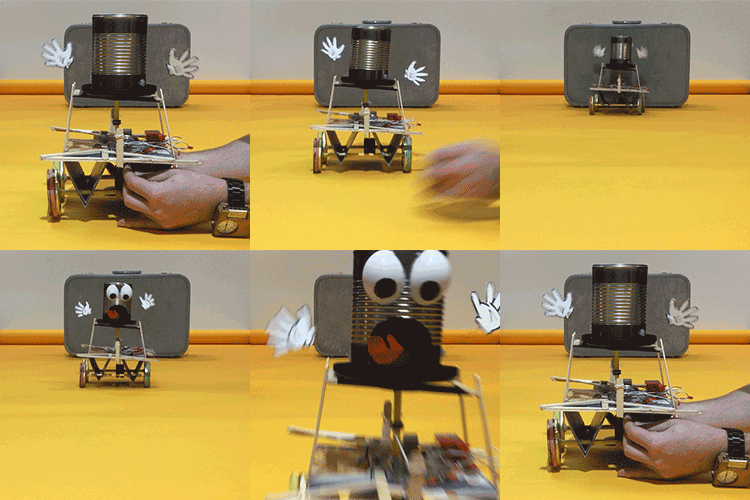
This little guy has bump sensors on either side made from popsicle sticks and carefully placed tin-foil electrical contacts that allow it to switch directions and run the other way whenever it runs into something. The tin-can body turns around based on the same input, using the mechanical linkage to spin a central pencil axis.

The New Trail has issued a challenge to anyone who wants to try building one of their own, and they’ve put together a nice assembly manual for the project as well. If you do end up attempting a build, I will make one suggestion: have lots of glue on hand. The article isn’t joking when it says I used a lot of glue.

Photo and video courtesy of New Trail Magazine.

Guitar Refinishing

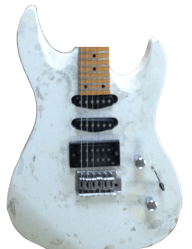
About four or five years ago, I bought an old electric guitar mostly because it was really cheap and I didn’t have an electric one yet. However, the previous owner had coated it in gaudy, sparkly stickers which refused to come off without leaving gobs of glue behind, and the receiver for the whammy bar was cracked badly enough that it couldn’t be used at all. It was fun to play around with for a while, but never really got much use because it was in such a state of disrepair. Then a few weeks ago I picked it up again, tried to tune it, and broke a string.  Like a hardened drug addict, this guitar had to hit rock bottom before it was going to admit it had some problems.

At first I thought I’d just replace the broken string. Then I figured why not change the set? Keep things consistent. Then I thought hey, while these strings are off I should probably get rid of all this glue residue. To do that properly I had to take off the knobs and covers. Once those were off, it only made sense that I fix the whammy bar receiver while I was inside… before I knew it, I had a full-blown restoration project.

IMG_2965.png


The sticky residue was the first hurdle to overcome, but a little bit of nail polish remover and some elbow-grease did the trick nicely.


IMG_2966


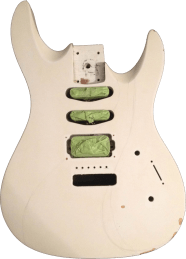
Once the glue was off, I couldn’t ignore the fact that this clean white body was a canvas waiting to be painted with something more expressive… and so the project grew yet again.


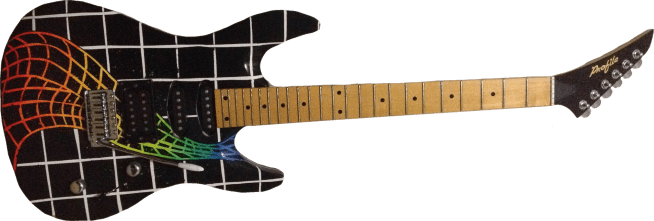
I wanted the design to be mainly black to match the already black head, and I also wanted it to be somehow related to music without being trite or over-done. What I eventually settled on is a symbol of music bringing colour and variety to an otherwise rigid and mundane world. I first painted the rainbow motif across the centre using acrylic paint, then masked off the grid using green painter’s tape cut to approximately 1/8″ thickness. After masking, I painted the entire guitar black. Finally, I sprayed on a droplet rainbow using the acrylics mixed with water by flicking the tip of my paintbrush. Once I took off the mask, I sprayed the whole thing with many layers of clear glaze topcoat.

The whammy bar receiver was originally cast iron, and very brittle. I fashioned a new one from an old piece of angle-iron and a welded-on nut, then spray-painted the whole thing to help prevent rusting.

IMG_2973.png

Once everything was put back together I took her out for a spin and was quite pleased with the results! Riffing with this guitar felt like putting a new spirit into old bones—and within a short time, I think I was able to do the same thing for one of my old poems. The Startled Eye of Passer-By is a poem I wrote back in 2014 (around the same time I bought this guitar, coincidentally), which may be coming to life again soon as a song: one refinishing project brought on by another.

The Day I Almost Died

The following story I wrote and performed for Edmonton’s Story Slam. It’s a wonderful organization and a great event; for anyone interested in telling or listening to stories, I recommend you check them out: www.edmontonstoryslam.com

The story I’m going to tell you is from back when I was four, living on a cattle farm just west of Morinville. Now, when you’re four years old, you perceive the world a little bit differently than the adults around you do. The way my parents tell the story is simply this: my dad took me and my older sister out on the skidoo one day to check the cows, and when we drove over a bump, she and I fell off the back (no injuries sustained). While dad circled back to pick us up again, one of the cows might have looked in our direction.

But that’s not the way I remember it.

What I’ll tell you now is my recollection of the story, exactly as my four-year-old self would have wrote in my journal—if, of course, I had been able to write at the time.

Dylan’s log: January 15, 1998.

I almost died today.

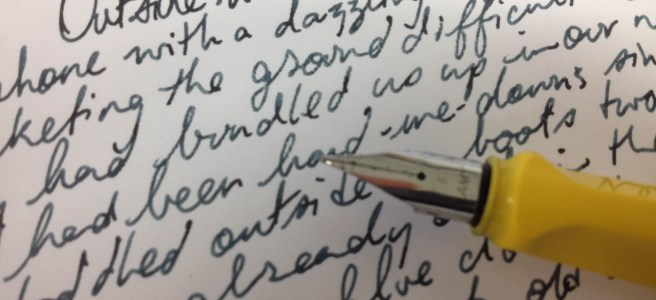
Outside was a treacherous cold, but the bright blue sky shone with a dazzling light that made the snow blanketing the ground difficult to look at for long. Mom bundled us tightly in our neon snowsuits that had been hand-me-downs since the ’80s, and we toddled outside in boots two sizes too big. Dad was already out in the driveway amid a thick blue cloud of smoke, trying to convince the rusty old snowmobile to start. With just a few more tugs on the frayed pull-cord, a rattle and a bang, we were off! We putzed across the yard at an easy five miles an hour toward the field, and I hollered in excitement, “Faster, faster!” Dad chuckled to himself as he patted the hood of the skidoo with a heavy mittened hand, saying, “I dunno if these squirrels can handle much more than this.” I never knew that’s how skidoos worked, but I guess it makes sense. The squirrels underneath the hood chattered noisily to themselves as they ran in their hamster wheels, and as we crossed into the field Dad bellowed loudly, “Cumbos, cumbos, cumbos!” I’m told that translated, cumbos literally means, “Come, boss!” and is the call used by old cowboys to draw the lead cow nearer. Wherever the boss cow goes, the rest of the herd is sure to follow.

We were just coming up alongside the herd when Laura and I were bucked off the back of the skidoo with violent suddenness and landed in a pillowy snowdrift. I looked around at first in dazed confusion, then immediately noticed that the skidoo was continuing to plug along away into the distance. Dad was completely unaware that we had fallen off. Laura sat bolt upright in the snow, eyes wide with fear as she pointed over my shoulder. “Look Dylan! Run!” she wailed, and took off toward the fence. I turned to look behind me and saw the deep, black eyes of the boss cow glowering in my direction, steam rising from her nose as her hoof pawed the ground. I scrambled to my feet and turned to the fence. The vast field stretched out before me endlessly; the safety of the other side must have been ten miles away. Laura was already halfway there. I ran as fast as my short legs would carry me, but the snow was very deep and filled my boots with every step as I sank as deep as my knees. My toque kept sliding down over my eyes, clouding my vision with darkness and my mind with fear. I didn’t dare look back, but I could hear the thunder of a thousand hooves as the rest of the herd joined in the boss cow’s mad charge. “Run, Dylan, Run!!” Laura called, both of her arms waving me in from the other side of the fence. I tripped on one of my laces and tumbled face-first into the snow. I scrambled to my feet again, but this time disoriented—which way was the fence? I couldn’t see through the snow caked over my eyes.

The hot, rank breath of the boss cow filled the air around me, and the ground trembled with the closeness of her hooves. I frantically wiped the snow away from my eyes and squinted in the brightness of the sun. The fence was too far. Boss cow was too close. I would never make it! I stumbled backwards and fell again, this time unable to pick myself up like a turtle on its shell. Then, over the crest of the hill, the rusty old skidoo came screaming out of a cloud of smoke. The squirrels howled with effort like they’d never howled before as they raced toward me at fifty—no—a hundred miles an hour. And above the thundering hooves, above the screeching engine, soaring on the wind like the battle-cry of Tarzan among the apes, came the call: “Cumbos, cumbos, cumbos!” Dad zoomed past the boss cow, spraying snow up into her face as he whisked me up in one strong arm without even stopping. We pulled up beside the fence, and Laura crawled back under to join us on the skidoo. “Hey, are you crying?” She asked. I was not. It was just the snow melting.

The Silence Here

A true story.

The silence here is filled with sound.

The river itself passes slowly, noiselessly, but the air above and all around it is rich with Nature’s busyness.

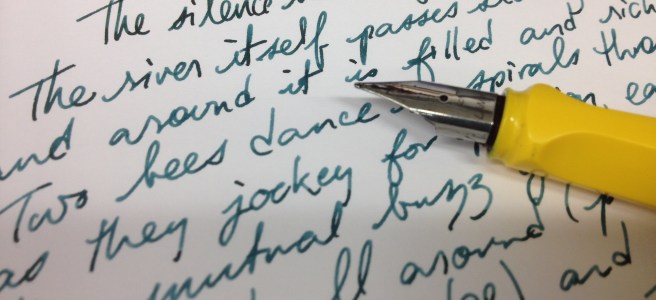
Two bees dance in spirals through the air around me as they jockey for position, each chasing the other in turn. Their mutual buzz grows and shrinks, zips left and right and all around (pauses a moment while they plod along my paddle’s edge), and whizzes about my feet before floating away on a zephyr.

The river is banked on one side by steep cliffs of sand and clay, varying between fifteen and twenty feet above the water. Tall blades of grass gather at the top of the precipice, spectators at the edge of my solitary parade. These are the leaves that Whitman loved, rustling to one another in the hushed tones of the breeze as they watch me float past. A sandpiper hops along beside the water, scratching and pecking at pebbles and sand.

The sky is a clear azure expanse, open and full of possibility. Trees and hills hem it in at the edges in a wide verdant belt, saving my fragile mortal mind from collapsing at the beauty of the whole.

I am completely taken in. My heart aches simultaneously with the blessing of being in this place, and the despair of the impermanence of my experience.  My mind drifts to thoughts of entropy, contemplations of the death and chaos that is such an inescapable part of living and order. Everything tends to chaos. Buildings once firm crumble and fall; lives once full of love and meaning come to end; Nature herself is ever-changing and will, in the end, cease to exist as disorder envelops the world. But could beauty exist without this chaos?

When I fall in love with a painting, it is because I know my eyes cannot rest on it forever that it is able to change and affect me. I gaze on a stunning vista or a lovely face, and seek to change myself, to better myself to have more of this beauty in my life. Were it not for the knowledge of beauty’s fragile nature, I would have no reason to change; no reason to feel touched.

Music’s charm is in the height of impermanence; sound is but travelling waves of energy that by necessity of physics must exist only in one moment and not in the next. We can only enjoy music while it plays, and once it is over enjoy only its memory.

My boat bumps against the side of the cliff and drifts leisurely outward into the stronger current. Today, the river is my guide; its direction is both gentle and strong, and I am content to follow its journey. My paddle is dry in the sun. I have the power to choose my own course and direction—even oppose the flow of the water, and ordinarily I would. But today the river will choose for me, and I will do my best to learn from it.

Ahead, a clump of trees and brush stubbornly holds fast amid the powerful water, having fallen there victim of the river’s fury as it swelled in the spring. The stream babbles and bubbles noisily as it flows over and under and around the logs and twigs, swirling in eddies and churning tempestuously. The river, like time (tempus, you say: the root of tempestuousness), refuses to stop or slow for any earthly obstacle. As I gradually float nearer, it seems I’m headed for the fray. I lower my hands to my paddle, but do not lift it. My boat circles slowly sideways, then backward as it turns in the eddies upstream of the brush.

I’m taken aback by the wonderful view I hadn’t gazed on before: upstream, beyond the cliff face, the land rolls upward in gently sloping hills, clothed in trees and greenery. Mighty poplars stand firmly at the side of a low forest, acquiescing to be swayed only ever so slightly by the fresh westward wind. They solemnly guard the forest behind them from the wide expanse to the left: a brightly blooming field of lemony yellow canola which extends as far as I can see in the other direction before falling from view behind the jutting cliff edge. Beyond the forest lay a soft rolling meadow freckled with grazing Herefords as content to live in this place as I am to gaze upon it.

The logs and brush pass harmlessly by my side, the current of my guiding river having nudged me out of the reach of the tangled snarl.

I consider how often I’ve worried throughout the course of my life, anxiously trying to affect things beyond my control. Many nights I’ve been unable to sleep, my mind racing with one particular concern or another. How many beautiful things have I missed in all my furious paddling?

The sun blazes high overhead, and I can feel its rays bathing my skin in a soothing warmth. Upstream on the water a skiff of ripples dances ethereally, and my grass spectators on the cliff bend gracefully in a wave moving swiftly downstream toward me. All at once I am caught in a warm gust, the straw of my hat rustling and creaking as the brim catches the breeze. It dies down as suddenly as it had started, and the river continues to guide me along around the bend.

A while later I come across a small cove where the current slows and actually turns back on itself before joining again with the main river body. Most of the river rushes past, intent on continuing its circuitous eastward journey, but those parts near the cove are content to take a short rest.

I myself have floated up alongside the cove, and my guide gently pushes me in. My boat lazily turns as I begin my slow upstream journey to the top of the cove. Eventually, I come to a dead stop. The water laps at the side of my kayak, patiently waiting for some small change in the current that might start me moving again. I wait patiently also.

In the middle of the river, where the current is the strongest, the remains of a once-proud tree protrudes from the water like a spear. It is bent low just above the water’s surface, humbled by the river’s endless might. The scars in the wood tell much about its former glory. It is wide at its base, and very long; this tree would have towered among many others. Knots along its length exist as remnants of many powerful branches which would have been clothed with innumerable leaves, rich and green each summer, and glorious in gold and yellow each autumn. Squirrels and birds would have enjoyed many generations in this tree; it would have been the pillar and foundation of their existence: immutable and everlasting.

Its bark and branches are now completely stripped, and its underside is worn completely smooth by the water’s erosion. Its topside, by contrast, is jagged and rough; myriad splinters and shards of wood stab this way and that, evidence of having survived the forceful and dangerous ice floes of the spring thaw. This tree has been allowed to rest near its place of former glory only by virtue of its willingness to be humbled: to part with its leaves and branches and to bow along the water. It has accepted its inevitable aging and death with grace, and remains beautiful.

I turn my gaze back to my peaceful cove, and upward to the cliff face which here hangs out over the water. Roots and twigs dangle from the edge, thirstily reaching to the water below. The sun reflects off the water’s surface onto this overhang, projecting fantastic dancing shapes of light onto the sandy clay.

A tiny bank swallow pokes its head out from a hole in the cliff, checking left, right, up and down before fluttering skyward with a frantic beating of its wings. What a wonderful home you have here, little swallow, I muse. What a wonderful home I have here too.

A small eddy bubbles up beside me from somewhere below, and I am shifted ever so slightly to the side. The current catches me again, and I am gone. I am somewhat reluctant to leave, yet grateful for the impermanence of my stay—that I was blessed to have left while everything was still beautiful.

A short while later I have reached the end of my journey, and I know I must return to the hustle and hurry of the city. Again I am reluctant to have to go; again I am grateful for the impermanence of my stay. It seems to me now that the inevitability of time’s progression and the necessity for change are not so much at odds with beauty and happiness, but are perhaps their essence.

I thank the river for its guidance—both physical and otherwise, and begin the long journey back home.

Music Recording

Another item crossed off the bucket list: record an album.

Over the last month and a half or so, I’ve been working to make recordings of all of the songs I’ve written so far so that people can get a sense of what the songs are supposed to sound like even when I’m not around. I had no idea what the recording process entailed going into the project, and it seemed like it might be an intimidating venture… I mean, shouldn’t you be a professional before recording your music? Apparently, you don’t have to be.
I worked with Copper Cabbage Studios here in Edmonton, and the process was not only painless but actually genuinely enjoyable! Paige was absolutely fantastic to work with: always patient and willing to provide guidance where I was naïve, and a barrel of laughs to boot.
You can listen to any of the tracks over on my Music page, and if you’d like .mp3 copies of any of the songs please contact me and I’d be happy to share!

Which One’s The Robot

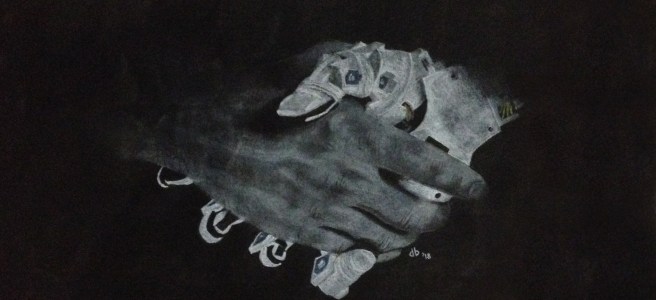
A charcoal and chalk drawing of a human hand shaking a robot hand.

A true story. April 4, 2018

I sat down in the back of the bus today, just like I always do. I was in a good mood, and feeling like I might want to chat with the other commuters, so I sat upright with open body posture. I’ve never actually started a conversation with anyone on the bus, because I’m too concerned about respecting boundaries, and I’m never sure whether anyone else actually wants to talk to me. I’m usually open to having a conversation though, and I’ve found that something in my face or the way I sit must signal to other people that I’m open to it, because occasionally they’ll strike up a conversation—and it’s almost always interesting.

I had just received back a drawing I had done for the Engineering Art Show, and I held it face-up on my lap as though that were the most natural way to transport it, so that it could serve as a conversation starter for someone else should they choose to use it. Beside and to the left of me a few seats away sat a First Nations woman who looked to be in her mid-forties. She wore a pink sweater that seemed like it had seen quite a lot of use, white and black checkered pants, and sneakers that at one time had been white. On the seat beside her was a clear plastic garbage bag, inside of which were a few empty water and pop bottles, and what might have been a change of clothes. She had her right leg crossed over her left knee, and both her hands were continually employed in pulling her foot up closer to her waist as it slid toward the ground.

She pointed at the drawing on my lap, and asked,

“Did you draw that?”

“Yes, I did,” I replied, always happy to receive recognition from strangers.

“What is it?” she asked. I was a bit taken aback, as I had thought that was relatively clear by just looking at it. In my head ran an image of a five-year-old child, pleased as punch with a drawing he had made that no one else could recognize. I turned the picture toward her so that she could see it better, and started to explain what I had drawn.

“It’s a drawing of a robotic hand I designed, shaking hands with a human to symbolize the equal partnership between robots and humans we should see in the future.”

“Oh,” she replied, “It’s very beautiful.”

“Thank you.” I sat back, she sat back, and that was the end of that conversation.

A while later down the road I happened to glance again in her direction and noticed that her face was buried in her sweater, and she was muffling sobs. My face must have had a look of mixed surprise and concern, because the man sitting next to her saw my expression and turned to look at her. He was equally concerned, and put a hand on her shoulder asking her if she was okay. They talked for a few moments, but I couldn’t make out any of what they said. She spoke in very timid tones, just barely audible over the whir of the bus engine.

After a while their conversation was over too. I thought to myself, trying to guess at what the problem might be, and whether there was anything I should do to help her. It seemed as though I should say or do something, but also that it wasn’t my place. I started to think about the social constructs around strangers talking to strangers; what was allowed and what was not allowed, why, whether that was good or bad, and if it needed change how someone might try to do that. Of course, I was barred by my own inability to initiate conversation.

Some moments passed, and she spoke to me again, pointing at the picture.

“You know what that makes me think of?” she asked, as timidly as before.

“What?” I asked, moving one seat over so I could hear her better. It seemed like she needed someone to talk to.

“The Terminator.” She grinned from ear to ear, her eyes disappearing as she chuckled. It was not at all what I wanted to hear, since I’ve built up the Terminator for myself as a societal hurdle we need to get over before we can really move forward in humanoid robotics. I laughed a little with her, then replied,

“Well, I hope the robots in the future are a little nicer than that!” She smiled and nodded. She was only joking after all.

“I think I’m a robot,” she said, not joking this time. Her dark, wet eyes said she was hinting at something a little bit more.

“Why do you say that?” I asked, leaning in to hear better. She looked down at her hands concernedly, as though they weren’t hers. She flexed and unflexed them, splaying her fingers. There was a tattoo of some symbol I didn’t recognize on the back of her left hand.

“I’m a science experiment.” Her voice had a quality of unbearable sadness, like she had made some great mistake she couldn’t fix. I looked at her, confused. Was she suggesting that she was a subject in some drug testing trials? Maybe her own? She said a few more things that I was unable to hear over the sounds of the bus as it left South Campus.

“Why do you say you’re a science experiment?” I asked. I’m not sure what I was hoping for, perhaps to find the reason for her sadness and maybe a way to console her. She pointed at her face.

“Do you see me?” she asked. It looked like she was indicating the fact that she was Native American. I was suddenly painfully aware of the common societal perception and historical treatment of First Nations people, and the fact that only a moment ago my own mind had jumped to the conclusion that she must be on drugs. I wasn’t sure what to say. We sat in silence for a short while. Eventually, I replied,

“You seem fairly human to me. I’d say you’re more than some science experiment, more than some robot.”

She said something again that I couldn’t hear. Her voice was so soft.

We sat again for quite some time without talking. During this time I felt sure that I was there for some reason; I was supposed to say something or do something for her. What did she need?

A while later she spoke again.

“Which one’s the robot?” At first I was confused, then realized she was referring again to my drawing. Then I was confused again; I had thought it was pretty obvious.

“Well, this one,” I replied, pointing at the robot hand in the picture.

“Why do you think that’s the robot? What do you think of when you think of robots?”

“Well, because that’s the one I designed; it’s made of plastic and metal, and sensors and stuff,” I was having a hard time gauging her level of understanding. Finally I clued in that she was talking big-picture. “But…” I thought for a moment, “People tend to think of robots and humans as separate things. That one’s lesser than the other.” I was trying to make a connection back to her feelings about her ethnicity. “But I think… I mean… I hope, in the future, that there won’t be a distinction anymore. I mean, if a thing can think for itself, and if it’s got feelings, then it ought to have the same rights as any other human.” She nodded. She must have picked up on my analogy. Maybe I was helping her?

“You know, I’ve met a lot of robots,” she said.

“Oh?” I asked, “Which ones?” Maybe she knew someone who owned a Roomba or something.

“No. I don’t like to name names.” I nodded as though I understood, but it was another block or two down the road before I did. She was talking about people, about connections. I thought back over our entire conversation, and how she must have had the human condition in mind the whole time while I was talking shop about machinery. I was right, I was meant to be here, having this conversation—but it wasn’t for her, it was for me.

A question entered my mind, but I wasn’t sure I wanted to know the answer. I initiated the conversation this time, for the first time.

“Do you think I’m a robot?”

“Yes,” she replied, without hesitation. She smiled like she had done with her Terminator joke.

“What makes you say that?” I asked.

“Because you draw them. And you believe in them.”

I nodded. With that, my stop was up and I had to get off the bus. I thanked her for the conversation, and we parted ways.

Teacup Still Life

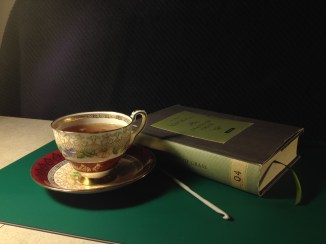
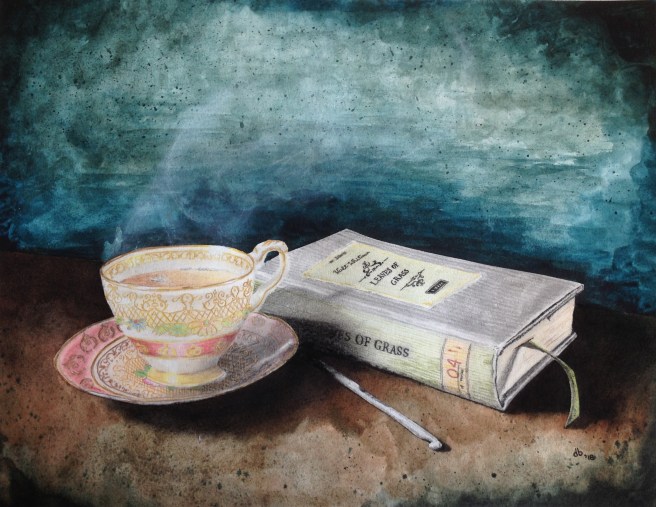
My cousin-in-law commissioned me to paint a still life for her, of a teacup with steaming tea, a crochet needle, and Walt Whitman’s “Leaves of Grass”. The quality of the result surpassed my expectations, and I think that was mostly due to a process I tried. Good artists use this method or one like it all the time, but I’m sometimes a stubborn and cavalier sort of fellow, so I had always thought I could do without it.

Composition and Lighting (~3h)

I started by arranging the items in every way I could think of, paying attention to leading lines, balance, and negative space. Once I found the composition that suited the objects best, I lit the scene using a lamp and a mirror to create dramatic shadows that drew attention to the focal points. I took a picture of the final arrangement and used that as my reference for the rest of the project so my perspective and lighting would be consistent.

Full.JPG
Reference photograph after composition and lighting arrangement

Line Drawing (~2h)

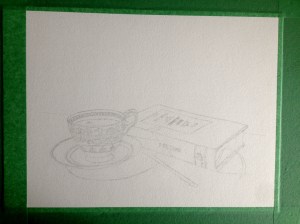
Using a grid overlaid on the reference photo, I carefully drew in the general outline and some details of the objects onto 140 lb watercolour paper with a 4H pencil.


Line Drawing
Line drawing


Background Wash and Steam (~1h)

Knowing the background would need to be dark for the steam to be visible against it, I used a mixture of intense blue and burnt umber, applied with much water in circular strokes with a no. 6 filbert brush. For the table, I used the same intense blue and burnt umber, but with more emphasis on the umber. I think I might have tossed in some burnt sienna as well. To keep the object edges sharp without impinging my free brushstrokes, I masked them off with green painter’s tape. If you use this technique, I strongly recommend de-stickifying the tape first by applying it several times to some cloth surface where it can pick up lint. Otherwise, you’ll end up losing a lot of your paper along with your mask.

The steam was going to make or break this picture (and I wasn’t sure I had the chops to do it well), so that’s what I wanted to get out of the way right from the get-go. If it wasn’t going to work out, I wanted to know that before investing a lot of time in the detailed drawings. I used white charcoal, which seemed to work quite nicely. It’s a little tough to see in these photographs (no steam on left, steam on right), but it looks great in the original. The trick to believable steam is subtlety.

Coloured Pencil Drawing (~7h)

Diligence was my watchword while transcribing the reference photo onto the page. I used a combination of coloured pencils, graphite, and charcoal: coloured pencils for colour (of course), graphite for subtle shading and grays, and charcoal for dark shadows and blacks. Every small detail and subtle change in lighting or shadow I mimicked as best I could, patiently working and re-working areas until I was satisfied. The cup alone took about 4 hours to do.

Erin's Teacup

Some lessons learned:

  • As good as you think you are, you can always learn something from the pros.
  • Working from a carefully taken reference photo is the key to consistent and believable lighting and shadows. Having that photo zoomable on a tablet is fantastic for details.
  • Charcoal and graphite don’t adhere well to the waxy surface of several layers of coloured pencil (note the saucer on the right-hand side; I wanted that shadow darker, but it just wouldn’t take). Do shadows first, colours after.
  • Attack the most difficult parts of the picture first before investing your time in other areas. If something goes irrecoverably wrong, you’ll waste less time.
  • Patience, patience, patience.

Custom Harmonica Watch

If you could have a custom-built watch with any gadgets and gizmos built into it that you could want, what would you include?

Harmonica Watch Finished

When I first had the idea to integrate a tiny harmonica into a wristwatch, I started asking myself this very question. My mind ran the gamut of potentially useful items, creating a list of things including a compass, bits of string, LED flashlights… you name it. Being constrained to some degree by the size of my intended watch, I ended up selecting a few components that I thought might be the most useful to me: a chronometer (of course), a USB memory stick, and a harmonica.

The Chronometer

No wristwatch would be properly complete without a means of telling the time, so this was the first consideration. Without having any of the skill, tools, or means of building my own timepiece, I went for the next best thing: I bought and disassembled a cheap watch from Walmart and appropriated the functional components into the body of the watch I designed and built.

The Harmonica

This was the second consideration. As the spark of the idea that created this project in the first place, the harmonica was certain to earn a spot in the final design. It’s a vintage Hohner Little Lady from some unidentified era (presumably from before they started calling them Little Ladies since there is no etching on it anywhere to indicate that name). This is the same tiny harmonica design that earned the honor of being the first musical instrument played in space, in 1965.

The USB Memory Stick

While these memory sticks are growing somewhat out-of-fashion with the ubiquity of cloud-based storage, I still find them personally useful in a number of situations. And that of course, is the beauty of designing and building your own custom tech. You’re not limited by what the vast majority of consumers might find useful, or by what will be easy to sell. You just get exactly what you want. I pulled this little 2 GB memory stick out of a rubber Speedy Gonzales that I believe originally came from Staples.

Design and Build

The watch is designed to be built from four layers of woComplete-Assemblyod, that when glued and screwed together create the cutouts necessary for all the pieces to fit in properly. Both the harmonica and USB stick are held in place using friction fits, which actually turned out remarkably well given my limited experience with woodworking projects. If you’re planning on making your own watch or something similar, I recommend cutting your pieces very slightly larger than required and sanding down, testing the fits as you go until you’re satisfied.

The drawings for all of the wood parts and for the assembly of all the pieces can be found here: Casing Drawings.

It has been quite a fun project, and to be honest I wasn’t sure at any point during the process that I had the skill or ability to be able to pull something like this off. There are a few things that I might change in a re-design if I ever come back to it, and a few things that didn’t turn out quite as I’d hoped (notably two screws in the back shearing off meaning I can no longer change the battery without drilling them out), but overall I’m pleased with the final product. I guess it just goes to show that just because you don’t think you can do something doesn’t mean you can’t try. You may surprise yourself… I did.

Wings

In the process of going through my old artwork to include on this website, I came across a series of three paintings I had done way back in grade 10 or so, that I hadn’t realized at the time went quite well together.

Once I finally saw all three side-by-side I was struck with the idea that together, they could create something more meaningful than the sum of its parts. A little bit of digital photo-editing later, and the three paintings merged to become something of a panoramic storyline, which I like to call “Wings”.

Wings

I remember the first time I came across the word “serendipity” was during one of my art reviews for that class, as my teacher, Ms. Miller, was describing some good artistic choices I hadn’t realized I’d made for some other project. It’s interesting how nine or so years later that same word comes back along with the memory of creating these paintings for the first time.