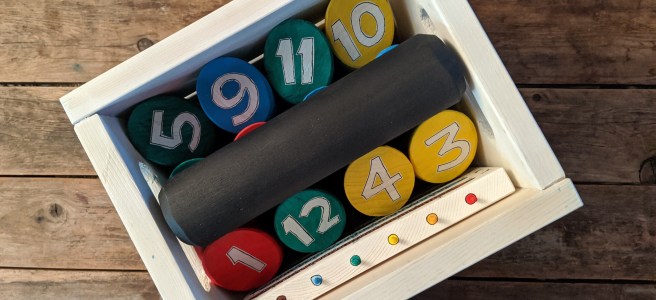
DIY Mölkky Set

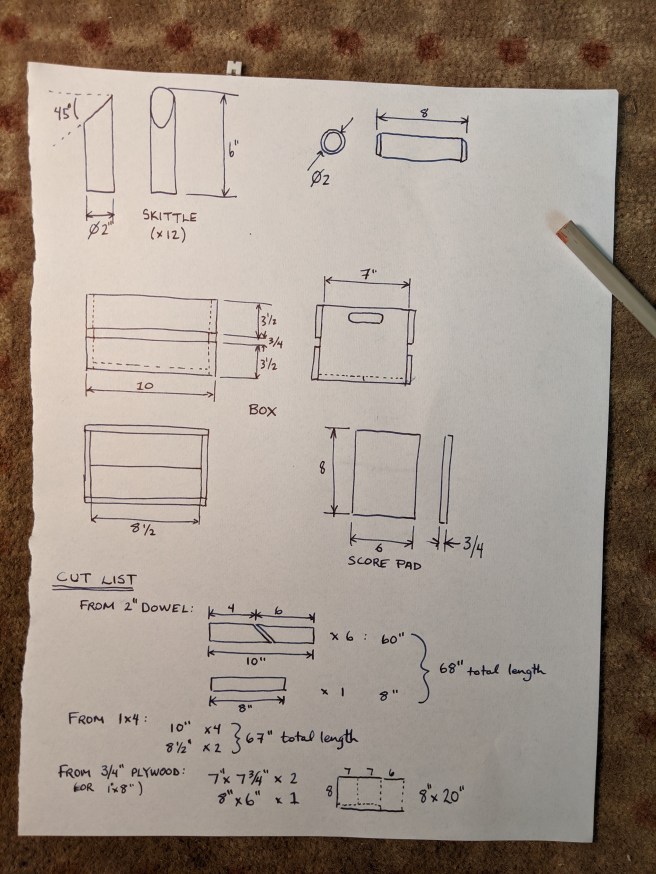
Step 1: The plan. Always a good place to start.

I looked up the rules and regulations, and poured a little bit of brain-juice out through my pen onto some paper. With that bit of compulsive engineering out of the way, I was ready to start pulling materials together.
img_20200704_160638

Step 2: Procure materials.

The cut list in the plan lays it all out, and I’m happy to say the final result didn’t end up deviating from the plan in any major way. It also didn’t break the bank.
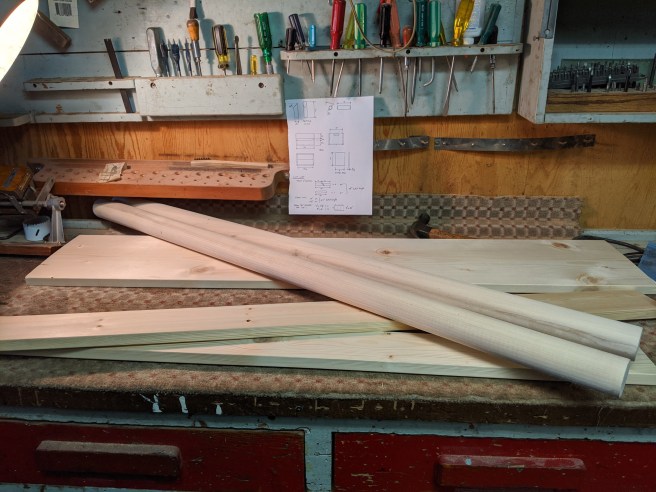
img_20200704_160838

Step 3: Cut the skittles.

You’ll need a sharp knife and a steady hand. Oh wait, not that kind of skittles. First cut the dowel to six 10″ lengths.
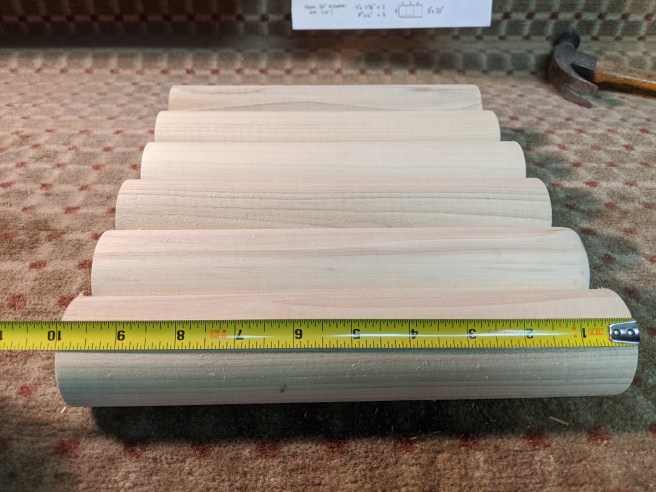
img_20200704_161245

Then cut those lengths directly in half at a 45 degree angle. This leaves the high side of the skittle at 6″, and the low side at 4″.
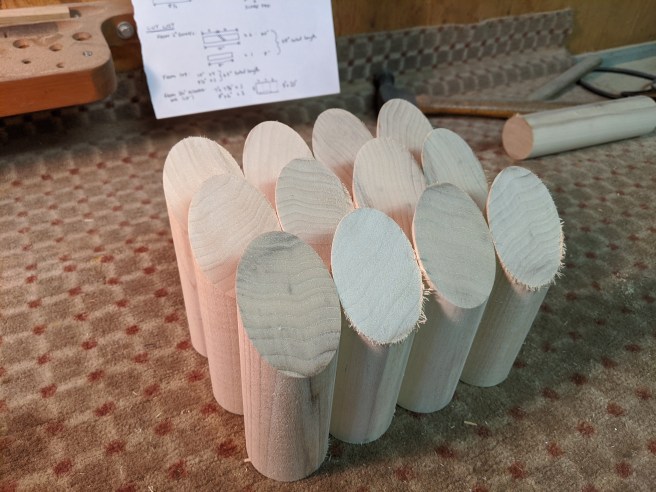
img_20200704_161741

Step 4: Cut the Mölkky.

This step is pretty easy. One cut, 8″.
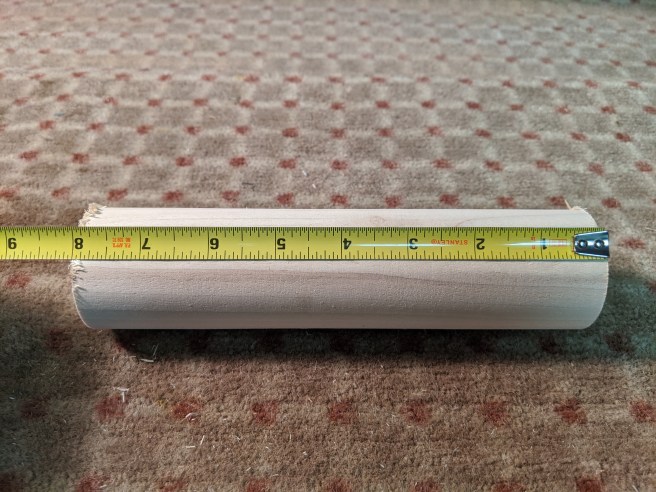
img_20200704_161307

Step 5: Cut the box boards and the scorepad.

Nothing too fancy here. The 1″ x 4″ pieces are as follows: four at 10″, and two at 8 1/2″. From your larger piece (I used a 1″ x 10″ board), cut one scorepad to 8″ x 6″, and two box-sides to 7″ x 7 3/4″.

Step 6: Cut the handles.

Into the box-sides, cut a one-inch wide slot an inch down from the top of the board. Remember that the top side is the narrow (7″) edge. I started with two 1″ holes at the 2″ and 5″ marks, then completed the slot with a hacksaw and file combination. There are cleaner ways, but my scrollsaw was out of commission.

Step 7: Make some dust.

At this stage I sanded out all the major defects, tool marks, etc. and rounded all the sharp corners. Very glad I sprang for the belt sander a while back.

img_20200704_175026

Step 8: Build the box.

Wood glue, clamps, and finishing nails were my tools of choice to put the box together. I set it up so that the bottom boards are held to the sides by nails in shear rather than pull-out tension. Not that the Mölkky set itself needs a lot of strength, but in my experience crates tend to get repurposed.

Step 9: Drill many many holes on the scorepad.

Mark it out, punch a guide, then drill… 362 times. If you do one a day, you’ll be done in less than a year.

Without a drill press, I needed a good way to consistently and quickly get the right depth, as these aren’t through-holes. I drilled through a short length of dowel, until my drill bit extended only as far as I wanted the holes to go. Then I drilled the holes with the dowel shrouding the drill bit, and keeping it from going too deep. I used 9/64″ holes to fit 1/8″ dowel pegs. The holes are 1/4″ on-centre from each other at a minimum.

Step 10: Cut the pegs, and make storage holes for them.

1″ long bits of 1/8″ dowel work for pegs, and holes in the sides of the scorepad serve to store them.

Step 11: Do a snazzy paint job.

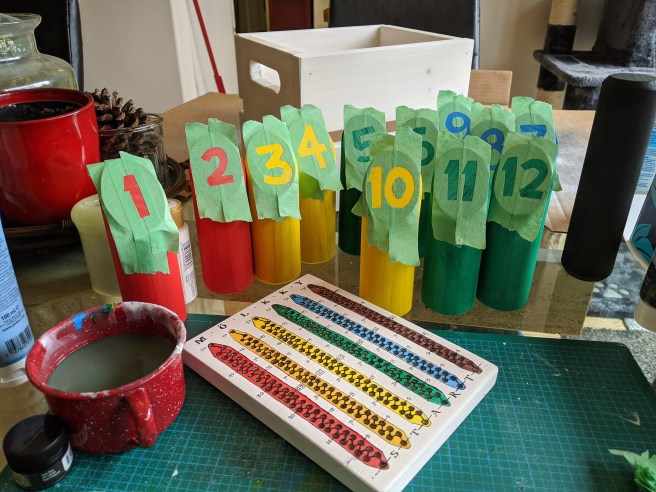
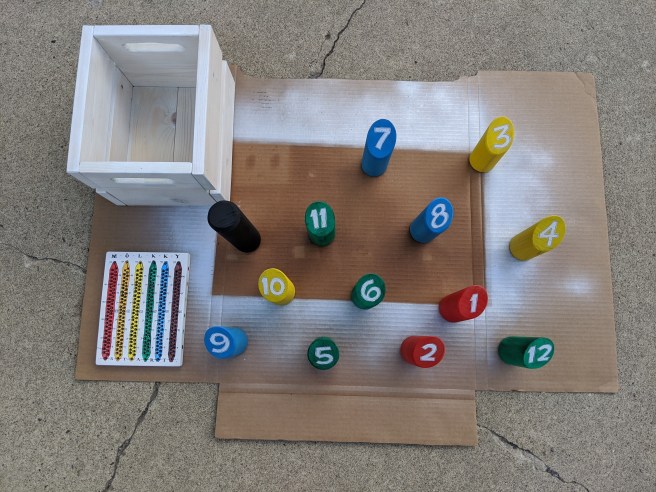
I went for white on the box, bold colours on the skittles, and black for the Mölkky. All painted with craft acrylics and a paintbrush. For the detailed inking for the scorepad I pulled out the pen-and-ink. Are there faster ways to do this? Sure. But turtles live an awfully long time.
img_20200705_124045

Step 12: Follow the rules.

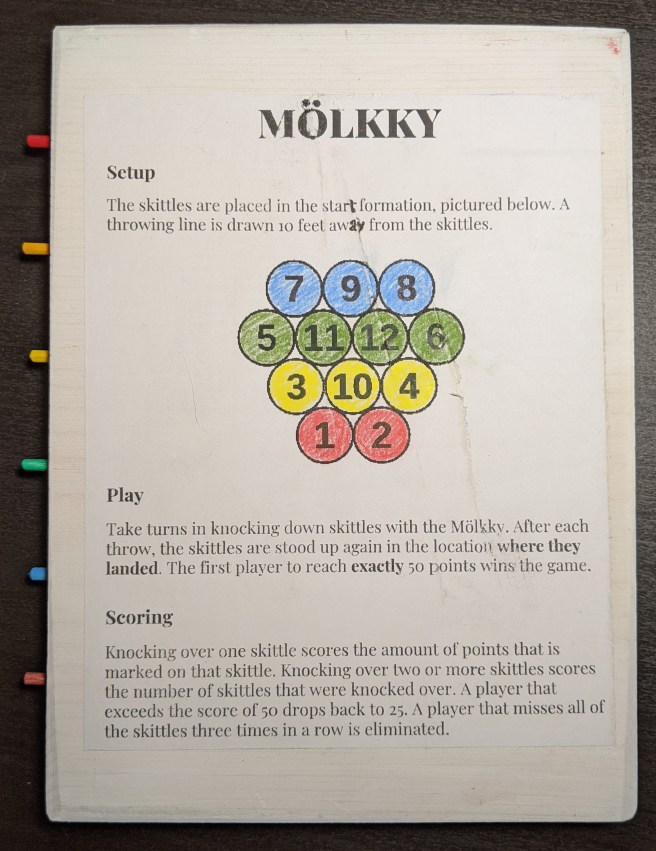
I printed out a rule sheet, and pasted it onto the back of the scorecard with watered-down white glue. That way it’s always there when you need it for the inevitable dispute.

I’m not too happy with the wrinkles that came as a result of the water-and-paste method. I guess that’s what you get for going too fast.
Rules

Step 13: Spray a clear coat.

Last step is to spray everything down with a clear-coat, to keep things nice as long as possible.
Spray ClearCoat

And that’s a wrap.

It fits neatly into a the box, and has everything you need to play!

DIY PickleBall Paddle

Here’s a quick how-to recipe for making your own pickleball paddle! Bear in mind that, as much as I strive to stay within regulations, homemade paddles are not permitted for “official” play. But we’re just building and playing for fun anyway.

Step 1: Cut out paddle

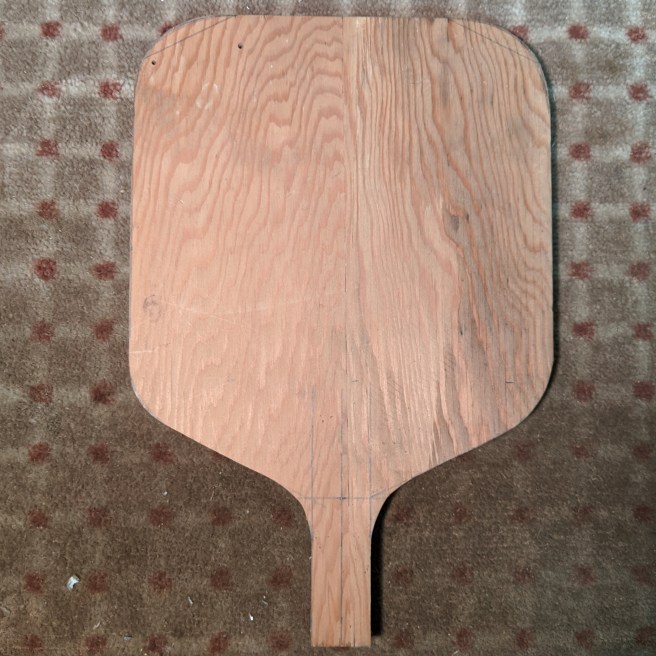
Using a scroll saw, I cut out the main paddle shape from a scrap piece of 3/8″ plywood. Officially speaking, it seems like just about any shape is allowed, as long as the combined length and width don’t exceed 24″, and the paddle length doesn’t exceed 17″.

img_20200216_114421

Step 2: Cut out the handle

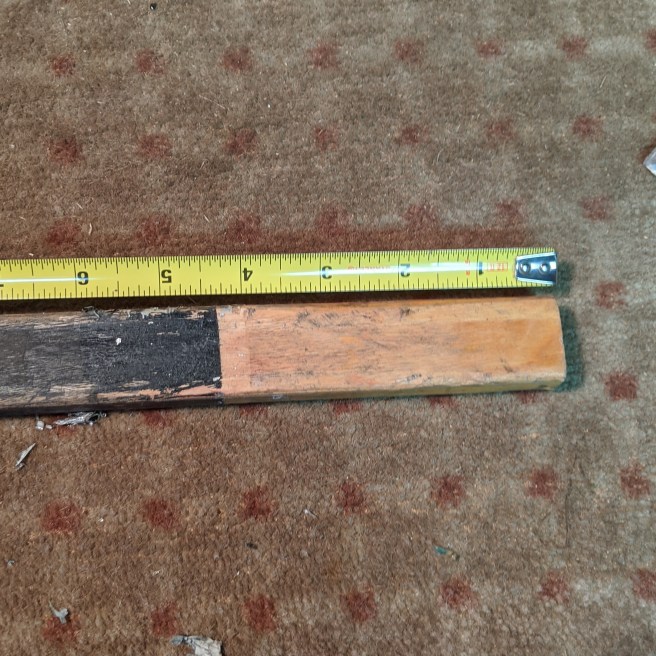
I fashioned a handle from an old hockey stick I found in the garage. 6″ does the trick for my hand.

img_20200216_114434

Step 3: Cut the handle notch

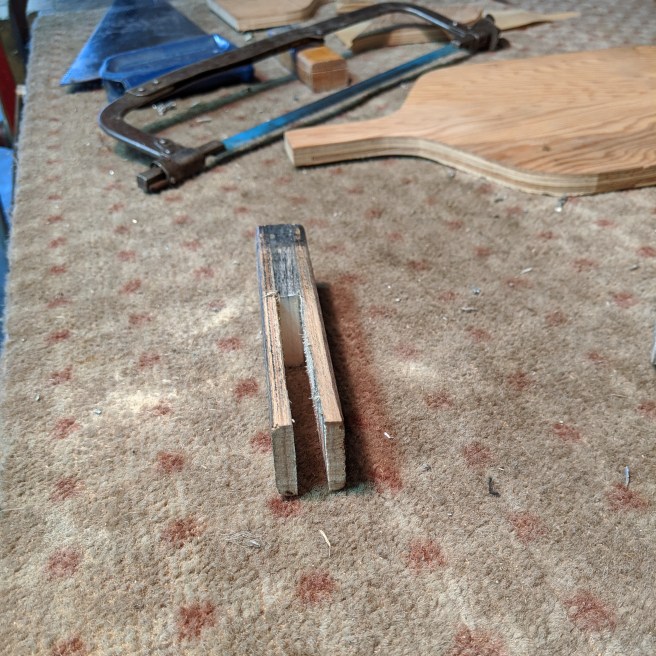
I cut a notch down the centre of the handle, where the paddle slips in. I used a hacksaw for the cut, then cleaned it up with a flat file.

img_20200216_122700

Step 4: Attach the handle

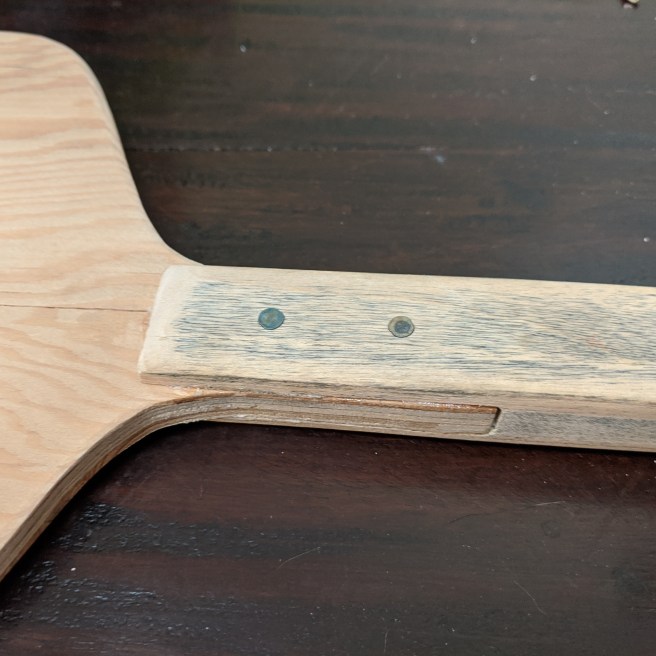
I used a bit of wood glue between the faces, and two small nails to make absolutely sure the paddle doesn’t go flying off. That would definitely not be regulation.

img_20200216_183207

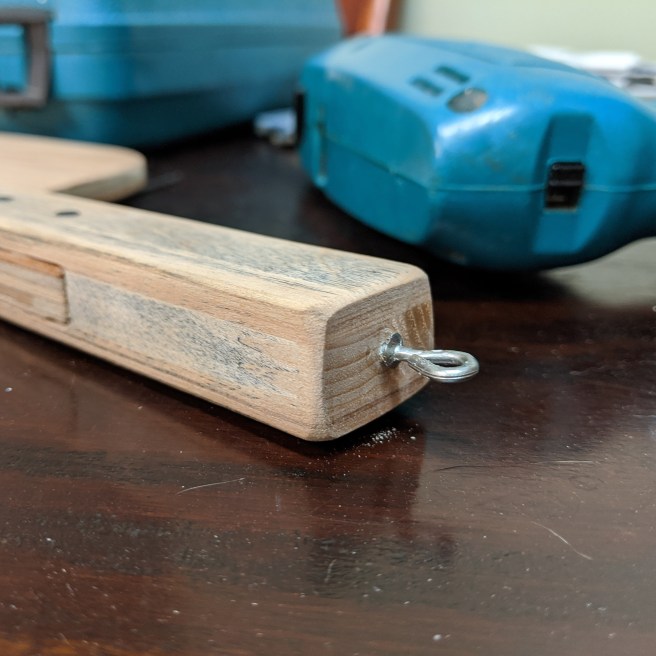
Step 5: Add a hook for the wrist strap

Just a simple hobby-store hook, screwed into the butt end of the handle.

img_20200216_183759

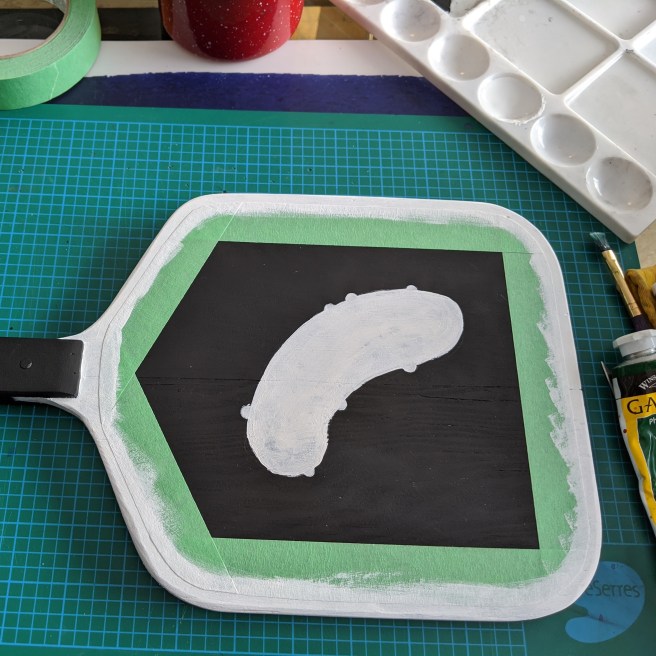
Step 6: Snazzy coat of paint

Of course, before painting, sand down everything smooth. And bear in mind for whatever type of finishing you do, the maximum roughness is 40μm peak-to-valley. If, like me, you made this with plywood you’ll never get to regulation roughness. However, if, like me, you made this yourself you’re out of regulation already anyway.

img_20200217_100200

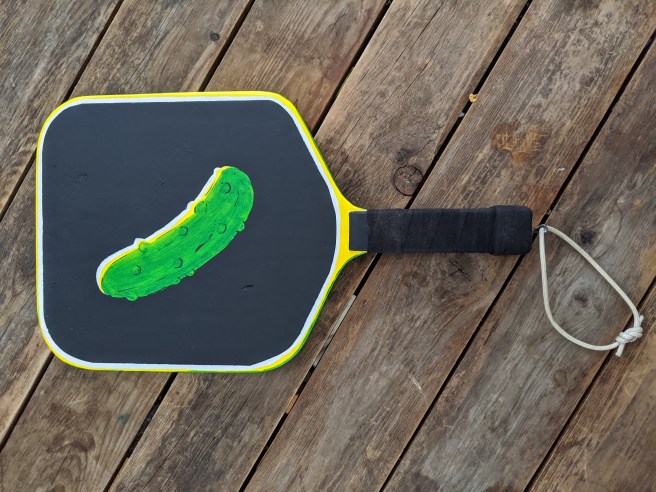
Step 7: Handle grip and… you’re done!

A couple of layers of hockey tape, a bit of string for the wrist strap, and you’re off to the court!

img_20200217_164442

Robot from Household Trash

A few months ago, the New Trail magazine contacted me with an interesting request: They wanted me to design and build a robot out of household trash. At the time, I was right in the middle of writing my thesis, so of course, I jumped at the opportunity for something else to work on.

In order to be able to call the thing a robot, I figured it needed to take in some information about its environment, and change its behaviour based on that input. Making this thing out of household trash and salvaged components meant that I would have to keep it simple… but as with most of my projects, my ideas tend to run away with themselves.
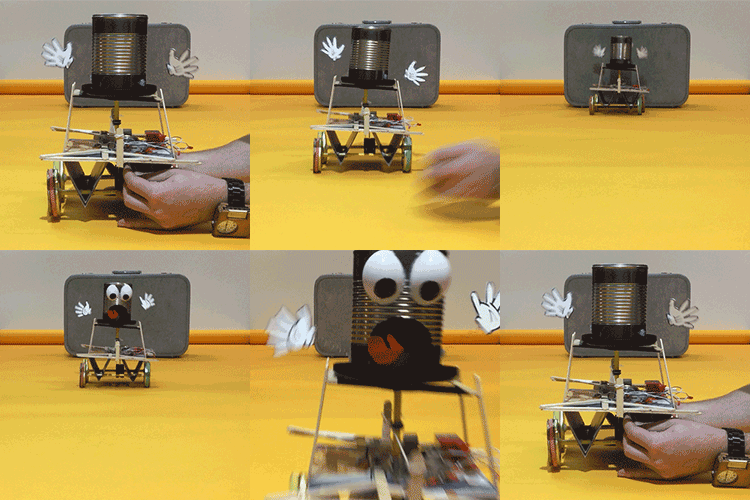
NTD-02-19-Robot-Run-250x250

This little guy has bump sensors on either side made from popsicle sticks and carefully placed tin-foil electrical contacts that allow it to switch directions and run the other way whenever it runs into something. The tin-can body turns around based on the same input, using the mechanical linkage to spin a central pencil axis.

The New Trail has issued a challenge to anyone who wants to try building one of their own, and they’ve put together a nice assembly manual for the project as well. If you do end up attempting a build, I will make one suggestion: have lots of glue on hand. The article isn’t joking when it says I used a lot of glue.

Photo and video courtesy of New Trail Magazine.

Guitar Refinishing

About four or five years ago, I bought an old electric guitar mostly because it was really cheap and I didn’t have an electric one yet. However, the previous owner had coated it in gaudy, sparkly stickers which refused to come off without leaving gobs of glue behind, and the receiver for the whammy bar was cracked badly enough that it couldn’t be used at all. It was fun to play around with for a while, but never really got much use because it was in such a state of disrepair. Then a few weeks ago I picked it up again, tried to tune it, and broke a string.  Like a hardened drug addict, this guitar had to hit rock bottom before it was going to admit it had some problems.

At first I thought I’d just replace the broken string. Then I figured why not change the set? Keep things consistent. Then I thought hey, while these strings are off I should probably get rid of all this glue residue. To do that properly I had to take off the knobs and covers. Once those were off, it only made sense that I fix the whammy bar receiver while I was inside… before I knew it, I had a full-blown restoration project.

IMG_2965.png


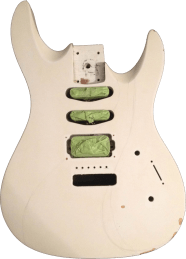
The sticky residue was the first hurdle to overcome, but a little bit of nail polish remover and some elbow-grease did the trick nicely.


IMG_2966


Once the glue was off, I couldn’t ignore the fact that this clean white body was a canvas waiting to be painted with something more expressive… and so the project grew yet again.


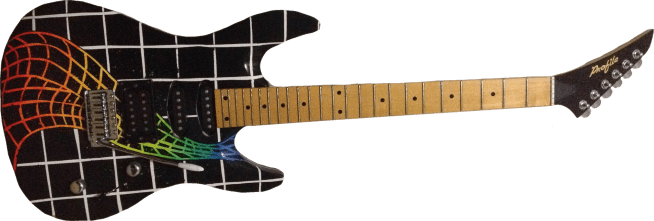
I wanted the design to be mainly black to match the already black head, and I also wanted it to be somehow related to music without being trite or over-done. What I eventually settled on is a symbol of music bringing colour and variety to an otherwise rigid and mundane world. I first painted the rainbow motif across the centre using acrylic paint, then masked off the grid using green painter’s tape cut to approximately 1/8″ thickness. After masking, I painted the entire guitar black. Finally, I sprayed on a droplet rainbow using the acrylics mixed with water by flicking the tip of my paintbrush. Once I took off the mask, I sprayed the whole thing with many layers of clear glaze topcoat.

The whammy bar receiver was originally cast iron, and very brittle. I fashioned a new one from an old piece of angle-iron and a welded-on nut, then spray-painted the whole thing to help prevent rusting.

IMG_2973.png

Once everything was put back together I took her out for a spin and was quite pleased with the results! Riffing with this guitar felt like putting a new spirit into old bones—and within a short time, I think I was able to do the same thing for one of my old poems. The Startled Eye of Passer-By is a poem I wrote back in 2014 (around the same time I bought this guitar, coincidentally), which may be coming to life again soon as a song: one refinishing project brought on by another.

Teacup Still Life

My cousin-in-law commissioned me to paint a still life for her, of a teacup with steaming tea, a crochet needle, and Walt Whitman’s “Leaves of Grass”. The quality of the result surpassed my expectations, and I think that was mostly due to a process I tried. Good artists use this method or one like it all the time, but I’m sometimes a stubborn and cavalier sort of fellow, so I had always thought I could do without it.

Composition and Lighting (~3h)

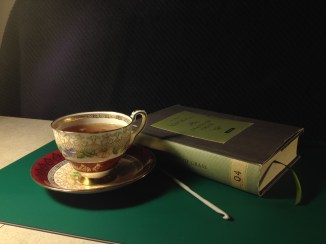
I started by arranging the items in every way I could think of, paying attention to leading lines, balance, and negative space. Once I found the composition that suited the objects best, I lit the scene using a lamp and a mirror to create dramatic shadows that drew attention to the focal points. I took a picture of the final arrangement and used that as my reference for the rest of the project so my perspective and lighting would be consistent.

Full.JPG
Reference photograph after composition and lighting arrangement

Line Drawing (~2h)

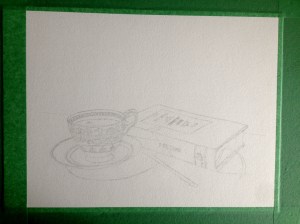
Using a grid overlaid on the reference photo, I carefully drew in the general outline and some details of the objects onto 140 lb watercolour paper with a 4H pencil.


Line Drawing
Line drawing


Background Wash and Steam (~1h)

Knowing the background would need to be dark for the steam to be visible against it, I used a mixture of intense blue and burnt umber, applied with much water in circular strokes with a no. 6 filbert brush. For the table, I used the same intense blue and burnt umber, but with more emphasis on the umber. I think I might have tossed in some burnt sienna as well. To keep the object edges sharp without impinging my free brushstrokes, I masked them off with green painter’s tape. If you use this technique, I strongly recommend de-stickifying the tape first by applying it several times to some cloth surface where it can pick up lint. Otherwise, you’ll end up losing a lot of your paper along with your mask.

The steam was going to make or break this picture (and I wasn’t sure I had the chops to do it well), so that’s what I wanted to get out of the way right from the get-go. If it wasn’t going to work out, I wanted to know that before investing a lot of time in the detailed drawings. I used white charcoal, which seemed to work quite nicely. It’s a little tough to see in these photographs (no steam on left, steam on right), but it looks great in the original. The trick to believable steam is subtlety.

Coloured Pencil Drawing (~7h)

Diligence was my watchword while transcribing the reference photo onto the page. I used a combination of coloured pencils, graphite, and charcoal: coloured pencils for colour (of course), graphite for subtle shading and grays, and charcoal for dark shadows and blacks. Every small detail and subtle change in lighting or shadow I mimicked as best I could, patiently working and re-working areas until I was satisfied. The cup alone took about 4 hours to do.

Erin's Teacup

Some lessons learned:

  • As good as you think you are, you can always learn something from the pros.
  • Working from a carefully taken reference photo is the key to consistent and believable lighting and shadows. Having that photo zoomable on a tablet is fantastic for details.
  • Charcoal and graphite don’t adhere well to the waxy surface of several layers of coloured pencil (note the saucer on the right-hand side; I wanted that shadow darker, but it just wouldn’t take). Do shadows first, colours after.
  • Attack the most difficult parts of the picture first before investing your time in other areas. If something goes irrecoverably wrong, you’ll waste less time.
  • Patience, patience, patience.

Custom Harmonica Watch

If you could have a custom-built watch with any gadgets and gizmos built into it that you could want, what would you include?

Harmonica Watch Finished

When I first had the idea to integrate a tiny harmonica into a wristwatch, I started asking myself this very question. My mind ran the gamut of potentially useful items, creating a list of things including a compass, bits of string, LED flashlights… you name it. Being constrained to some degree by the size of my intended watch, I ended up selecting a few components that I thought might be the most useful to me: a chronometer (of course), a USB memory stick, and a harmonica.

The Chronometer

No wristwatch would be properly complete without a means of telling the time, so this was the first consideration. Without having any of the skill, tools, or means of building my own timepiece, I went for the next best thing: I bought and disassembled a cheap watch from Walmart and appropriated the functional components into the body of the watch I designed and built.

The Harmonica

This was the second consideration. As the spark of the idea that created this project in the first place, the harmonica was certain to earn a spot in the final design. It’s a vintage Hohner Little Lady from some unidentified era (presumably from before they started calling them Little Ladies since there is no etching on it anywhere to indicate that name). This is the same tiny harmonica design that earned the honor of being the first musical instrument played in space, in 1965.

The USB Memory Stick

While these memory sticks are growing somewhat out-of-fashion with the ubiquity of cloud-based storage, I still find them personally useful in a number of situations. And that of course, is the beauty of designing and building your own custom tech. You’re not limited by what the vast majority of consumers might find useful, or by what will be easy to sell. You just get exactly what you want. I pulled this little 2 GB memory stick out of a rubber Speedy Gonzales that I believe originally came from Staples.

Design and Build

The watch is designed to be built from four layers of woComplete-Assemblyod, that when glued and screwed together create the cutouts necessary for all the pieces to fit in properly. Both the harmonica and USB stick are held in place using friction fits, which actually turned out remarkably well given my limited experience with woodworking projects. If you’re planning on making your own watch or something similar, I recommend cutting your pieces very slightly larger than required and sanding down, testing the fits as you go until you’re satisfied.

The drawings for all of the wood parts and for the assembly of all the pieces can be found here: Casing Drawings.

It has been quite a fun project, and to be honest I wasn’t sure at any point during the process that I had the skill or ability to be able to pull something like this off. There are a few things that I might change in a re-design if I ever come back to it, and a few things that didn’t turn out quite as I’d hoped (notably two screws in the back shearing off meaning I can no longer change the battery without drilling them out), but overall I’m pleased with the final product. I guess it just goes to show that just because you don’t think you can do something doesn’t mean you can’t try. You may surprise yourself… I did.