Hammock Philosophy

I was doing some thinking. Thought I’d jot down some thoughts here in an unstructured and largely unedited way, mostly just so that I wouldn’t forget them. Perhaps best to not put too much stock into anything.

Philosophy is best done from a hammock in the shade of an apple tree. Ideally with a cool beverage.

This one strikes me as a no-brainer. No explanation needed, no explanation offered.

Do it well, not fast.

The inspiration for this one, I think, comes from Robert M. Pirsig’s Zen and the Art of Motorcycle Maintenance. Since I read it about two years ago, I’ve been thinking often about the concept of Quality, and what that means for me. I think it’s always been something I’ve held in high regard, but I never really had a name or a concrete conception of it until reading ZAMM. It’s a notion of taking the time to work with something until it’s right; understanding and accepting when it’s not, and continuing to work with it.

I also read through a good chunk of Analog Circuit Design: Art, Science, and Personalities, edited by Jim Williams (a surprisingly entertaining read). A number of the engineers that wrote articles for that compilation referred to an ancient electrical engineering analysis technique known as the “what if?” method. Essentially, to analyze a circuit, the engineer would consider “what would happen at point a if I applied voltage x at point b” for all possible combinations of a, b, and x. They would answer the question for themselves theoretically before running the test, and any discrepancy, even due to measurement error, had to be thoroughly understood and explained before the circuit was considered completely analyzed. The description of such a process made EE sound like a beautiful and pure form of the scientific method. There were many tales of engineers that would skip the process would have their ICs out the door quicker, but inevitably end up with unexplainable failures. Understanding every little detail of the system, and having the patience to turn over every stone before moving on to the next field seems to me to represent scientific inquiry in its highest and purest form.

Before closing this section, I’d like to breathe a word of caution against perfectionism. Here, when I speak of Quality, and doing things well, I speak of taking the time to truly understand the thing you’re building or doing. Iteration on an idea or prototype is not just a necessary evil–it’s a good thing. It helps build the understanding. And the understanding is, I think, what we’re really here for. Cogito ergo sum, and all that jazz.

Time is relative anyway; don’t let it push you around.

I’ve been reading Your Brain is a Time Machine by Dean Buonomano. A great read so far, and has really got me thinking a lot about time. Coincidentally, I’ve also been reading Stephen Hawking’s A Brief History of Time, which also offers a number of mind-bending considerations.  One note that struck me from Buonomano’s book, was a quote from the Roman poet Plautus, from the 2nd century BCE:

The gods confound man who first found out / How to distinguish hours! Confound him too / Who in this place set up a sun-dial, / To cut and hack my days so wretchedly / Into small pieces! When I was a boy, / My belly was my sun-dial–one more sure, / Truer, and more exact than any of them. / This dial told me when twas proper time / To go do dinner, when I ought to eat; / But, now-a-days, why even when I have, / I can’t fall to, unless the sun gives leave. / The town’s so full of these confounded dials…

If poets were lamenting the oppressive control of the clock and meeting schedules back in the 2nd century BCE, what hope do we have now that we can measure and break down our days with an accuracy of 10e-18 seconds? Well, as it turns out, when you can measure time that accurately you realize it’s actually relative. Even objective, scientific time depends on you–where you are relative to other massive objects and how fast you’re going. So don’t let it push you around.

You only control You. Only you control you.

The first half of this one I heard iterated many times from my 6th grade teacher, Mr. Manson. I recently read it echoed through Stoic philosophy, which I can only assume is where Mr. Manson got it from. I came across the Stoics in a particularly good read: A Guide to the Good Life: The Ancient Art of Stoic Joy by William B. Irvine. Don’t let the title throw you off; it’s not actually cheesy. Essentially the crux of this one (for me at least) is that if you’re setting goals for yourself that are based on other people, you’re in for disappointment. While in the hammock this afternoon I realized that an implicit goal I had been working toward, and that had been giving me a lot of stress, was that I wanted to do meaningful work, and be respected for the contributions I make. Trouble is, how do you measure “meaningfulness” in your work, especially before it’s had a chance to do anything in the world? And how do you control whether other people respect your work? Bad goals. Much better would be just to focus on doing work of high Quality. Do that right, and meaningfulness and respect are sure to follow.

The second half of this one came to me as I was writing down the first half. I haven’t thought it all the way through just yet, but it seems like there might be something to it.

Let it come with time.

You don’t have to have all the answers right away. Jot it down, come back to it later. Or let someone else come back to it. The answers won’t all come even within your lifetime, so don’t worry about having them all right now.

One thing that struck me while reading A Brief History of Time was that it appeared that Einstein didn’t really grasp the full implications of his general theory of relativity when he published it. Only when other people read it did they make connections with other areas of physics, and realize the full implications. If Einstein doesn’t know it all, who does?

A thing born quickly dies quickly.

I was thinking about what the meaning of life might be.

My thoughts wandered back to the Musee Mechanique that I visited in San Francisco almost exactly a year ago. There you’ll find loads of wonderful antique arcade machines, music boxes, player pianos, etc. In a few places around the museum, tacked up with scotch tape, were inkjet signs on 8 1/2 x 11 paper, reading:

PLEASE BE CAREFUL. SOME OF THESE MACHINES ARE OLDER THAN YOU WILL EVER BE.

Something about the message hit me in just the right place. That means the machines are also older than their creators ever got to be. At the same time that I was in San Francisco, Alex was touring Japan. She had told me about some sacred floorboards that had been stained with the blood of samurai who had committed seppuku around 700 years ago.

This all lead me to thinking about how the actions you take in your life have effects and leave artifacts that last far longer than you do. So a thought that I’ve been rolling around but haven’t fully committed to is the idea that the meaning of life is to do meaningful work. A bit of a tautology here, and the idea hinges on a precarious definition of “meaningful”. But throughout our lives we spend our energy doing things. Bringing order out of the entropy. Entropy works to undo whatever we’ve done, and largely succeeds–except at unravelling the things that other people have found meaningful. Do a thing really well, and people will work to maintain it despite the natural destructive forces of the world. Have an idea that’s really good, and other people will work with it and riff off it.

In order to do a thing well, you have to take your time. In order for the thing to live longer than a short while, it has to be made well. So, in summary, a thing born quickly will die quickly also.

Pleasure has merit also. Its danger, like anything else, comes in arriving at it too quickly.

Having not found a satisfying answer for the meaning of life, I decided to consider the flipside of the coin to see if there might be anything useful over there. Maybe there’s no point in doing meaningful work. Any advances you make that aren’t disintegrated into entropy will be buried under still more thirst for development. If your life’s meaning is tied up in helping other people, you have to at some point wonder what’s the point of their lives? To help everyone else, or you? So the point of humanity is to help humanity? Maybe. But perhaps dissatisfying. What if the point of life is just to enjoy it?

If we take that to an extreme, and imagine a person living solely for their own hedonistic pleasures, we quickly conjure up a caricature of someone lying to, stealing from, and abusing other people, while maximizing the frequency with which they participate in drug abuse and sex. Quickly we can imagine this person living a short an unsatisfying life full of hatred and fear.

But what if we didn’t take it quite so extreme? What if a person maximized their long-term satisfaction and happiness, rather than a short-term hedonistic pleasure? How would a person do that? Cultivate meaningful relationships, work hard at things they’re passionate about, plan for the future, and take time in each moment to soak up all of the pleasure that it might contain. This seems not only not dangerous, but beneficial.

My takeaway here is to plan and be responsible for long-term pleasures and satisfaction. In the meantime, take some time to enjoy whatever comes your way. Spend some time in your hammock. It’s nice.

Turtles live an awfully long time.

That they do. Jonathan was born in 1832.
 

The Day I Almost Died

The following story I wrote and performed for Edmonton’s Story Slam. It’s a wonderful organization and a great event; for anyone interested in telling or listening to stories, I recommend you check them out: www.edmontonstoryslam.com

The story I’m going to tell you is from back when I was four, living on a cattle farm just west of Morinville. Now, when you’re four years old, you perceive the world a little bit differently than the adults around you do. The way my parents tell the story is simply this: my dad took me and my older sister out on the skidoo one day to check the cows, and when we drove over a bump, she and I fell off the back (no injuries sustained). While dad circled back to pick us up again, one of the cows might have looked in our direction.

But that’s not the way I remember it.

What I’ll tell you now is my recollection of the story, exactly as my four-year-old self would have wrote in my journal—if, of course, I had been able to write at the time.

Dylan’s log: January 15, 1998.

I almost died today.

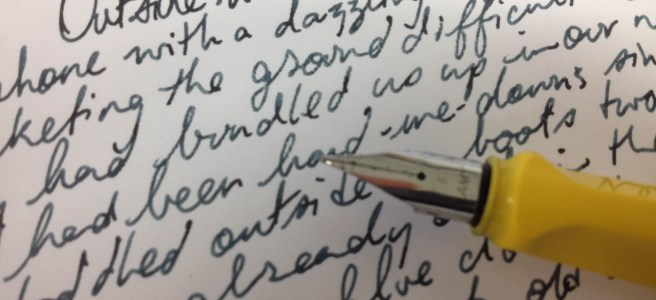
Outside was a treacherous cold, but the bright blue sky shone with a dazzling light that made the snow blanketing the ground difficult to look at for long. Mom bundled us tightly in our neon snowsuits that had been hand-me-downs since the ’80s, and we toddled outside in boots two sizes too big. Dad was already out in the driveway amid a thick blue cloud of smoke, trying to convince the rusty old snowmobile to start. With just a few more tugs on the frayed pull-cord, a rattle and a bang, we were off! We putzed across the yard at an easy five miles an hour toward the field, and I hollered in excitement, “Faster, faster!” Dad chuckled to himself as he patted the hood of the skidoo with a heavy mittened hand, saying, “I dunno if these squirrels can handle much more than this.” I never knew that’s how skidoos worked, but I guess it makes sense. The squirrels underneath the hood chattered noisily to themselves as they ran in their hamster wheels, and as we crossed into the field Dad bellowed loudly, “Cumbos, cumbos, cumbos!” I’m told that translated, cumbos literally means, “Come, boss!” and is the call used by old cowboys to draw the lead cow nearer. Wherever the boss cow goes, the rest of the herd is sure to follow.

We were just coming up alongside the herd when Laura and I were bucked off the back of the skidoo with violent suddenness and landed in a pillowy snowdrift. I looked around at first in dazed confusion, then immediately noticed that the skidoo was continuing to plug along away into the distance. Dad was completely unaware that we had fallen off. Laura sat bolt upright in the snow, eyes wide with fear as she pointed over my shoulder. “Look Dylan! Run!” she wailed, and took off toward the fence. I turned to look behind me and saw the deep, black eyes of the boss cow glowering in my direction, steam rising from her nose as her hoof pawed the ground. I scrambled to my feet and turned to the fence. The vast field stretched out before me endlessly; the safety of the other side must have been ten miles away. Laura was already halfway there. I ran as fast as my short legs would carry me, but the snow was very deep and filled my boots with every step as I sank as deep as my knees. My toque kept sliding down over my eyes, clouding my vision with darkness and my mind with fear. I didn’t dare look back, but I could hear the thunder of a thousand hooves as the rest of the herd joined in the boss cow’s mad charge. “Run, Dylan, Run!!” Laura called, both of her arms waving me in from the other side of the fence. I tripped on one of my laces and tumbled face-first into the snow. I scrambled to my feet again, but this time disoriented—which way was the fence? I couldn’t see through the snow caked over my eyes.

The hot, rank breath of the boss cow filled the air around me, and the ground trembled with the closeness of her hooves. I frantically wiped the snow away from my eyes and squinted in the brightness of the sun. The fence was too far. Boss cow was too close. I would never make it! I stumbled backwards and fell again, this time unable to pick myself up like a turtle on its shell. Then, over the crest of the hill, the rusty old skidoo came screaming out of a cloud of smoke. The squirrels howled with effort like they’d never howled before as they raced toward me at fifty—no—a hundred miles an hour. And above the thundering hooves, above the screeching engine, soaring on the wind like the battle-cry of Tarzan among the apes, came the call: “Cumbos, cumbos, cumbos!” Dad zoomed past the boss cow, spraying snow up into her face as he whisked me up in one strong arm without even stopping. We pulled up beside the fence, and Laura crawled back under to join us on the skidoo. “Hey, are you crying?” She asked. I was not. It was just the snow melting.

The Silence Here

A true story.

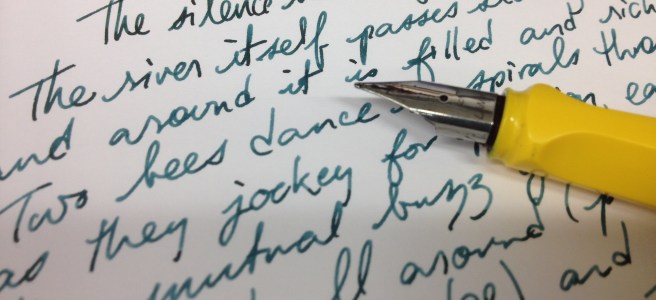
The silence here is filled with sound.

The river itself passes slowly, noiselessly, but the air above and all around it is rich with Nature’s busyness.

Two bees dance in spirals through the air around me as they jockey for position, each chasing the other in turn. Their mutual buzz grows and shrinks, zips left and right and all around (pauses a moment while they plod along my paddle’s edge), and whizzes about my feet before floating away on a zephyr.

The river is banked on one side by steep cliffs of sand and clay, varying between fifteen and twenty feet above the water. Tall blades of grass gather at the top of the precipice, spectators at the edge of my solitary parade. These are the leaves that Whitman loved, rustling to one another in the hushed tones of the breeze as they watch me float past. A sandpiper hops along beside the water, scratching and pecking at pebbles and sand.

The sky is a clear azure expanse, open and full of possibility. Trees and hills hem it in at the edges in a wide verdant belt, saving my fragile mortal mind from collapsing at the beauty of the whole.

I am completely taken in. My heart aches simultaneously with the blessing of being in this place, and the despair of the impermanence of my experience.  My mind drifts to thoughts of entropy, contemplations of the death and chaos that is such an inescapable part of living and order. Everything tends to chaos. Buildings once firm crumble and fall; lives once full of love and meaning come to end; Nature herself is ever-changing and will, in the end, cease to exist as disorder envelops the world. But could beauty exist without this chaos?

When I fall in love with a painting, it is because I know my eyes cannot rest on it forever that it is able to change and affect me. I gaze on a stunning vista or a lovely face, and seek to change myself, to better myself to have more of this beauty in my life. Were it not for the knowledge of beauty’s fragile nature, I would have no reason to change; no reason to feel touched.

Music’s charm is in the height of impermanence; sound is but travelling waves of energy that by necessity of physics must exist only in one moment and not in the next. We can only enjoy music while it plays, and once it is over enjoy only its memory.

My boat bumps against the side of the cliff and drifts leisurely outward into the stronger current. Today, the river is my guide; its direction is both gentle and strong, and I am content to follow its journey. My paddle is dry in the sun. I have the power to choose my own course and direction—even oppose the flow of the water, and ordinarily I would. But today the river will choose for me, and I will do my best to learn from it.

Ahead, a clump of trees and brush stubbornly holds fast amid the powerful water, having fallen there victim of the river’s fury as it swelled in the spring. The stream babbles and bubbles noisily as it flows over and under and around the logs and twigs, swirling in eddies and churning tempestuously. The river, like time (tempus, you say: the root of tempestuousness), refuses to stop or slow for any earthly obstacle. As I gradually float nearer, it seems I’m headed for the fray. I lower my hands to my paddle, but do not lift it. My boat circles slowly sideways, then backward as it turns in the eddies upstream of the brush.

I’m taken aback by the wonderful view I hadn’t gazed on before: upstream, beyond the cliff face, the land rolls upward in gently sloping hills, clothed in trees and greenery. Mighty poplars stand firmly at the side of a low forest, acquiescing to be swayed only ever so slightly by the fresh westward wind. They solemnly guard the forest behind them from the wide expanse to the left: a brightly blooming field of lemony yellow canola which extends as far as I can see in the other direction before falling from view behind the jutting cliff edge. Beyond the forest lay a soft rolling meadow freckled with grazing Herefords as content to live in this place as I am to gaze upon it.

The logs and brush pass harmlessly by my side, the current of my guiding river having nudged me out of the reach of the tangled snarl.

I consider how often I’ve worried throughout the course of my life, anxiously trying to affect things beyond my control. Many nights I’ve been unable to sleep, my mind racing with one particular concern or another. How many beautiful things have I missed in all my furious paddling?

The sun blazes high overhead, and I can feel its rays bathing my skin in a soothing warmth. Upstream on the water a skiff of ripples dances ethereally, and my grass spectators on the cliff bend gracefully in a wave moving swiftly downstream toward me. All at once I am caught in a warm gust, the straw of my hat rustling and creaking as the brim catches the breeze. It dies down as suddenly as it had started, and the river continues to guide me along around the bend.

A while later I come across a small cove where the current slows and actually turns back on itself before joining again with the main river body. Most of the river rushes past, intent on continuing its circuitous eastward journey, but those parts near the cove are content to take a short rest.

I myself have floated up alongside the cove, and my guide gently pushes me in. My boat lazily turns as I begin my slow upstream journey to the top of the cove. Eventually, I come to a dead stop. The water laps at the side of my kayak, patiently waiting for some small change in the current that might start me moving again. I wait patiently also.

In the middle of the river, where the current is the strongest, the remains of a once-proud tree protrudes from the water like a spear. It is bent low just above the water’s surface, humbled by the river’s endless might. The scars in the wood tell much about its former glory. It is wide at its base, and very long; this tree would have towered among many others. Knots along its length exist as remnants of many powerful branches which would have been clothed with innumerable leaves, rich and green each summer, and glorious in gold and yellow each autumn. Squirrels and birds would have enjoyed many generations in this tree; it would have been the pillar and foundation of their existence: immutable and everlasting.

Its bark and branches are now completely stripped, and its underside is worn completely smooth by the water’s erosion. Its topside, by contrast, is jagged and rough; myriad splinters and shards of wood stab this way and that, evidence of having survived the forceful and dangerous ice floes of the spring thaw. This tree has been allowed to rest near its place of former glory only by virtue of its willingness to be humbled: to part with its leaves and branches and to bow along the water. It has accepted its inevitable aging and death with grace, and remains beautiful.

I turn my gaze back to my peaceful cove, and upward to the cliff face which here hangs out over the water. Roots and twigs dangle from the edge, thirstily reaching to the water below. The sun reflects off the water’s surface onto this overhang, projecting fantastic dancing shapes of light onto the sandy clay.

A tiny bank swallow pokes its head out from a hole in the cliff, checking left, right, up and down before fluttering skyward with a frantic beating of its wings. What a wonderful home you have here, little swallow, I muse. What a wonderful home I have here too.

A small eddy bubbles up beside me from somewhere below, and I am shifted ever so slightly to the side. The current catches me again, and I am gone. I am somewhat reluctant to leave, yet grateful for the impermanence of my stay—that I was blessed to have left while everything was still beautiful.

A short while later I have reached the end of my journey, and I know I must return to the hustle and hurry of the city. Again I am reluctant to have to go; again I am grateful for the impermanence of my stay. It seems to me now that the inevitability of time’s progression and the necessity for change are not so much at odds with beauty and happiness, but are perhaps their essence.

I thank the river for its guidance—both physical and otherwise, and begin the long journey back home.

Which One’s The Robot

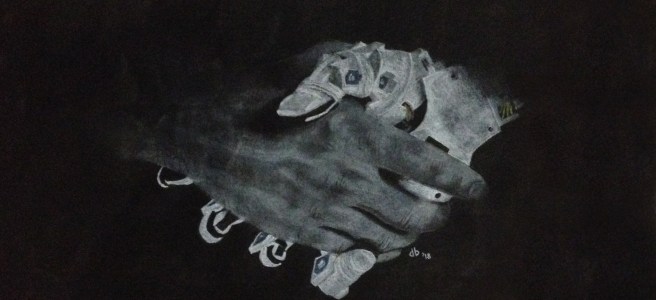
A charcoal and chalk drawing of a human hand shaking a robot hand.

A true story. April 4, 2018

I sat down in the back of the bus today, just like I always do. I was in a good mood, and feeling like I might want to chat with the other commuters, so I sat upright with open body posture. I’ve never actually started a conversation with anyone on the bus, because I’m too concerned about respecting boundaries, and I’m never sure whether anyone else actually wants to talk to me. I’m usually open to having a conversation though, and I’ve found that something in my face or the way I sit must signal to other people that I’m open to it, because occasionally they’ll strike up a conversation—and it’s almost always interesting.

I had just received back a drawing I had done for the Engineering Art Show, and I held it face-up on my lap as though that were the most natural way to transport it, so that it could serve as a conversation starter for someone else should they choose to use it. Beside and to the left of me a few seats away sat a First Nations woman who looked to be in her mid-forties. She wore a pink sweater that seemed like it had seen quite a lot of use, white and black checkered pants, and sneakers that at one time had been white. On the seat beside her was a clear plastic garbage bag, inside of which were a few empty water and pop bottles, and what might have been a change of clothes. She had her right leg crossed over her left knee, and both her hands were continually employed in pulling her foot up closer to her waist as it slid toward the ground.

She pointed at the drawing on my lap, and asked,

“Did you draw that?”

“Yes, I did,” I replied, always happy to receive recognition from strangers.

“What is it?” she asked. I was a bit taken aback, as I had thought that was relatively clear by just looking at it. In my head ran an image of a five-year-old child, pleased as punch with a drawing he had made that no one else could recognize. I turned the picture toward her so that she could see it better, and started to explain what I had drawn.

“It’s a drawing of a robotic hand I designed, shaking hands with a human to symbolize the equal partnership between robots and humans we should see in the future.”

“Oh,” she replied, “It’s very beautiful.”

“Thank you.” I sat back, she sat back, and that was the end of that conversation.

A while later down the road I happened to glance again in her direction and noticed that her face was buried in her sweater, and she was muffling sobs. My face must have had a look of mixed surprise and concern, because the man sitting next to her saw my expression and turned to look at her. He was equally concerned, and put a hand on her shoulder asking her if she was okay. They talked for a few moments, but I couldn’t make out any of what they said. She spoke in very timid tones, just barely audible over the whir of the bus engine.

After a while their conversation was over too. I thought to myself, trying to guess at what the problem might be, and whether there was anything I should do to help her. It seemed as though I should say or do something, but also that it wasn’t my place. I started to think about the social constructs around strangers talking to strangers; what was allowed and what was not allowed, why, whether that was good or bad, and if it needed change how someone might try to do that. Of course, I was barred by my own inability to initiate conversation.

Some moments passed, and she spoke to me again, pointing at the picture.

“You know what that makes me think of?” she asked, as timidly as before.

“What?” I asked, moving one seat over so I could hear her better. It seemed like she needed someone to talk to.

“The Terminator.” She grinned from ear to ear, her eyes disappearing as she chuckled. It was not at all what I wanted to hear, since I’ve built up the Terminator for myself as a societal hurdle we need to get over before we can really move forward in humanoid robotics. I laughed a little with her, then replied,

“Well, I hope the robots in the future are a little nicer than that!” She smiled and nodded. She was only joking after all.

“I think I’m a robot,” she said, not joking this time. Her dark, wet eyes said she was hinting at something a little bit more.

“Why do you say that?” I asked, leaning in to hear better. She looked down at her hands concernedly, as though they weren’t hers. She flexed and unflexed them, splaying her fingers. There was a tattoo of some symbol I didn’t recognize on the back of her left hand.

“I’m a science experiment.” Her voice had a quality of unbearable sadness, like she had made some great mistake she couldn’t fix. I looked at her, confused. Was she suggesting that she was a subject in some drug testing trials? Maybe her own? She said a few more things that I was unable to hear over the sounds of the bus as it left South Campus.

“Why do you say you’re a science experiment?” I asked. I’m not sure what I was hoping for, perhaps to find the reason for her sadness and maybe a way to console her. She pointed at her face.

“Do you see me?” she asked. It looked like she was indicating the fact that she was Native American. I was suddenly painfully aware of the common societal perception and historical treatment of First Nations people, and the fact that only a moment ago my own mind had jumped to the conclusion that she must be on drugs. I wasn’t sure what to say. We sat in silence for a short while. Eventually, I replied,

“You seem fairly human to me. I’d say you’re more than some science experiment, more than some robot.”

She said something again that I couldn’t hear. Her voice was so soft.

We sat again for quite some time without talking. During this time I felt sure that I was there for some reason; I was supposed to say something or do something for her. What did she need?

A while later she spoke again.

“Which one’s the robot?” At first I was confused, then realized she was referring again to my drawing. Then I was confused again; I had thought it was pretty obvious.

“Well, this one,” I replied, pointing at the robot hand in the picture.

“Why do you think that’s the robot? What do you think of when you think of robots?”

“Well, because that’s the one I designed; it’s made of plastic and metal, and sensors and stuff,” I was having a hard time gauging her level of understanding. Finally I clued in that she was talking big-picture. “But…” I thought for a moment, “People tend to think of robots and humans as separate things. That one’s lesser than the other.” I was trying to make a connection back to her feelings about her ethnicity. “But I think… I mean… I hope, in the future, that there won’t be a distinction anymore. I mean, if a thing can think for itself, and if it’s got feelings, then it ought to have the same rights as any other human.” She nodded. She must have picked up on my analogy. Maybe I was helping her?

“You know, I’ve met a lot of robots,” she said.

“Oh?” I asked, “Which ones?” Maybe she knew someone who owned a Roomba or something.

“No. I don’t like to name names.” I nodded as though I understood, but it was another block or two down the road before I did. She was talking about people, about connections. I thought back over our entire conversation, and how she must have had the human condition in mind the whole time while I was talking shop about machinery. I was right, I was meant to be here, having this conversation—but it wasn’t for her, it was for me.

A question entered my mind, but I wasn’t sure I wanted to know the answer. I initiated the conversation this time, for the first time.

“Do you think I’m a robot?”

“Yes,” she replied, without hesitation. She smiled like she had done with her Terminator joke.

“What makes you say that?” I asked.

“Because you draw them. And you believe in them.”

I nodded. With that, my stop was up and I had to get off the bus. I thanked her for the conversation, and we parted ways.