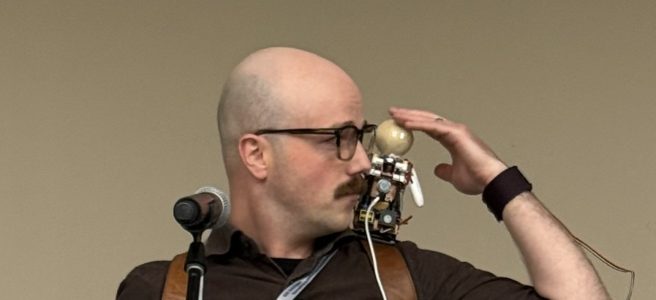
This post documents the performance “Ineffable Idiosyncrasy”, performed August 1 2026 at an IEEE Conference workshop on “Co-designing Bio-Robotics with Smart Textiles, Social Justice, and Arts”.1
What don’t our models contain? What can’t be contained by any model? What gut feelings do you trust, but can’t put into words?
There are many forms of knowledge our models don’t currently contain. Here, I want to focus on one particular kind: the knowledge I call ineffable, idiosyncratic knowledge2. “Ineffable”, to describe its inarticulability, and “idiosyncratic” to emphasize its origin in particular lived experience. Epistemological debatists might wonder whether I should use the term “knowledge”, but I only contend to use it in the colloquial sense. I might not be able to tell you how I feel while still feeling confident in telling you that I know how I feel.
Last weekend, I performed “Ineffable Idiosyncrasy” with ORBiE at a scientific conference workshop focused on smart wearable assistive technologies. Below is our poster-session teaser video, a transcript of our presentation, an audio recording of our rehearsal (the rehearsal referenced in the talk), and the accompanying visual materials.
Poster Teaser Video
Performance Recording (Studio Rehearsal)
Performance Transcript3 (Live at Workshop)
Hello, my name is Dylan Brenneis, and as Marilène mentioned, I research human–machine co-creation as a Master of Fine Arts student at the University of Alberta. Before that, I worked as an engineer at a bunch of different places, working in prosthetic limb control and AI research. At that time, I was focused really heavily on trying to shape machines so that they would be able to learn. Now, in the art department, I’ve actually committed to living with one of these learning machines over a long span of time — at least the term of my degree. In doing so, the focus is a lot less on me shaping the machines, or the machines learning. Instead, I’m focusing on introspecting, and seeing the ways that the machine is shaping me, and the ways that we are learning together.
I want to use a prosthesis metaphor in order to explain how I see that happening, much in the way that Patrick did earlier. When I use the term prosthesis here, I want to use it in the broadest sense that we can imagine that term. When I think of prostheses, I think of technologies that we’re making that are intended to be very tightly coupled to a very particular human being. That coupling might be physical, or it might not be — but it’s a very particular machine and a very particular human being. And the machine is intended to augment or supplement the person’s agency in some way or another. That definition captures pretty well everything that we’ve talked about today. All of us are working on that kind of technology.
Now, I think of ORBiE sometimes as a thinking prosthesis. ORBiE is not like the commercially available thinking prostheses that might claim to provide information or logic or write text for you or things like that — no. ORBiE instead provides chaos, perturbations, randomness. It nudges my thinking in different ways. Only some of the things that it provides by chaos it provides via ORBiPhore code. It can send messages to me that I have pre-programmed into it, which are intended to sort of nudge my mind in different directions — reminding me of something that I want to remember when I’m thinking about design. But that’s only part of the chaos.
Most of the chaos comes from the commitment of actually choosing to live with a learning machine over a long span of time and seeing what that experience really is. That is an absurd commitment, yes. But I want to make sure that we remember that whenever we’re making prosthetic technologies, in this broad sense of the term, that’s exactly what we’re asking our users to do: to live with our learning machines. Do we know what that’s like?
I want to talk a little bit about what my research method is, because it’s easy to assume that the art is a decorative element on top of some more serious mode of inquiry, or is maybe just used for communication of ideas — no. It’s important to remember that the art is the mode of inquiry. It is the site of knowledge generation. It is where I come across new experiences and have new ideas because of it. I use a mode of research-creation called durational performance. That differs a little bit from performance that you might be thinking of — dance, music, theater — though it can contain those elements. The important part of durational performance is the duration. It’s the artist putting their body on the line for an extended period of time. The experience that the artist actually has, and that the audience has watching the artist endure that experience, is where the heart of the art lies. And that’s the experiential part of it. We can document that, and describe it, and talk about it later — but that’s not actually the art. The art is in that moment of experience, and only then.
And what I find that gives me, for my research, is a much heightened appreciation of user experience. Not because I believe that I have, by my experiments, actually experienced what these users experience, but rather, by seeing just how inarticulable my own experience is, I understand that I cannot know what they’ve experienced by any representation of information that they might be able to give me. Their lived experience lives in them, and so they need to be at the table in the design phase.
And because I can’t tell you what I mean, let me show you what I mean. We’re going to do a little performance here. Assuming everything works, you’re going to experience it in two ways. First, I’m going to give you all of the information. You will have everything that you need to know to describe what you will see today, and to understand what is going to happen. And then I want you to hold that informational understanding and then see how it differs from the experience of the actual performance.
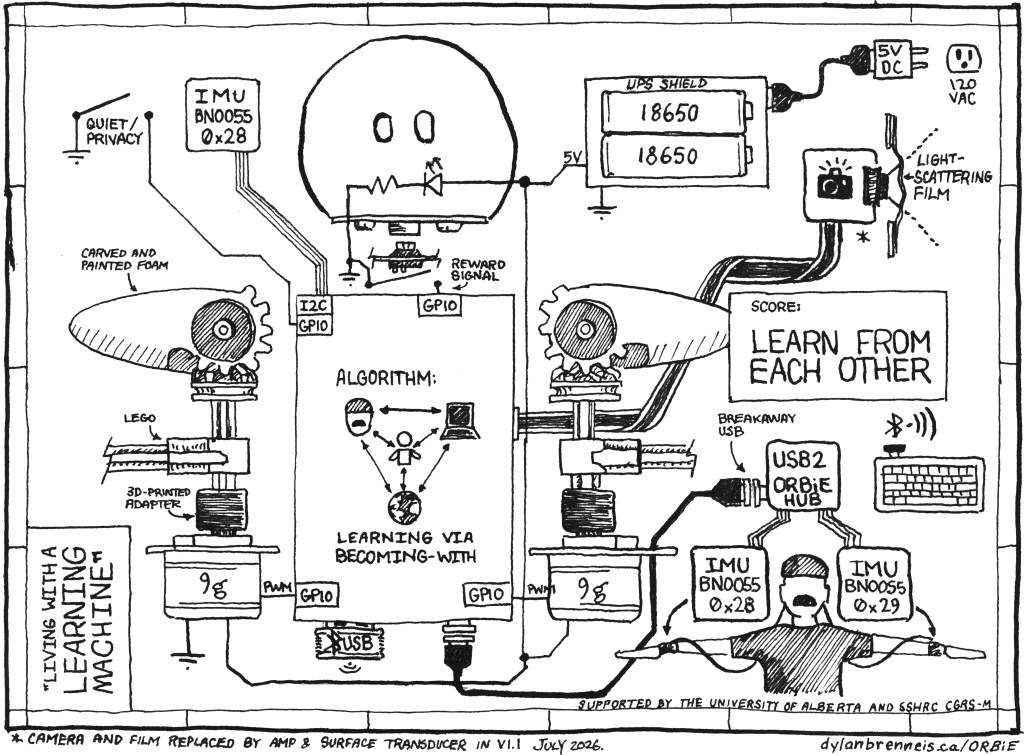
So first, what are we actually going to do? I have a phrase that I would like to teach ORBiE to be able to repeat back to me in the future. I will teach ORBiE by using the data from my body over time to teach it to signal the phrase.
(Dylan connects USB between himself and ORBiE)
I have IMUs on my wrists that are measuring my arm positions —Oh, I should actually hold still while the calibration phase is running…
(audience laughs)
ORBiE is running a very simple learning algorithm. This one comes from 1972, so it’s about as simple as it gets. And it’s just a series of tile-coded features, those features being my arm positions, and then two different representations of time. One being: where are we in the phrase that I’m repeating? We will repeat the phrase seven times, so it has an idea of where we are in that long span of time. And then the other representation of time it has is: where are we within a particular character of that phrase? So there will be two different representations of time spans. What else do we need to know?
(sound over loudspeakers)
Ooh, the sound works. That’s great.
(audience laughs)
I will be making the sound with this joystick: that gates the sound. And the sound is important because what it’s doing is keeping me in sync with ORBiE’s algorithm. So that’s how our minds are sort of coupled together — because it locks us in time, driven by music.
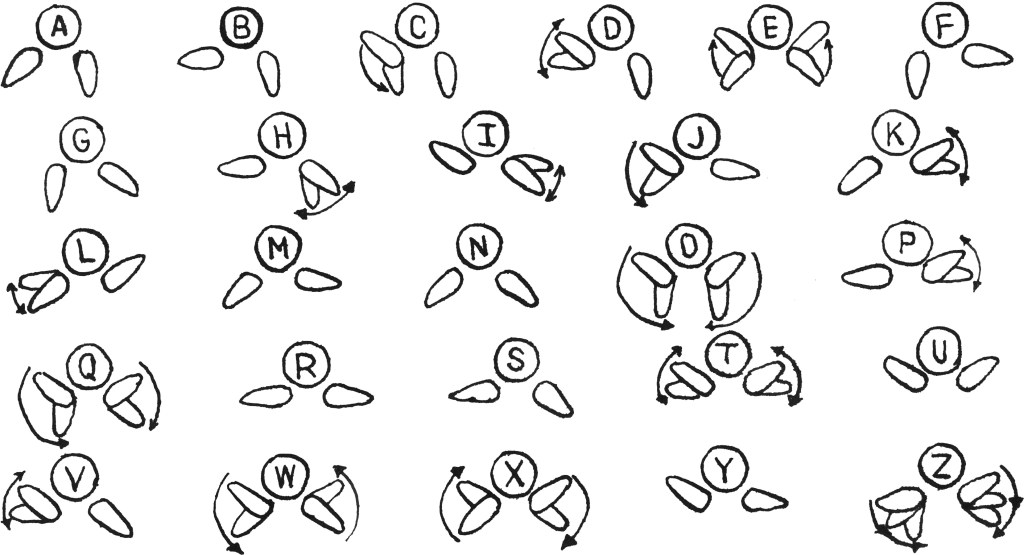
Now, because of what I’ve described of ORBiE’s space — of what it can see, and what its very simple learning algorithm is doing — it’s important to recognize that it cannot learn the meaning of the phrase. It cannot even understand that there are repeated characters within the phrase. All of that understanding is up to you. And that’s why you have decryption keys. You will have a choice to make. You can watch me signal, and try to decode and understand what phrase I’m teaching ORBiE. Or, if you want, you can join in with ORBiE and sign along, and instead experience the feeling of making the phrase. It’s difficult enough that you won’t be able to do both. You will either be able to transmit the phrase by feeling it, or you will be able to understand what it means. The choice is yours.
Now is the part where we see if it works.
(To ORBiE) How’re you feeling?
(ORBiE responds, one character at a time. Dylan watches carefully)
Ha! He’s saying “hell yeah.”
(audience laughs)
Okay, now I need to find the switch to get us into performance mode.
—BEGIN PERFORMANCE INTERLUDE—
(During the performance, after about the third or fourth repetition, Dylan begins to speak while signalling)
Well, I’m already way off time, so I suspect the learning’s shot. I wonder if I could tell a story while doing this?
Yesterday, during our rehearsal, I felt very stiff, and stressed out. I was moving very stiffly, methodically; like a robot might. Like the way I thought a robot might need me to move. Then I tapped ORBiE on the head. He said “LET GO”.
And then something in my heart said “disco”.
(Performance continues, much more freely)
—END PERFORMANCE INTERLUDE–
Did anyone get the phrase? Haha, I don’t blame you–that one’s on me. I don’t think ORBiE quite got it either. Learning to teach in this way takes a lot more practice than I’ve been doing.
The phrase was “INEFFABLE IDIOSYNCRASY”. By teaching ORBiE this phrase, and by having him repeat it back to me, I hope to remind myself to consider and make space for this kind of knowledge in my designs. By living with ORBiE, I’ve seen the ways that my behaviour and his design are converging toward a kind of interaction that is totally idiosyncratic to us — and which would be completely inappropriate for anyone else. Or even for myself, in relation to some other machine. You may ask, why do research that is inherently not generalizable? I asked myself that question, when taking up artistic research. But for our users, particular humans paired with particular machines, generalizability doesn’t matter. What matters is their own ineffable, idiosyncratic experience with our technology. It’s what makes the difference between a prosthesis that actually sees daily use and thereby multiplies its user’s agency, and one which gathers dust in the closet.
I want to leave you with one final thought. When we stand alongside our users at the whiteboard, and enable them to develop the technology idiosyncratically themselves via education and good design — then, and only then, will we be equal participants in co-creation.
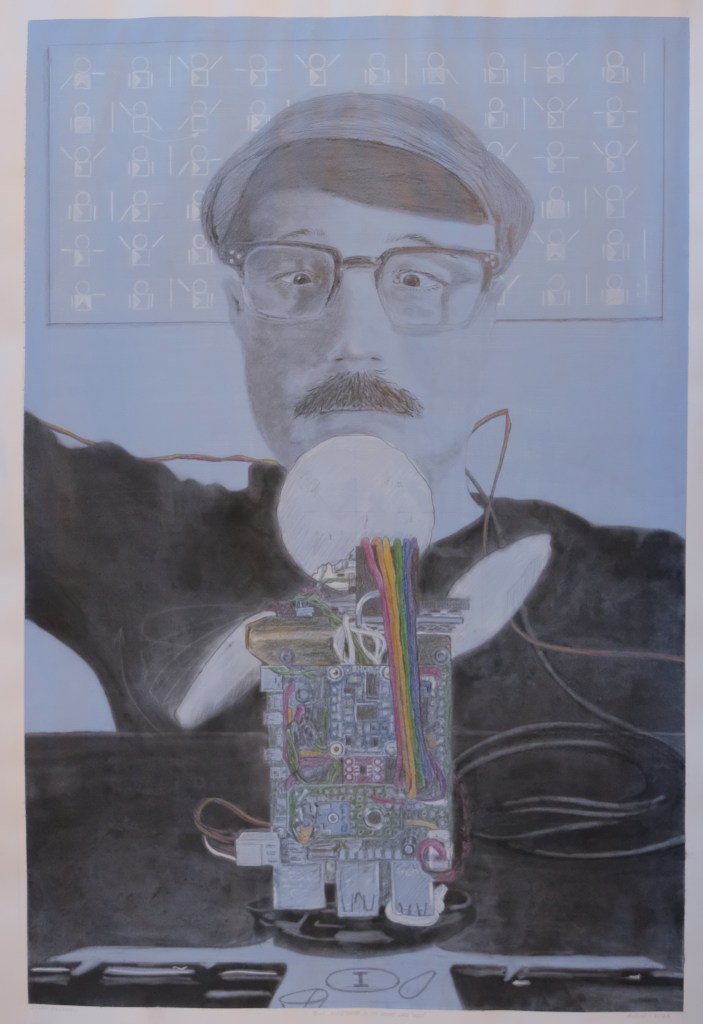
Poster
Technical Diagram
ORBiPhore Decryption Key
- “Co-designing Bio-Robotics with Smart Textiles, Social Justice, and Arts.” Workshop presented at the 11th IEEE RAS/EMBS International Conference on Biomedical Robotics and Biomechatronics (BioRob 2026), Edmonton, AB, August 1, 2026. https://smartwearrevolution.ca/biorob2026workshop. ↩︎
- This form of knowledge is related to Situated Knowledges (Haraway, 1988). By this term I emphasize some of the key properties which make it difficult to design into automated knowledge systems, whereas Haraway’s term emphasizes its specific locality and tentacular origin. Haraway also reminds us that inspecting these origins and localities can help to expose our biases and inheritances, which I think worth remembering — especially when automating knowledge systems. ↩︎
- This transcript is written from a partial recording, which covers the first portion of the talk up to the performance interlude, edited for clarity. I have re-written the talk from the beginning of the interlude onward as best I can from my memory of the event. ↩︎


