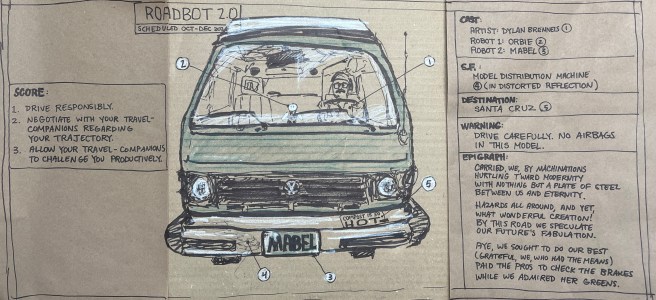
My MFA research began in 2025 with a three-day-long durational performance road-trip titled “RoadBot“. For that performance, I was in charge of driving responsibly, and my robot ORBiE was in charge of navigation. While ORBiE was learning behaviour policy updates (in a blind and very limited mathematical sense), I had plenty of time to meditate on absurdity, human-machine interaction, and the interplay between randomness and meaning-making.
Throughout the first year of my study I have continued following ORBiE’s “navigation”: no longer literally through physical space, but through the landscape of ideas. Carefully considering what it means to “drive responsibly” with a robot companion has led me down a garden path of reading and discussion, to encounter at various turns the research of Sherry Turkle1, James Bridle2, Daniel Dennett3, Kate Crawford4, and, most significantly, Donna Haraway5.
Haraway’s companion species model of responsible interaction is a richly challenging framework from which to consider relationship dynamics between humans and the myriad other species we coexist with. It is a stance from which human values are respected and honoured while making space for more-than-human kin to coexist in multi-species flourishing. Importantly, Haraway’s mode of thinking works against simplification and categorization of kinds into tidy structures and hierarchies. Instead, she emphasizes the entangled and interdependent nature of real lives in the real world, across species boundaries. For Haraway, no individual is innocent, and particular histories matter. For myself, I believe much of this line of thinking extends to human coexistence with intelligent machines6.
In my experience observing how both myself and the machines I create change in response to our interaction, I have encountered my human-machine entanglements first-hand. I have also come to believe that the recognition and discussion of this kind of entanglement is both necessary and lacking in contemporary discourse around the responsible use and development of intelligent machines.
I explore the meaning of responsibility in entangled human-machine co-creation by engaging with it first-hand. To support this, I use durational performance as my primary research-creation method. I create rules of engagement for myself that I expect will generate challenging experiences, and document those experiences through photography, story-telling, illustration, and poetry.
This time, the score takes the form of a three-month durational performance titled “RoadBot v2.0”. My rules of engagement for this performance are as follows (updated from the sketch above):
- Drive responsibly.
- Where doing so does not conflict with Rule #1, anthropomorphize your robot companions.
I intend to travel with two robots on this trip: ORBiE, the small humanoid robot who has been my research-companion for the duration of my thesis work; and Mabel, a 1983 Volkswagen Vanagon.
First, ORBiE. Last time, I interpreted ORBiE’s arm gestures to be instructions for where to turn. They were actions chosen by the machine, and executed by me. This time, I will interpret ORBiE’s arm gestures to be attentional nudges: “pay attention to this or that”. These nudges may, in turn, affect my actions and thereby the direction of our course… but not directly. I think this more honestly reflects my relationship with technology. Seldom do I (intentionally) blindly follow the directions of a machine. But machines do, undoubtedly, direct my attention.
And then there’s Mabel. Including Mabel as an equal companion for this performance allows me to investigate the kinds of responsibility involved in being a user of another designer’s technology, particularly when that technology is critically depended-upon, carries high personal risk, and does not feature all of the safety and environmentally-conscious design enhancements we expect of modern technology.
We will travel a meandering course, responding to experiences encountered along the way, toward an outpost at the University of California Santa Cruz. There, I will ground myself for much of the duration of the performance not only with Haraway’s writing, but also her extended intellectual ecosystem of former students and colleagues. I will meet with researchers, artists, and technologists across social justice, AI research, and artistic disciplines. These people, their ideas, and the others they will introduce me to will undoubtedly challenge and inspire my understanding of what it means to use, develop, and coexist with intelligent machines. Then, we will return home: again meandering in response to encounters along the way, and using the ideas gathered along the journey to reconsider what it means to drive responsibly in coexistence with learning machines.
I wonder where this road goes.
This research-travel performance is funded in part by the Canadian Social Sciences and Humanities Research Council’s Canada Research Training Awards Suite – Research Travel Supplements (SSHRC CRTAS-RTS). I extend grateful acknowledgement to Marilène Oliver, Natalie Loveless, and Beth Stephens for helping me to make this happen.
- Turkle, Sherry. Alone Together: Why We Expect More from Technology and Less from Each Other. New York: Basic Books, 2011.
Turkle, Sherry. Reclaiming Conversation: The Power of Talk in a Digital Age. New York: Penguin Press, 2015. ↩︎ - Bridle, James. Ways of Being: Animals, Plants, Machines: The Search for a Planetary Intelligence. New York: Farrar, Straus and Giroux, 2022. ↩︎
- Dennett, Daniel C. Consciousness Explained. Boston: Little, Brown, 1991.
Dennett, Daniel C. Elbow Room: The Varieties of Free Will Worth Wanting. Cambridge, MA: MIT Press, 1984.
Dennett, Daniel C. Kinds of Minds: Toward an Understanding of Consciousness. New York: Basic Books, 1996. ↩︎ - Crawford, Kate. Atlas of AI: Power, Politics, and the Planetary Costs of Artificial Intelligence. New Haven, CT: Yale University Press, 2021. ↩︎
- Haraway, Donna J. “A Cyborg Manifesto: Science, Technology, and Socialist-Feminism in the Late Twentieth Century.” In Simians, Cyborgs, and Women: The Reinvention of Nature, 149–81. New York: Routledge, 1991.
Haraway, Donna J. The Companion Species Manifesto: Dogs, People, and Significant Otherness. Chicago: Prickly Paradigm Press, 2003.
Haraway, Donna J. “Situated Knowledges: The Science Question in Feminism and the Privilege of Partial Perspective.” Feminist Studies 14, no. 3 (1988): 575–99. https://doi.org/10.2307/3178066.
Haraway, Donna J. Staying with the Trouble: Making Kin in the Chthulucene. Durham, NC: Duke University Press, 2016. ↩︎ - Brenneis, Dylan. “Responsible Use of Intentional, Plastic Tools” Term paper, PHIL 505, University of Alberta, April 20, 2026. https://dylanbrenneis.ca/wp-content/uploads/2026/05/responsible-use-of-intentional-plastic-tools.pdf. ↩︎

 Dylan Brenneis