<< Prev: RoadBot v2.0: The Plan
1
Mabel gleams with the green of youth and opportunity. She stands tall and poised, with round, wide, and hopeful eyes. You can tell at a glance she was made for adventures. And once you get to know her, you can tell she’s been on plenty.
Mabel is a robot designed to enable her owner to achieve superhuman speeds over long distances. Her digital computer makes up to 50 decisions every second, autonomously managing between two and ten thousand micro-explosions every minute to convert toxic chemicals into forward propulsion. All the owner needs to do is point her in the desired direction and press the “go” button. Mabel is a marvel, and I am privileged to have the chance to get to know her.
A few years ago, I learned how to read the life history of wood[1]. Once you know what to look for, you can not only tell what kind of tree the board came from, but where that tree’s branches were; which were snapped or bitten off while the tree was young; what kinds of conditions it grew in; how it was sawn. I think a similar process can be used to get to know robots.
Like getting to know wood, getting to know Mabel has been a process of uncovering her history by paying close attention. For example, I know that Mabel was manufactured in 1983 in Hanover, Germany, before being completed in Wiedenbrück: a fact easily discovered by tracing her serial number. While German-made, Mabel was always destined to be a Canadian machine: a fact I uncovered while repairing her charging system. Her flexible circuit board had become corroded from her years living along the salty and humid British Columbia coast, and it needed replacing. In doing so I learned that her manufacturer made special Canadian-only circuit boards in 1983, which leave out the wiring for the oxygen sensor. At the time, Canada’s air-pollution regulations were more lax than those of the US. It must have been cheaper at scale to make design-level exceptions than to fit destined-for-Canada vehicles with oxygen sensors and catalytic converters. So, just as a branch snapped off in the woods 40 years ago is written indelibly into the figure of a cabinet, regional differences in government regulations are written into the design of robots.
2
Sherry Turkle found that many people who consider a relationship with a robot do so because of the assumption that a robot would never let them down, or would never die and so leave them lonely[2]. Humans let you down, and humans die. But age is hard on machines too; they’re fallible and mortal just like any physical thing. I first learned this from working with robots for over a decade, but I never completely took in what it meant. That is, until developing a relationship with a robot who came with a well-developed rust problem.
The first time Alex and I went adventuring with Mabel, we came home by tow truck. The day had started out marvellously, and as we sailed past a shiny new F-150 on the side of the road with the hood up, I quipped “looks like you don’t need an old vehicle to wind up on the side of the road!” About an hour later, well away from the city, Mabel’s top speed fell from 100 km/h to 80. Then 60. Then 50. “Mabel is able! Mabel is able!” Alex’s encouragement from the passenger seat gave me and Mabel just enough courage to inch up one more small hill. But rust from inside her gas tank had clogged her fuel filter, and she sputtered to a standstill just shortly after. Since the beginning, my relationship with Mabel has been characterized by mortality and fallibility–both mine and hers.
When I use the term “relationship” in my research, I don’t mean to indicate anything quite like a relationship one might have with another human person (though that is what Turkle’s research investigates, and what her subjects describe). My relationship with Mabel is the same one that many people develop with tools they use frequently and come to depend on. I care for her in the form of maintenance; I get to know the way she operates, and the subtle differences between her particularity and others like her. Because of my familiarity with her, I come to prefer her to others, in spite of her limitations–remarkably, even because of her limitations. Some people further allow themselves the whimsy of self-conscious anthropomorphization, and name their most beloved tools. They might give them pronouns, and invent a character for them based on their actual and imagined behaviour and temperament. So have I done with Mabel.
3
The rules of RoadBot v2.0 are as follows:
- Drive responsibly.
- Where doing so does not conflict with Rule No. 1, bring your robot companions to life.
- Learn from each other.
I purchased Mabel specifically for RoadBot v2.0, as a vehicular robot that I would be excited about bringing to life. I wish I could say I had been careful about this choice, that I had done ample research, that I had viewed many different options. There were other robots like her available, many of which likely had benefitted from more careful maintenance over their lifetime. Many were newer, with improved designs and safety features. Knowing what to look for now, there were clear signs from the beginning that Mabel’s history would not make her continued care simple. But I didn’t know them then. What I knew, from the first photo, was that Mabel was the one. If I am to be completely honest, it was her particular shade of green that made the sale.
While her aesthetic appeal was intuitive and obvious to me, I discovered her conceptual resonances by degrees in getting to know her. I think of her as filling the role of robot of commercial origin, the natural counterpart to ORBiE: my robot of personal origin. Despite her age and seeming distance from modern AI systems, I find there are several parallels. Like any robot of commercial origin, her design is entirely outside of my control. Understanding how to operate her safely (which includes her maintenance) requires learning how she works, and what her limitations are. And even while I understand her less than any robot I can make myself, she is much more powerful, and so comes with greater dangers.
I also find resonances at a societal scale, considering transportation robots as a general category. Much as AI promises to do today, robots like Mabel historically empowered individual persons to express their agency in unprecedented ways, saving lives and creating opportunities at vast scales. Individual use and large-scale manufacturing strained and continues to strain the environment. Massive infrastructural projects to support people’s use of the technology have shaped and continue to shape urban development, regardless of the impact on livability. The development of transportation technology occurred before we understood all the dangers it posed, and every modern traffic law or safety feature’s origin story is written in the blood of those whom we sacrificed to progress.
Finally, there’s the issue of speed. Contemporary discourse describes AI and its development as both fast and accelerating, characterizing the process as a “race,” as though there were a finish line or agreed-upon destination. At the same time, many note the conspicuous inadequacy of regulation or other measures available to course-correct or slow development should we find we’re headed somewhere we don’t want to go. Casting Mabel in RoadBot v2.0 rather than a more modern robot is a deliberate action to choose technology that slows me down and encourages responsiveness to experience (particularly to her own technological failures). However, it also means choosing a robot without airbags.
4
Once Mabel became a symbolic stand-in for AI development, and my own life the symbolic stand-in for humanity, replacing her cracked and bulging brake hoses became an imperative pre-departure procedure. Superhuman speeds need reliable brakes. I committed to doing this maintenance myself to see what I might learn. In doing so, I finally saw the full extent of her rust problem. Ensuring Mabel was able to slow down ended up slowing me down far more than I had expected.
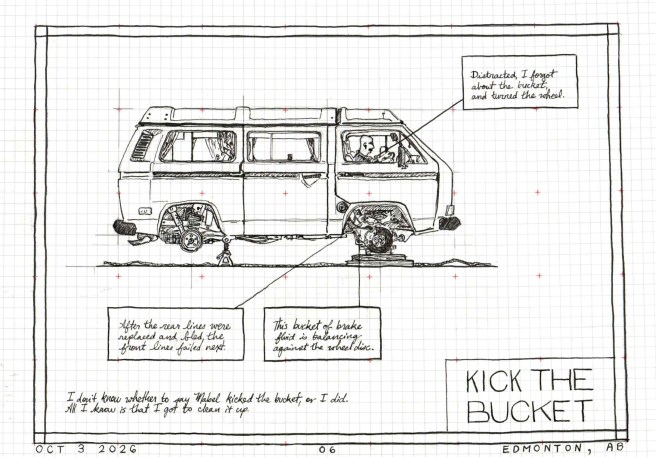
In theory the job could have been done in a few hours: remove the old hoses, replace them with new ones, bleed the system of air, and call it a day. Instead, every rusty connection to remove meant breaking or cutting something else to get it free. Hours turned into days, and exasperation turned into despair. Every day still working on the brakes meant another day behind schedule. How long could I delay leaving before the funders started asking questions? At what point would the plan need to change? Mabel had become an integral character to the trip I had imagined, but I wasn’t sure I had the ability to make her able.
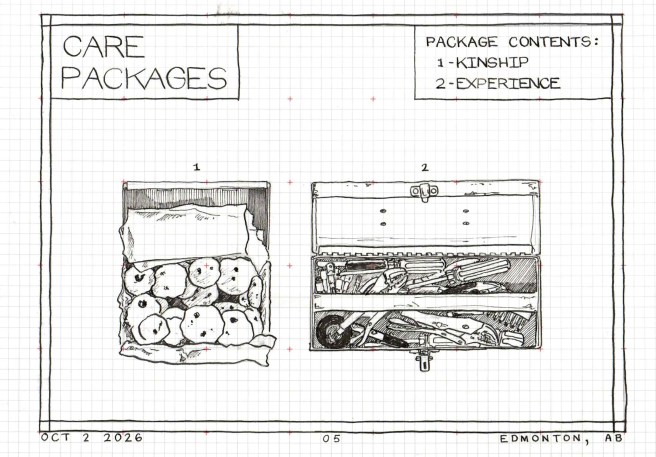
Then, when my parents dropped by with a shoebox full of cookies and a toolbox full of experience, frustration turned into laughter. The job became enjoyable. As it turned out, I had misunderstood what it meant to fix the brakes: for all my talk about slowing down, I had been rushing to get out the door so I could start doing it. This trip was explicitly designed to be about the journey, not the destination. But I was worried about being late getting there. A few days later, I finally performed the last bleed.
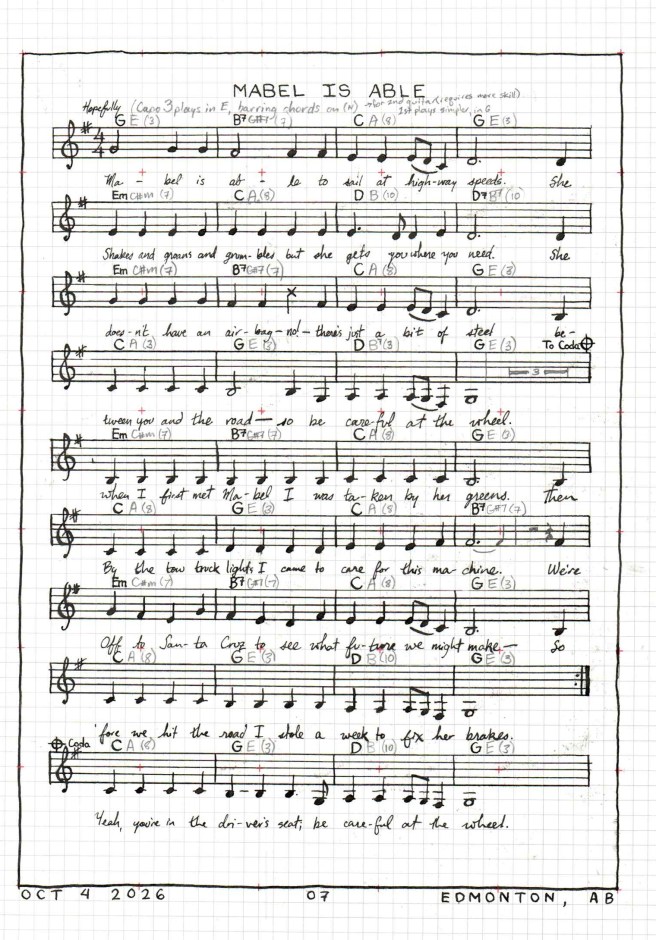
Mabel passed the road test with flying colours, at least in the slowing-down department. After nimbly braking at every test stop in our quiet neighbourhood, we ventured out to a stretch of quiet highway with nobody else around and tromped on the brakes from highway speed. We heaved to a stop tens of metres ahead of the tree in the ditch I had spied as the “deer you saw at the last minute” marker. I began to sing.
Mabel is able to sail at highway speeds!
She shakes and groans and grumbles but she gets you where you need.
She doesn’t have an airbag–no!–there’s just a bit of steel
Between you and the road, so be careful at the wheel!
Driving home, already planning what I would need to do to leave the next day, I noticed a familiar stumble under the gas pedal. New fuel filters had masked the problem for a short while, but her tank was still rusty. I had cast Mabel as a robot that would slow me down, and she was determined to do her job thoroughly.
We limped home over the next hour through side roads and streets. Mabel didn’t stall at all, at first. Then, as her fuel pump started to howl and rush-hour traffic started to mount, she coughed and sputtered and died in the middle of a traffic circle. Still rolling, I turned the key and she sparked back to life, lurching forward. At the next light she did the same, a gigantic city bus looming impatiently in the rear-view mirror. Once again with a turn of the key she kicked in and carried on, fuel pump straining all the while. Finally, we came to the very last leg just before home: an uphill stretch. Just one lane of traffic in either direction. And winding.
Halfway up, Mabel stalled. Hazard lights flashing, I pulled to the side as best I could as the driver of the pickup truck behind us honked and swerved into oncoming traffic to get ahead. The driver behind him did the same. This was no place to stop and wait for a tow truck. I turned the key and Mabel started up, and we chugged up the hill another twenty feet before coughing to another standstill. More drivers swerved around us. Mabel started again, and we lurched ahead another twenty feet. And so it went, up the entire hill. It was slow going, but it was going. A stretch of road that usually takes maybe thirty seconds to climb took us around two minutes, all told–but that was long enough to convince ten or fifteen other drivers to decide a head-on collision was worth risking.
As we finally pulled into our back alley, Mabel coughed and died one last time. I didn’t have the heart to start her again, so I just put in the clutch and rolled slowly into the driveway. I put my head down on the steering wheel. For every time she’d died, she dutifully started up again. “You did good, old girl.”
I wonder how much of my life I spend like those other drivers. How often do I sail headlong into whatever’s coming because I have a destination in mind and can’t slow down to consider whether doing so might be dangerous? The whole world seems designed to get me to go places, to do things. My whole life has been training for forward progress, productivity, making things go according to plan. What in the world would be able to slow me down amid all of that?
Mabel.
Mabel is able.
But in a world where everyone else is moving fast, is it safe to go slow?
5
I wanted to be able to reason about the actual risks involved in taking Mabel to California, rather than relying entirely on my relationship with her to guide my judgement. I had been fastidiously logging our repairs over the summer so that Claude[3] could have a somewhat accurate picture of Mabel’s true condition. So, I tasked Claude with preparing a report of the statistical likelihood of various kinds of trouble for a round-trip California adventure, based on published breakdown data, our planned route and usual weather, and Mabel’s maintenance data.
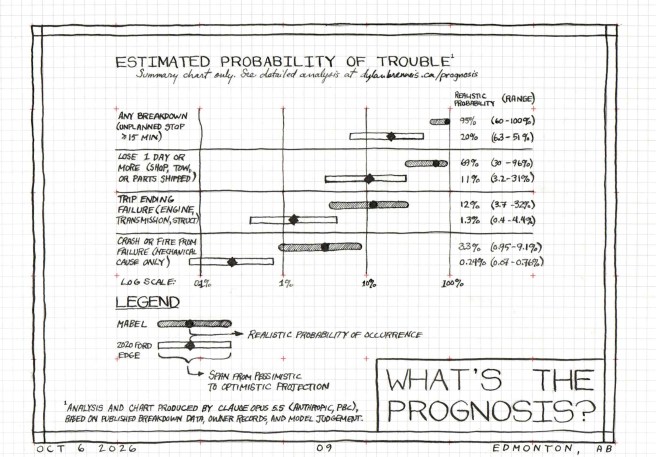
The headline item was the projected likelihood of a crash or fire due to mechanical fault, which came out to between 0.95% and 9.1%[4]. For comparison, the likelihood of the same event in a 2020 Ford Edge came out to between 0.07% and 0.76%. The report also pointed out that a crash event in an Edge likely has different outcomes than one in Mabel, where my legs are the crumple zone.
I don’t believe any of these numbers are accurate. There are just too many assumptions needed in order to arrive at a number at all. For one thing, these projections are based on the rates of average drivers, and I am a more responsible than average driver. I wonder how many of the drivers that make up the crash dataset also believed they were more responsible than average.
In September 2026, Anthropic’s alignment science research lead Evan Hubinger stated that he believed there was a greater than ten percent chance that AI would be the cause of human extinction within the next decade[5]. The company continues to develop AI at an accelerated pace, but has positioned itself as a more responsible than average company.
As much as I want to bring Mabel to life, the RoadBot V2.0 rules clearly state: “where doing so does not conflict with Rule No. 1…” I must drive responsibly. I cannot take Mabel on this trip.
- R. Bruce Hoadley, Understanding Wood: A Craftsman’s Guide to Wood Technology, 2nd ed. (Newtown, CT: Taunton Press, 2000). Hoadley explains this topic marvellously.↩︎
- Sherry Turkle, Alone Together: Why We Expect More from Technology and Less from Each Other (New York: Basic Books, 2011).↩︎
- Claude is an AI system developed by Anthropic, PBC.↩︎
- Claude, response to a request for a statistical risk assessment of driving a 1983 Volkswagen Vanagon Westfalia from Edmonton to Santa Cruz, Anthropic, October 6, 2026. For the full report, see dylanbrenneis.ca/prognosis.↩︎
- See Robert McGreevy, “Anthropic Researcher Says AI Has over 10% Chance to ‘Kill All Humans’ within Next Decade,” Fox Business, September 9, 2026, https://www.foxbusiness.com/technology/anthropic-researcher-says-ai-has-over-10-chance-kill-all-humans-within-next-decade.↩︎


One thought on “RoadBot v2.0: Mabel Is Able”